

Why Small Business Accounting Advice Matters More Than Ever

Small business accounting advice is critical for any business owner who wants to survive and thrive. With 33.2 million small businesses across the United States representing 99.9% of all American businesses, getting your finances right isn't optional—it's the foundation of your success.
Quick Answer: Essential Small Business Accounting Advice
- Separate your finances - Open a dedicated business bank account immediately
- Choose the right accounting method - Cash basis for simple operations, accrual for inventory or growth
- Track everything - Record all transactions, save receipts, and reconcile monthly
- Stay compliant - Pay estimated taxes quarterly if you owe $1,000+ annually
- Get help when needed - Hire a bookkeeper or accountant as your business grows
Financial management can feel overwhelming, but poor financial management is one of the fastest ways to derail a growing business.
The good news? You don't need an accounting degree to manage your books effectively. With the right systems, habits, and guidance, you can take control of your finances and make informed decisions that drive growth.
This guide breaks down everything you need to know—from setting up your first bank account to understanding financial statements and knowing when to hire professional help. You'll find practical, actionable advice you can implement today.
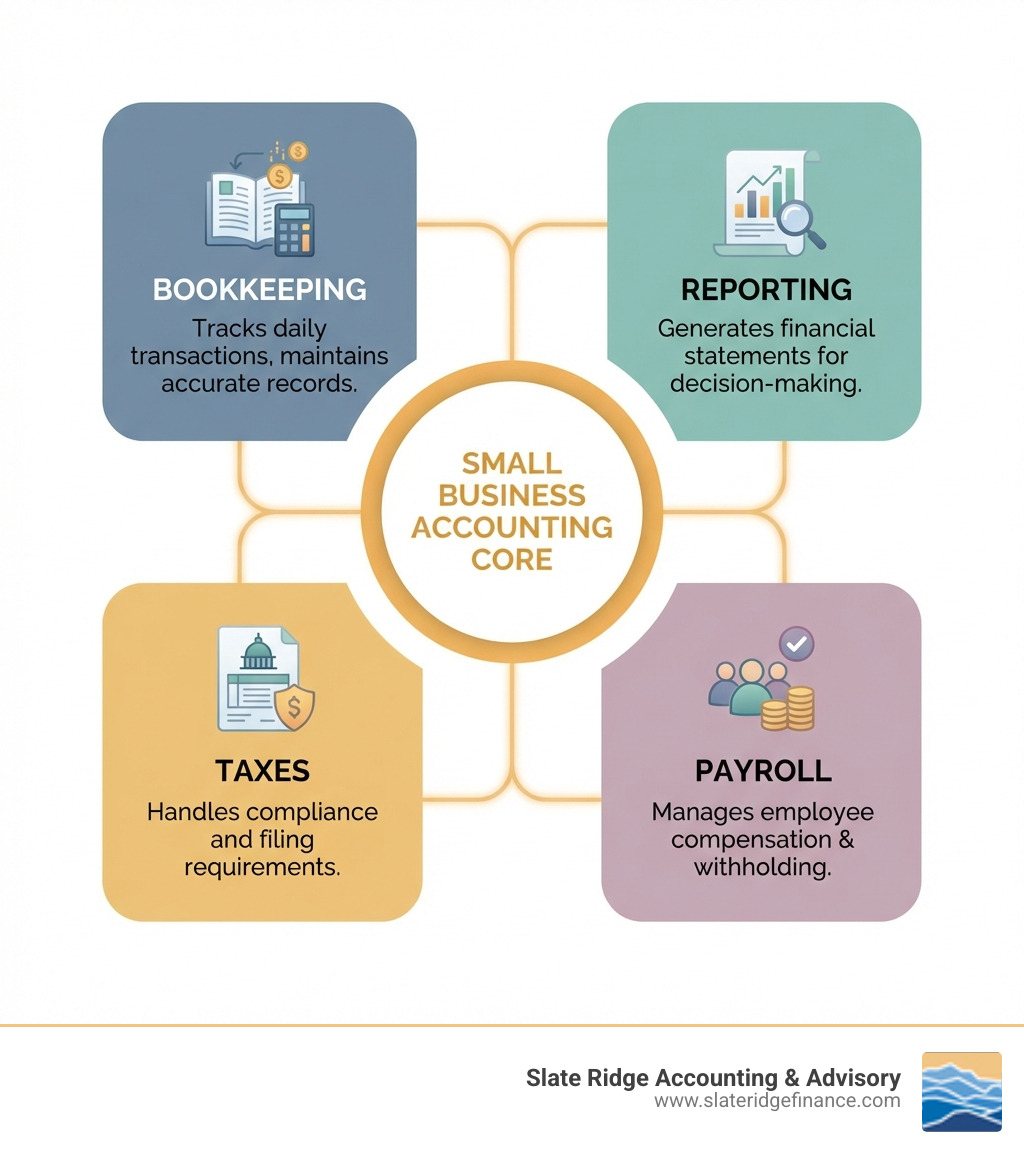
Key terms for small business accounting advice:
- best accounting systems for small businesses
- financial performance analysis
- what type of accountant is best for a small business
Building Your Financial Foundation: First Steps to Success

Starting a small business in North Carolina is exciting, but it comes with financial responsibilities. The first piece of small business accounting advice is to build a strong financial foundation from day one.
This means separating your personal and business finances, setting up a dedicated business bank account, choosing the right legal structure, and understanding the core components of your accounting system. These initial steps are crucial for clarity, compliance, and future growth.
Choosing Your Business Structure
Before registering your business, you must decide on its legal structure. This decision impacts your tax obligations, personal liability, and ability to raise capital. Consulting with a business counselor or accountant can be extremely helpful.
Here are the most common structures:
- Sole Proprietorship: The simplest structure for an individual owner. There's no legal distinction between you and the business, meaning you report business income on your personal tax return. However, your personal assets are not protected from business liabilities.
- Partnership: For businesses with two or more partners. Profits and losses pass through to the partners' personal returns. General partners have unlimited personal liability, while limited partners have liability limited to their investment.
- Limited Liability Company (LLC): An LLC offers personal liability protection, separating your personal assets from business debts. It also provides tax flexibility, as an LLC can be taxed as a sole proprietorship, partnership, or corporation.
- Corporation (C-Corp vs. S-Corp): A separate legal entity from its owners.
- C-Corporations (C-Corps) face "double taxation"—on corporate profits and then on shareholder dividends.
- S-Corporations (S-Corps) avoid this by passing income through to shareholders but have stricter eligibility rules.
Your business structure dictates how you pay taxes and your personal liability. For more information, refer to resources on how to structure your business before registering with your state.
Once you've registered your business, you'll need a separate bank account for all business transactions. This simplifies tax time and helps establish business credit. We can provide more on setting up accounts for your small business.
Understanding Key Accounting Terms
Let's get comfortable with some fundamental terms of your business's financial language.
- Assets: What your business owns that has economic value, such as cash, equipment, and accounts receivable.
- Liabilities: What your business owes to others, including loans and accounts payable.
- Equity: The owner's stake in the business (Assets - Liabilities). It's your investment plus retained earnings.
- Accounts Payable (AP): Money your business owes to suppliers for goods or services purchased on credit.
- Accounts Receivable (AR): Money owed to your business by customers for goods or services already delivered. For managing these, check out our tips for managing small business accounts receivable and payable.
- Cost of Goods Sold (COGS): The direct costs of producing the goods your company sells, including materials and direct labor.
- Gross Margin: Calculated as (Total Revenue - COGS), it shows the profit made from each sale before operating expenses.
Essential Small Business Accounting Advice for Systems & Methods
With your foundation set, the next step in our small business accounting advice guide is to establish the systems and methods that will keep your financial data organized and accurate. This involves choosing an accounting method and leveraging modern tools to streamline the process.
Cash vs. Accrual: Which Method is Right for You?
One of the first accounting decisions you'll make is whether to use the cash or accrual method. This choice dictates when you recognize income and expenses.
| Feature | Cash Accounting | Accrual Accounting |
|---|---|---|
| Definition | Records income when cash is received; expenses when cash is paid. | Records income when earned; expenses when incurred. |
| Recognize Revenue | When customer pays you. | When you make the sale (even if not yet paid). |
| Recognize Expenses | When you pay the bill. | When you incur the expense (even if not yet paid). |
| Pros | Simple, easy to understand, tracks actual cash flow. | More accurate picture of financial health, matches revenues/expenses. |
| Cons | Doesn't always reflect overall financial performance, can distort profitability. | More complex, requires adjusting entries. |
| Best For | Small businesses without inventory, low revenue (under $5M). | Businesses with inventory, higher revenue, seeking loans. |
The cash method is straightforward: you record income when cash is received and expenses when you pay them. This method works well for small businesses with simple operations (often under $5 million in revenue) and gives a clear picture of cash on hand.
The accrual method provides a more accurate view of financial health by recording income when it's earned and expenses when they're incurred, regardless of when cash changes hands. The IRS generally requires this method for businesses with inventory or average sales over $25 million.
Choosing the right method is a key piece of small business accounting advice for accurate reporting. For more detailed insights, explore our accounting best practices small business guide.
The Power of Modern Accounting Software

Manual ledgers are a thing of the past. Modern accounting software is a game-changer for small businesses, with over half of U.S. companies now using cloud-based solutions.
The benefits of using accounting software are immense:
- Time Savings: Automation of tasks like transaction categorization and invoice generation.
- Accuracy: Reduces the risk of human error, ensuring your financial records are precise.
- Real-time Data: Provides an up-to-the-minute snapshot of your financial health.
- Scalability: Grows with your business, handling increasing transaction volumes.
- Accessibility: Cloud-based solutions allow you to access your financial data securely from anywhere.
- Professional Reports: Generates polished financial statements for lenders, investors, or tax authorities.
For North Carolina businesses, cloud accounting means you can manage your books efficiently from anywhere. This user-friendly technology can transform your operations. To learn more, check out how cloud services benefit accounting and our best cloud accounting small business guide.
Your Practical Accounting Checklist: Daily, Weekly, & Monthly Tasks
Consistent financial habits are vital. This section provides actionable small business accounting advice by breaking down essential tasks into a manageable routine to keep your books clean, your cash flow healthy, and your tax season stress-free.
Daily and Weekly Accounting Habits
Regular attention to your finances prevents small issues from becoming big problems.
Daily Tasks:
- Deposit all payments: Deposit all cash or checks received into your business bank account.
- Enter and pay bills: Record bills as they arrive and pay urgent ones promptly. Keep receipts for all purchases.
- Summarize cash sales: If applicable, summarize cash transactions daily to track immediate cash flow.
Weekly Tasks:
- Reconcile bank accounts: Compare your bank statements with your accounting records to catch errors.
- Follow up on unpaid invoices: Review accounts receivable and send reminders for outstanding payments.
- Review upcoming bills: Look at your accounts payable and plan for upcoming payments.
- Prepare and send invoices: Ensure all work is invoiced promptly and accurately.
- Review projected cash flow: Check your anticipated income and expenses for the coming weeks.
Utilizing tools for AP automation services can greatly simplify many of these weekly tasks.
Monthly, Quarterly, and Annual Small Business Accounting Advice
Beyond the daily grind, a structured approach to these tasks ensures financial oversight and compliance.
Monthly Tasks:
- Balance your books: Reconcile all bank and credit card accounts.
- Review aging and past-due receivables: Follow up on any outstanding invoices.
- Analyze inventory: If applicable, review inventory data to manage stock levels.
- Process payroll and taxes: Ensure employees are paid correctly and payroll taxes are processed.
- Review the Profit & Loss (P&L) statement against your budget.
- Review the month-end balance sheet against the prior period to spot changes.
Quarterly Tasks:
- Revise your annual P&L estimate based on actual performance.
- Review and pay quarterly payroll taxes.
- Pay quarterly sales tax if your North Carolina business collects it.
- Pay quarterly estimated income taxes to avoid penalties if you expect to owe over $1,000 for the year.
Annual Tasks:
- Make a final push to collect past-due receivables.
- Conduct a physical inventory count and adjust records.
- Prepare and send W-2s and 1099s to employees and contractors.
- Approve final financial reports and tax returns before filing.
For a deeper dive into preparing your financial reports, consult our guide on financial statement preparation.
Setting Up a Payroll System
Managing payroll is a significant responsibility where sound small business accounting advice can prevent costly mistakes.
- Employees vs. Contractors: It's vital to correctly classify workers. For an employee, you withhold income tax, Social Security, and Medicare taxes (FICA), and you also pay federal unemployment tax (FUTA). For an independent contractor, you generally don't withhold taxes, but you must track payments and issue a Form 1099-NEC if you pay them $600 or more in a year.
- Tax Withholding: For employees, you are responsible for withholding federal, state (North Carolina), Social Security, and Medicare taxes from their wages.
- Payroll Taxes: Beyond withholding, employers must pay their share of Social Security and Medicare taxes, as well as FUTA, which funds unemployment programs.
Due to its complexity, many businesses outsource payroll to ensure compliance and save time. Our small business payroll cost guide and resources on how to outsource payroll for small business can help you decide.
From Data to Decisions: Using Financial Reports to Grow
Accounting isn't just about recording numbers; it's about translating that data into actionable insights. Financial reports are powerful tools for analysis, forecasting, and strategic decisions. This section of our small business accounting advice focuses on leveraging your financial data for growth.
The 3 Key Financial Reports Every Owner Needs
These three reports are the pillars of financial understanding for any business:
- Profit & Loss (P&L) Statement (also known as Income Statement): This report summarizes your revenues, costs, and expenses over a period, telling you if your business made a profit or a loss. It's essential for understanding profitability.
- Balance Sheet: This is a snapshot of your company's financial position, listing your assets (what you own), liabilities (what you owe), and owner's equity. It provides insight into your solvency and liquidity.
- Cash Flow Statement: This statement tracks the cash moving into and out of your business from operating, investing, and financing activities. It's crucial for understanding if you have enough cash to pay your bills.
Understanding these reports is paramount for making informed decisions. For a comprehensive understanding, explore our small business financial reporting complete guide and dig into financial performance analysis.
Making Smart Decisions with Cost-Benefit Analysis
A cost-benefit analysis (CBA) is a practical tool that helps you weigh a business decision's strengths and weaknesses by comparing its potential benefits to its costs.
How to Apply It:
- Identify Benefits: List all positive outcomes or increased revenue.
- Identify Costs: List all initial and ongoing expenses.
- Quantify: Assign monetary values to both benefits and costs.
- Compare: If benefits outweigh costs, it's generally a good decision.
Example: Hiring an EmployeeConsider hiring a new employee in your Charlotte, North Carolina, business.
- Benefits: Increased productivity, ability to take on more clients (e.g., $50,000 in additional annual revenue).
- Costs: Salary ($40,000), benefits ($5,000), payroll taxes ($3,000), recruitment costs ($2,000 one-time). Total annual cost: $48,000.
- CBA: $50,000 (benefits) - $48,000 (costs) = $2,000 net benefit. This suggests it's a worthwhile investment.
Example: Buying New EquipmentPerhaps your Greenville, North Carolina, business needs new equipment.
- Benefits: Increased efficiency, reduced downtime (e.g., $10,000 in annual savings/revenue).
- Costs: Purchase price ($25,000), maintenance ($1,000 annually), financing ($500 annually).
- CBA (over 5 years): $50,000 (benefits) - $25,000 (purchase) - $5,000 (maintenance) - $2,500 (financing) = $17,500 net benefit.
CBA helps you make choices that contribute to your financial growth. For more strategies, see our financial growth strategies complete guide.
Avoiding Common Mistakes & Knowing When to Get Help
Even with the best intentions, small business owners fall into common accounting traps. Our small business accounting advice wouldn't be complete without highlighting these pitfalls and guiding you on when it's time to bring in professional help.
Top Accounting Mistakes and How to Avoid Them
Being aware of these frequent errors is the first step to preventing them:
- Mixing Personal and Business Funds: This common mistake creates a messy paper trail and can jeopardize your personal liability protection. Avoid it by opening separate business bank and credit accounts from day one and using them for all business transactions.
- Poor Record-Keeping: Failing to keep meticulous records leads to missed deductions and audit issues. Avoid it by using a system to track all transactions, digitizing receipts, and keeping all supporting documents like invoices and bank statements.
- Not Reconciling Accounts Regularly: Skipping monthly reconciliations means you might miss errors or fraudulent charges. Avoid it by making bank reconciliation a non-negotiable monthly task to ensure accuracy.
- Ignoring Tax Deadlines: Missing IRS and North Carolina tax deadlines results in penalties and interest. Avoid it by setting calendar reminders for all tax deadlines and budgeting for taxes throughout the year.
- DIYing for Too Long: As your business grows, its financial complexity increases. Trying to manage it all yourself can lead to costly mistakes and burnout. Avoid it by recognizing when your needs outgrow your expertise and seeking professional help.
For more insights into potential pitfalls, read our article on 3 bookkeeping myths that could be costing you money.
When to Hire a Professional: More Small Business Accounting Advice
Many small business owners in North Carolina wonder when to hire an accountant. While DIY is feasible initially, professional assistance eventually becomes a wise investment.
Signs You Need Help:
- Your revenue and transaction volume are increasing rapidly.
- You're spending too much time on bookkeeping.
- Your business structure, inventory, or tax situation becomes more intricate.
- You're unsure about tax compliance or interpreting financial reports.
- You want strategic advice to plan for the future.
Role of a Bookkeeper:A bookkeeper handles daily financial recording. Their tasks include categorizing transactions, reconciling accounts, processing AP/AR, managing payroll, and generating basic reports. They are crucial for maintaining accurate, up-to-date records. Learn more about our bookkeeping service for small business.
Role of an Accountant (CPA):An accountant or CPA offers higher-level strategic advice. They prepare and file tax returns, provide financial analysis, offer strategic tax planning, help with budgeting and forecasting, and assist with complex financial decisions. They provide the "big picture" guidance for growth. For insights, read what type of accountant is best for a small business.
Benefits of Outsourcing:Outsourcing your accounting to a firm like Slate Ridge Accounting & Advisory provides access to expert knowledge, saves you time, is often more cost-effective than hiring a full-time employee, and ensures accuracy and compliance.
Frequently Asked Questions about Small Business Accounting
We've covered a lot of ground, but you might still have some specific questions. Here's some quick small business accounting advice for common inquiries:
What is the most important piece of accounting advice for a new business?
The most important piece of small business accounting advice is to separate your personal and business finances immediately and maintain meticulous records. Open a dedicated business bank account and use it for all business transactions. This foundational step simplifies tax preparation, protects your personal assets, and is crucial for tracking performance and claiming deductions.
Can I do my own accounting for my small business?
Yes, many owners can manage their own accounting, especially when starting out. Modern accounting software makes it accessible to track finances and generate reports. However, as your business grows in complexity or you find yourself spending too much time on bookkeeping, it's a strong indicator that you should consider professional help.
How much does it cost to hire an accountant for a small business?
The cost varies based on the scope of services, business complexity, and your location in North Carolina. Monthly packages can range from a few hundred dollars for basic bookkeeping to several thousand for comprehensive advisory services. It's best to discuss your specific needs with a professional to get an accurate quote.
Conclusion
Navigating the financial landscape of a small business can seem daunting, but with the right small business accounting advice, it becomes a powerful tool for success. From setting up your initial financial systems and choosing the right accounting method, to diligently tracking expenses and leveraging key financial reports, every step you take brings greater clarity and control.
We've seen that proactive financial management, supported by modern tools and consistent habits, is not just about compliance—it's about empowering you to make informed decisions, avoid common pitfalls, and ultimately, grow your business. Whether you're in Asheville, Boone, Charlotte, or anywhere else in North Carolina, a solid accounting foundation is your bedrock.
At Slate Ridge Accounting & Advisory, we are dedicated to providing modern, personalized, and industry-custom financial solutions. We help businesses like yours track KPIs, forecast growth, and optimize financial processes. Don't let financial complexities hold your business back.
Take control of your finances with expert virtual accounting services.
Ready to get started?
Book a free consultation today and let’s explore how Slate Ridge can support your business with expert accounting that’s accurate, timely, and built around your goals.
You Might Also Like
A few more posts we think you’ll enjoy on topics that matter to business owners like you.