

Why Small Business Owners Are Turning to Payroll Outsourcing
Outsource payroll for small business operations is becoming the go-to solution for overwhelmed owners who are drowning in paperwork, struggling with tax compliance, and losing precious hours every month to administrative tasks.
Quick Answer: Should You Outsource Payroll?
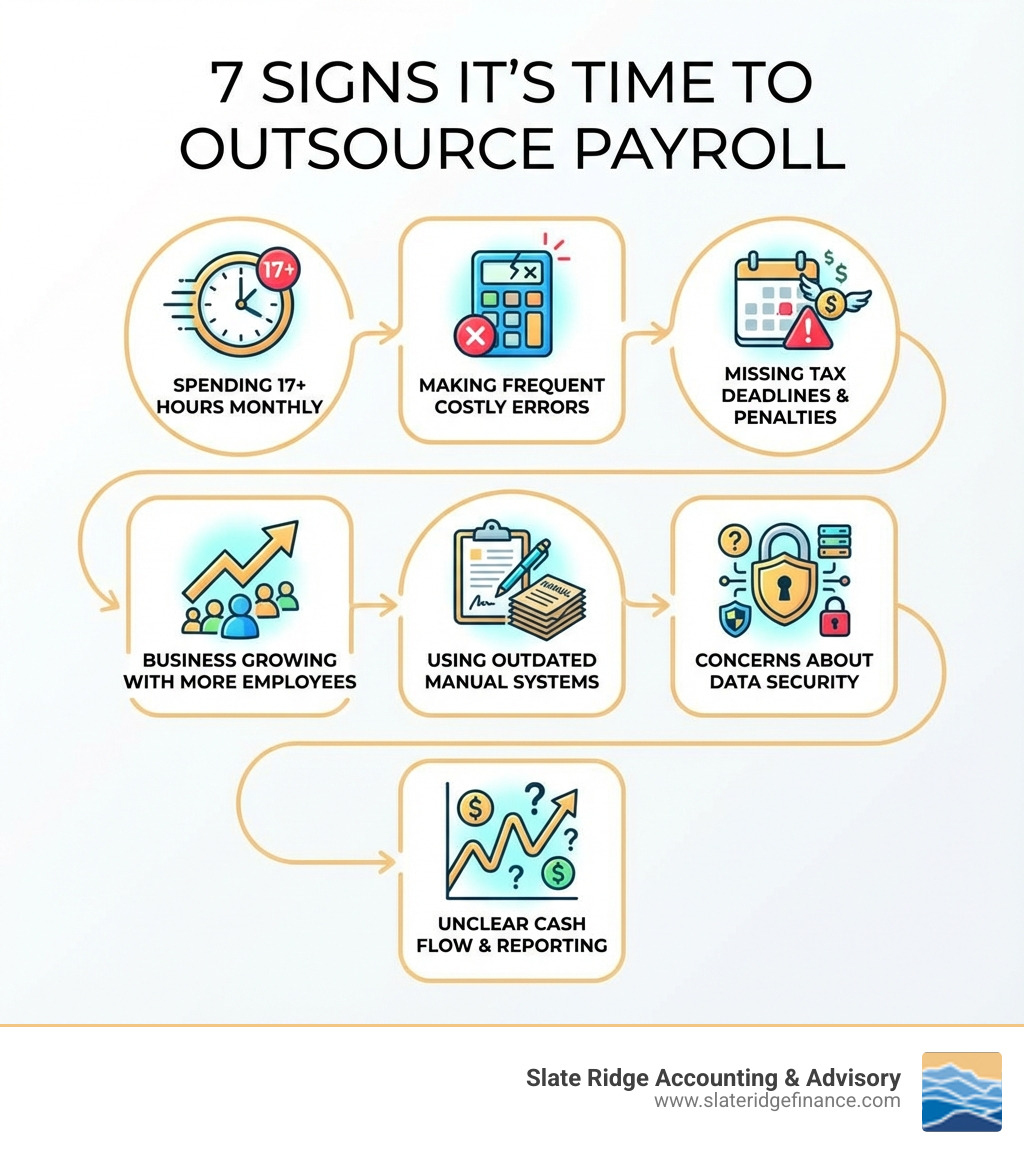
Consider outsourcing if you're experiencing any of these:
- Time drain: Spending 17+ hours monthly on payroll tasks
- Costly mistakes: Making errors that cost an average of $291 each to fix
- Tax penalties: Facing IRS fines (over $4.6 billion issued in 2023 alone)
- Growth challenges: Adding employees or expanding to new states
- Cash flow stress: Struggling with unpredictable payroll costs
- Outdated systems: Using manual processes instead of modern software
- Security concerns: Worrying about protecting sensitive employee data
Running payroll might seem straightforward at first—calculate wages, withhold taxes, write checks. But the reality is far more complex. Between federal, state, and local tax requirements, employee deductions, garnishments, and constantly changing regulations, payroll quickly becomes one of the most time-consuming and error-prone tasks a small business owner faces.
The numbers tell the story: 41% of small business owners spend three to 10 hours monthly handling payroll taxes internally, with another 10% spending over 10 hours. That's time you're not spending growing your business, serving customers, or developing your team.
And mistakes are expensive. Companies have an average payroll accuracy rate of just 80.15%, meaning one in five payroll runs contains an error. With penalties for late W-2 filing starting at $60 per form and the IRS assessing over $8.5 billion in employment tax penalties in 2023, getting payroll wrong isn't just frustrating—it's costly.
The good news? You don't have to do it alone.
Outsource payroll for small business word roundup:
- cost of payroll services for small business
- payroll management services
- accounting and payroll services for small business
Why Outsource Payroll for a Small Business? The 7 Telltale Signs
So, what exactly is payroll outsourcing, and why is it so important for small businesses? Simply put, payroll outsourcing means entrusting all or part of your payroll administration to an external service provider. This can include calculating employee pay, withholding deductions (like Social Security and federal taxes), ensuring employees are paid on time, and managing all the complex tax filings.
For small businesses, this isn't just about handing off a task; it's about strategic decision-making. By choosing to outsource payroll for small business operations, you free up internal resources, reduce costs, improve compliance, and gain access to expert knowledge that would be expensive to maintain in-house. It allows you to focus on what you do best: running and growing your business.
Let's explore the seven key signs that indicate it might be time for your small business to make the switch.
Sign 1: You're Spending Too Much Time on It
We get it. As a small business owner, you wear many hats. From sales and marketing to customer service and product development, your plate is overflowing. But if one of those hats is "payroll administrator," and it feels like it's glued to your head, that's a major red flag.
Studies show that small business owners spend a significant amount of time on payroll. A National Small Business Association survey found that 41% of small business owners report spending three to 10 hours monthly handling payroll taxes internally, with another 10% dedicating over 10 hours each month. Some estimates even suggest it takes around 17 hours a month to run payroll by themselves.
Think about what else you could accomplish with those hours. Could you be developing new strategies, nurturing client relationships, or innovating your services? Every hour spent wrestling with spreadsheets and tax forms is an hour not spent generating revenue or improving your business. This lost productivity is a hidden cost that can stifle your growth. When you outsource payroll for small business needs, you reclaim this invaluable time, allowing you to focus on Business Growth Strategies and other core activities.
Sign 2: Costly Payroll Errors Are Piling Up
Let's face it: nobody's perfect, especially when dealing with the minutiae of payroll. From input errors to erroneous pay amounts and inadequate tracking of vacation and sick time, mistakes happen. And in payroll, mistakes are more than just annoying; they're expensive.

A study from Ernst & Young found that a single payroll error costs an average of $291 to remedy. What's more alarming is that companies have an average accuracy rate of just 80.15%. That means nearly one in five payroll runs contains an error. These errors can lead to overpayments, underpayments, or incorrect tax filings, all of which have financial consequences.
Beyond the monetary cost, payroll errors can significantly impact employee morale. Imagine your employees, many of whom are already living paycheck to paycheck (the Federal Reserve found that 40% of US households can’t afford an unexpected $400 expense), receiving an incorrect payment. This can cause immense stress and erode trust, potentially leading to higher turnover rates. When we manage your payroll, we ensure precision, helping you avoid these common pitfalls and ensuring your team receives accurate and timely Paychecks.
Sign 3: You're Struggling with Tax Compliance
Payroll isn't just about paying employees; it's a minefield of federal, state, and local tax regulations that are constantly changing. Keeping up with these intricate laws, filing deadlines, and mandatory forms can feel like a full-time job in itself.
The stakes are incredibly high. As reported in the IRS Data Book, the agency assessed over $65.5 billion in civil penalties in the 2023 fiscal year, with more than $8.5 billion in fines imposed on companies for employment tax problems. In fact, in 2023 alone, the IRS issued penalties to businesses amounting to over $4.6 billion for late or erroneous payroll tax payments. Penalties for late W-2 filing start at $60 per form and increase the later they are filed. This highlights a critical lack of knowledge or capacity within many businesses.
Small businesses often have at least eight separate payroll-related tax filings per year, including quarterly Form 941 and annual Form 940, not to mention W-2s for employees and 1099s for contractors that must be delivered and filed by January 31st. A single misstep can lead to significant fines and audits. When you outsource payroll for small business operations to experts, you gain peace of mind knowing that specialists are navigating this complex landscape for you, helping you maintain compliance and potentially linking with our Virtual Tax Preparation services.
Sign 4: Your Business is Growing
Congratulations! Your small business is expanding. This is exciting, but it also brings new payroll complexities. As you add more employees, perhaps even in different North Carolina counties or remote work scenarios across the state, your payroll needs become more intricate.
Consider the challenge of managing various pay rates, different benefits packages, 401(k) deductions, health insurance requirements, and even wage garnishments. What about tracking paid time off, sick leave, and overtime for a larger team? What if you start hiring contractors in addition to W-2 employees?
Growth introduces scalability challenges that often overwhelm in-house payroll efforts. A system that worked for five employees might buckle under the weight of 20 or 50. Outsourcing payroll allows your system to scale seamlessly with your business, adapting to new hires, new locations within North Carolina, and increasing complexity without requiring you to hire additional in-house staff or invest heavily in new software. It’s a strategic move that supports your Payroll Services for Startups as they mature.
Sign 5: You Lack Access to Modern Technology
Are you still relying on manual spreadsheets, paper timecards, or outdated software to manage your payroll? If so, you're missing out on the efficiency, accuracy, and employee satisfaction that modern payroll technology provides. Manual processes are not only time-consuming but also prone to errors and security risks.
Professional payroll outsourcing providers leverage advanced Cloud Payroll Management software. This technology offers features like direct deposit, online employee self-service portals (where employees can view pay stubs, update personal information, and manage withholdings), and seamless integration with your accounting software. These tools not only streamline your processes but also improve the employee experience.
By outsourcing, you gain access to cutting-edge payroll solutions without the hefty investment in licenses, training, and maintenance. This means you can process payroll from anywhere, automate calculations, and flag potential errors before they become costly problems. It's a significant upgrade that aligns with modern Online Accounting Software Small Business practices.
Sign 6: Data Security is a Concern
Payroll data is among the most sensitive information your business handles. It includes employee names, addresses, Social Security numbers, bank account details, and wage information. Protecting this data from breaches, unauthorized access, and cyber threats is paramount, not just for compliance but for maintaining trust with your employees.
Managing data security in-house requires robust IT infrastructure, constant vigilance against evolving threats, and adherence to complex privacy laws. For many small businesses, this is a daunting and expensive undertaking.
Professional payroll outsourcing providers invest heavily in secure systems. They use encrypted platforms, secure data storage, and strong access controls to protect sensitive information. Many providers adhere to stringent security standards and certifications, offering a level of data protection that most small businesses would struggle to achieve on their own. When we handle your payroll, we employ Modern Accounting Practices that prioritize the security of your financial and employee data.
Sign 7: Cash Flow and Reporting Are Unclear
Do you have a clear, real-time understanding of your payroll costs and how they impact your overall cash flow? If your payroll process is a black box that only opens when paychecks are due, you're missing out on critical financial insights.
Effective financial management relies on accurate and timely reporting. Without detailed payroll data, it's difficult to forecast expenses, analyze labor costs, and make informed decisions about your business's financial health. Inaccurate payroll records can lead to misleading financial statements, making it harder to track Key Performance Indicators (KPIs) and plan for future growth.
Outsourcing payroll can provide you with comprehensive reporting and analytics. This clarity allows for better financial forecasting, more transparent expense tracking, and a deeper understanding of your labor costs. With this improved visibility, you can make smarter business decisions and maintain healthy cash flow. This is crucial for your Small Business Financial Reporting Complete Guide and helps you learn How to Track KPIs.
Making the Switch: How to Choose a Payroll Partner
Recognizing the signs is the first step; the next is finding the right partner to outsource payroll for small business operations. This decision depends on your business size, the complexity of your payroll needs, and your budget.
Types of Payroll Providers
When considering who to partner with, you'll generally encounter a few main types:
- Full-Service Payroll Companies: These providers handle everything from calculating wages and deductions to tax filings, direct deposits, and year-end reporting. Many also offer additional services like HR support, employee benefits administration, and compliance assistance. They often use advanced software for payroll processing and provide portals for both employers and employees.
- Payroll Specialists (Independent Contractors): An independent payroll contractor might be a good fit for very small businesses with straightforward payroll needs. They can offer a more personalized service, often at a lower cost, but might not have the robust technology or comprehensive compliance guarantees of a larger company. The ideal choice between a payroll company and an independent contractor depends on factors like your business size, the complexity of your payroll needs, and your budget.
- Bookkeepers or Accountants: Many local bookkeepers and Accounting and Payroll Services for Small Business firms, including those in Asheville, Boone, Charlotte, Greensboro, Greenville, Hickory, Morganton, Raleigh, and Wilmington, North Carolina, offer payroll services as part of their broader financial offerings. This can be a convenient option if you prefer to keep your accounting and payroll under one roof. They can provide expert guidance and ensure your payroll integrates seamlessly with your overall financial records. You can find excellent Bookkeepers Near Me who also offer payroll services.
Understanding the Cost to Outsource Payroll for a Small Business
One of the first questions small business owners ask is, "How much does it typically cost to outsource payroll for small business operations?" The answer isn't always straightforward, as pricing models vary significantly.
Common pricing structures include:
- Base Fees Plus Per-Employee Fees: Many providers charge a flat monthly or per-payroll base fee, plus an additional fee per employee per pay run. For example, a basic solution might start at $39 per month, plus $5 per employee.
- Tiered Packages: Providers often offer different service tiers (Basic, Plus, Premium) with increasing features and price points.
- One-Time Setup Fees: Be aware that many providers charge a one-time setup fee, which could be around $50 or more.
- Additional Fees: Look out for extra charges for services like year-end W-2/1099 processing, check printing, or expedited payments.
While competitive payroll software platforms might range from $100 to $300 per month for comprehensive services, working with an accountant can cost upwards of $5,000 annually. These costs are an investment that can lead to significant Cost Reduction Strategies by preventing costly errors and freeing up your time. For a detailed breakdown, explore our Small Business Payroll Cost Guide.
Key Questions to Ask Potential Providers
Before making a decision, we recommend asking potential payroll providers a series of probing questions. This thorough research into their reputation, customer feedback, and ability to adapt to your company’s future needs is crucial.
Here are some essential questions to ensure you find the right fit:
- What is your error resolution and liability policy? Do they offer an accuracy guarantee? Will they cover any fines or fees incurred due to their mistakes? How quickly do they resolve errors?
- How do you ensure tax compliance? Do they stay updated with federal, North Carolina state, and local tax laws? Do they have built-in compliance monitoring tools?
- What specific payroll tasks can you outsource? Does their service cover all your needs, from wage calculation and deductions to tax filings, W-2/1099 processing, new-hire reporting, and direct deposit?
- How does your payroll service integrate with my existing software? Is the connection bidirectional? Do they offer plug-and-play integrations, or will it require APIs?
- What are your data security protocols? What measures do they take to protect sensitive employee data (encryption, secure storage, access controls)? Are they compliant with relevant privacy laws?
- What is your customer support like? Do they offer robust and accessible customer support? What are their hours of operation? Will you have a dedicated specialist or access to a general support team?
- How does your service scale with my business? Can they accommodate future growth in employee numbers or increased complexity without significant disruption?
- What happens to my data if I decide to leave or switch platforms? Can you easily export your historical payroll data?
- Can I customize pay types and deductions? Do they support unique pay structures, benefits deductions, retirement contributions, or wage garnishments?
Asking these questions will give you a comprehensive understanding of a provider's capabilities and help you make an informed decision, aligning with our Expert Financial Advice.
Weighing the Pros and Cons of Outsourcing
Deciding to outsource payroll for small business operations is a significant step. It's important to understand both the benefits and potential drawbacks.
What Specific Payroll Tasks Can Be Outsourced?
When you partner with a payroll provider, you can delegate a wide range of tasks, effectively offloading the entire payroll burden. These Payroll Administration Services typically include:
- Calculating Pay and Deductions: Accurately calculating gross wages, overtime, commissions, and all necessary federal, state, and local tax withholdings (like FICA, FUTA, and SUTA) as well as employee benefits and other deductions.
- Tax Filing and Payments: Managing and submitting all required payroll tax forms (e.g., Form 941 quarterly, Form 940 annually) and depositing withheld taxes with the appropriate government agencies on time.
- W-2/1099 Processing: Preparing, delivering, and e-filing W-2 forms for employees and 1099 forms for contractors at year-end.
- New Hire Reporting: Ensuring compliance with state regulations that require reporting new hires to a state agency, typically within 20 days of the hire date.
- Paid Time Off (PTO) Tracking: Managing and tracking employee vacation, sick leave, and other paid time off balances.
- Garnishments: Automating the deduction and remittance of wage garnishments as required by law.
- Direct Deposit & Paycheck Distribution: Providing efficient payment methods, including direct deposit and, if needed, printing and distributing physical paychecks.
- Online Self-Service Portals: Offering employees secure access to their pay stubs, tax documents, and personal information.
- Compliance Monitoring: Staying updated on evolving employment laws and ensuring your payroll practices remain compliant.
Potential Risks When You Outsource Payroll for a Small Business
While the benefits are compelling, it's also important to acknowledge the potential downsides of outsourcing payroll:
- Perceived Loss of Direct Control: Some business owners feel a step removed from the process. Making last-minute adjustments or accessing detailed information might feel less immediate than an in-house system. However, reputable providers offer transparent communication, real-time reporting, and system access to mitigate this.
- Data Security Concerns (with the wrong provider): While outsourcing generally improves security, choosing an unreliable provider can expose your sensitive data to risks. It's crucial to vet their security protocols thoroughly.
- Communication Issues: If your provider isn't responsive or doesn't understand your specific business needs, communication can become a challenge, leading to frustration or delays.
- Hidden Fees: Some providers may have opaque pricing, with extra charges for system updates, additional reports, or complex pay adjustments. Always ask for transparent pricing and clear inclusions.
- Choosing an Unreliable Partner: A poor choice can lead to headaches, especially if you need to switch providers at an inconvenient time (e.g., mid-quarter or mid-year, which can create tricky tax issues).
[TABLE] Comparing In-House vs. Outsourced Payroll
| Feature | In-House Payroll | Outsourced Payroll |
|---|---|---|
| Cost | Hidden costs (time, errors, software, training), potential fines | Transparent fees (base + per employee), predictable, avoids penalties |
| Time | Significant time sink (17+ hours/month) | Frees up considerable owner/staff time |
| Accuracy | Prone to errors (80.15% accuracy average) | High accuracy, provider guarantees, reduces mistakes |
| Compliance Risk | High risk of fines (IRS penalties), constant learning curve | Expert compliance, stays updated on laws, minimizes fines |
| Scalability | Difficult to scale with growth, requires more internal resources | Scales easily with business growth, adapts to new hires |
| Technology Access | Often relies on outdated methods or costly software investment | Access to modern, secure, automated software and portals |
| Expertise | Limited to in-house knowledge, prone to oversight | Access to specialists, up-to-date regulatory knowledge |
Frequently Asked Questions about Outsourcing Payroll
How much does it cost to outsource payroll for a small business?
The cost to outsource payroll for small business operations varies widely based on several factors, including the provider's location (though we're focused on North Carolina), the specific services included in the package, your payroll frequency, and the number of employees.
Generally, you can expect a pricing structure that includes:
- A base monthly or per-payroll fee: This covers the core service.
- A per-employee fee: An additional charge for each employee processed.
- Setup fees: A one-time charge to get started, often around $50.
- Additional services: Extra costs for things like year-end W-2/1099 processing, specific reports, or integrations.
For example, a basic solution might start around $39-$59 per month plus $5-$10 per employee. While this might seem like an added expense, consider the value it brings. Outsourcing can save you money by minimizing costly payroll errors and tax penalties, and by reducing the labor expenses associated with processing payroll internally. It's an investment in efficiency and compliance that often pays for itself. For more detailed insights into pricing, please visit our Pricing page.
What's the difference between a payroll company and a payroll specialist?
The main difference lies in their scope of services and organizational structure.
- Payroll Company: This is typically an organization that offers comprehensive payroll services, often with a team of specialists, advanced software, and a range of integrated HR and compliance solutions. They handle everything from calculations and tax filings to direct deposits and year-end forms. They are generally more scalable and offer robust technology and customer support. Examples include large national providers and regional full-service firms.
- Payroll Specialist (Independent Contractor): This is usually an individual professional who offers payroll services, often working independently or as part of a smaller accounting/bookkeeping firm. They might provide more personalized attention and can be more flexible. They can be a great option for very small businesses with simpler needs. However, they might not have the same level of technological infrastructure, comprehensive compliance guarantees, or backup support as a larger payroll company.
The best choice for your small business depends on your specific needs, budget, and desired level of support.
Does my business still have liability after outsourcing payroll?
This is a crucial question, and the answer is generally yes, your business still retains ultimate responsibility for payroll compliance, even when you outsource payroll for small business operations.
While a reputable payroll provider will handle the day-to-day tasks, calculations, and filings, ensuring accuracy and timeliness, the IRS (and state tax authorities) typically holds the employer accountable for correct and timely tax payments.
This is why choosing a highly reputable provider with strong accuracy guarantees and a clear error resolution policy is paramount. A good provider will often cover any fines or penalties incurred due to their mistakes. However, if you provide incorrect information to your provider, or if they fail to meet their obligations and you don't take corrective action, the liability can still fall back on your business.
It’s essential to maintain oversight, understand your provider's guarantees, and ensure they are staying up-to-date with all federal, North Carolina state, and local regulations.
Conclusion: Reclaim Your Time and Focus on Growth
Running a small business is challenging enough without the added burden of complex and time-consuming payroll administration. If you're experiencing any of the seven signs we've discussed—from lost time and costly errors to tax compliance struggles and unclear financial reporting—it's a clear indicator that it's time to consider a strategic change.
By choosing to outsource payroll for small business operations, you're not just offloading a task; you're investing in accuracy, compliance, efficiency, and ultimately, the growth of your business. You reclaim valuable time, reduce financial risks, gain access to modern technology, and ensure your employees are paid correctly and on time, every time.
At Slate Ridge Accounting & Advisory, we understand the unique challenges faced by small businesses in North Carolina, from Asheville to Charlotte, Raleigh, and beyond. We are here to help you steer the complexities of payroll and integrate it seamlessly with your overall financial strategy. Let us handle the numbers so you can focus on what you do best.
Ready to simplify your payroll and propel your business forward? Get expert help with your accounting and payroll today.
Ready to get started?
Book a free consultation today and let’s explore how Slate Ridge can support your business with expert accounting that’s accurate, timely, and built around your goals.
You Might Also Like
A few more posts we think you’ll enjoy on topics that matter to business owners like you.