
Why Cloud Accounting is Changing Modern Business
How cloud services benefit accounting is no longer a question of "if" but "when" for businesses seeking to stay competitive. Cloud accounting delivers accessibility from anywhere, automated workflows that reduce manual errors, real-time financial visibility, seamless integration with other business tools, and improved data security—all while cutting IT costs.
Quick Answer: Top Benefits of Cloud Services for Accounting:
- Accessibility - Access financial data anytime, anywhere, from any device
- Cost Savings - Subscription model eliminates expensive software licenses and server maintenance
- Real-Time Data - Live dashboards and instant reporting for better decision-making
- Automation - Automated invoicing, bank reconciliation, and data entry reduce manual work
- Collaboration - Multiple users can work simultaneously with no version control issues
- Security - Bank-level encryption and automated backups protect your financial data
- Scalability - Easily add users and features as your business grows
- Integration - Connect seamlessly with payroll, CRM, inventory, and other business tools
If you're still relying on desktop software or spreadsheets, you're experiencing the pain points of traditional accounting: being tethered to an office computer, manual data entry errors, delayed financial insights, and the constant worry about data loss.
The shift is already happening. The global cloud accounting software market is projected to grow from $2.63 billion in 2019 to $4.32 billion by 2024, and by February 2024, over 5,000 remote accounting jobs were listed on staffing sites. This isn't just a technology upgrade—it's a fundamental change in how businesses manage their finances.
Cloud accounting moves your financial data from a single computer to secure remote servers, giving you the freedom to work from anywhere while automating time-consuming tasks. The result? More time for strategic decisions and less time buried in administrative work.
Similar topics to how cloud services benefit accounting:
What is Cloud Accounting and How Does It Differ from Traditional Methods?

Imagine being able to manage your business's finances from anywhere—your office in Raleigh, a coffee shop in Charlotte, or even your home in Asheville. That's the magic of cloud accounting. At its core, cloud accounting is a method where your accounting software and all your financial data are hosted on secure, remote servers, rather than being installed directly on your computer or local network. This means you access everything online, through a secure user portal, using any internet-enabled device.
Think of it like online banking or streaming services. You don't install the bank's software on your computer, nor do you store your movies locally. Instead, you log in to a secure website or app, and all your data and functionalities are there, accessible instantly. Cloud accounting applies this same powerful concept to your business's financial management.
Traditional accounting software, on the other hand, lives entirely on your office computers. It requires local installation, dedicated servers, and constant manual updates and maintenance on each machine. Your financial data is stored locally, often on a single computer, making it vulnerable to hardware failures, theft, or natural disasters.
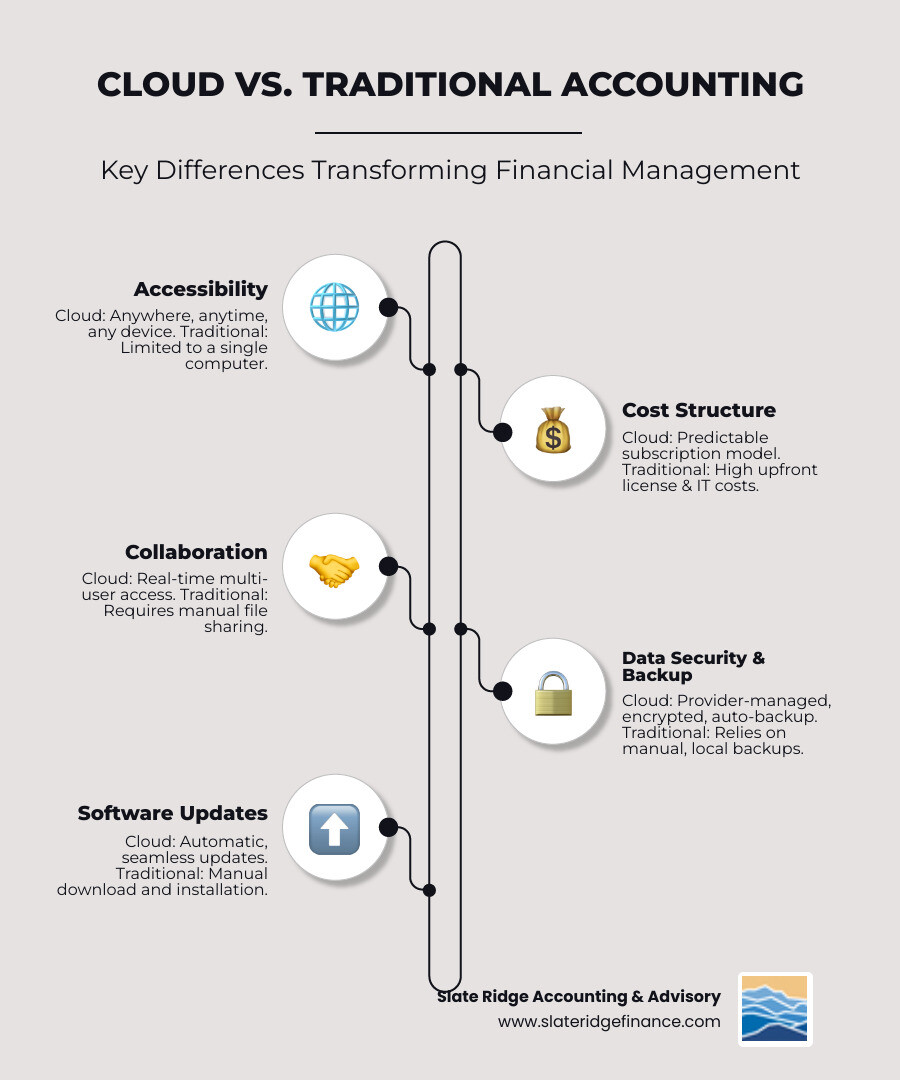
The differences are stark, and understanding them is key to appreciating how cloud services benefit accounting:
| Feature | Cloud Accounting | Traditional Accounting Software |
|---|---|---|
| Accessibility | Anytime, anywhere, any device with internet access | Limited to specific computers where software is installed |
| Cost | Subscription-based (monthly/annual), predictable, scalable | Upfront license fees, hardware costs, maintenance, IT staff |
| Collaboration | Multi-user access, real-time data sync, no version control | Single-user focus, file sharing (often manual), version control issues |
| Security | Provider-managed, advanced encryption, automated backups, disaster recovery | User-managed, relies on local backups, vulnerable to physical threats |
| Updates | Automatic, seamless, always current | Manual installation, downtime for updates, potential compatibility issues |
| Data Storage | Secure remote servers | Local computers/servers |
For us, at Slate Ridge Accounting & Advisory, cloud accounting isn't just a tool; it's the foundation of our Cloud Accounting Services. It allows us to offer seamless Remote Accounting Solutions to businesses across North Carolina, from the busy streets of Charlotte to the quiet corners of Boone.
How Cloud Services Benefit Accounting: 5 Transformative Advantages

The move to cloud accounting is more than just a technological shift; it's a strategic business decision that open ups a host of transformative advantages. These benefits extend far beyond simply managing your books, impacting everything from daily operations to long-term growth. We've seen how cloud services benefit accounting by driving automation, enhancing efficiency, ensuring scalability, and fostering a robust integration ecosystem for our clients.
Let's explore the five core advantages that make cloud accounting a game-changer for modern businesses. For more in-depth insights, explore our Cloud Accounting Guidance.
1. Unprecedented Accessibility and Collaboration
Imagine you're traveling for business, perhaps from Wilmington to Greensboro, and need to check your current cash flow or approve a payment. With cloud accounting, this is not only possible but effortless. You get anytime, anywhere access to your financial data, right from your laptop or mobile device. This means your business isn't tethered to a physical office.
Cloud accounting platforms are designed for multi-user access, allowing your team members, regardless of their location across North Carolina, to work simultaneously on the same financial records. Real-time data sync ensures everyone is always looking at the most up-to-date information, eliminating frustrating version control issues. We've all been there—trying to figure out which spreadsheet version is the correct one! Cloud accounting makes that a distant memory.
This accessibility also extends to collaboration with external partners, like us. We can seamlessly collaborate with your team, accessing the necessary data securely to provide timely insights and advice, whether you're in Hickory or Morganton. The rise of remote work in the accounting industry is a testament to this benefit; by February 2024, over 5,000 remote accounting jobs were listed, highlighting the industry's accept of location-independent work.
At Slate Ridge Accounting & Advisory, our Virtual Accounting and Online Financial Advisory services are built on this very principle, allowing us to serve your needs no matter where your business operates within North Carolina.
2. Significant Cost Savings and Operational Efficiency
One of the most compelling answers to how cloud services benefit accounting lies in its ability to dramatically reduce costs and boost operational efficiency. Traditional accounting software often demands hefty upfront license fees, expensive hardware, and ongoing maintenance costs for servers and IT staff. Cloud accounting flips this model on its head.
With a subscription-based model, you pay a predictable monthly or annual fee, eliminating large capital expenditures. You only pay for the features and user capacity you need, scaling up or down as your business evolves. This model also means no more worrying about server maintenance, software updates, or hardware upgrades—your cloud provider handles all of that, saving you considerable IT overhead and freeing up valuable resources.
Beyond direct cost savings, cloud accounting boosts operational efficiency through automation. Repetitive, manual tasks like invoicing, bank reconciliation, and data entry can be automated, reducing human error and freeing up your team's time for more strategic activities. Imagine invoices being sent automatically or bank transactions being imported and categorized with minimal effort. This process optimization is a game-changer.
Furthermore, cloud accounting contributes to a paper-free, eco-friendly environment. Traditional accounting can generate an astonishing 350 pounds of waste paper per employee annually. By digitizing records and processes, we not only save trees but also streamline workflows, making document management a breeze. This aligns perfectly with our focus on Financial Process Optimization and implementing smart Cost Reduction Strategies for businesses across North Carolina. For more on going paperless, check out these paper-free/eco-friendly benefits.
3. Real-Time Reporting and Data Visualization
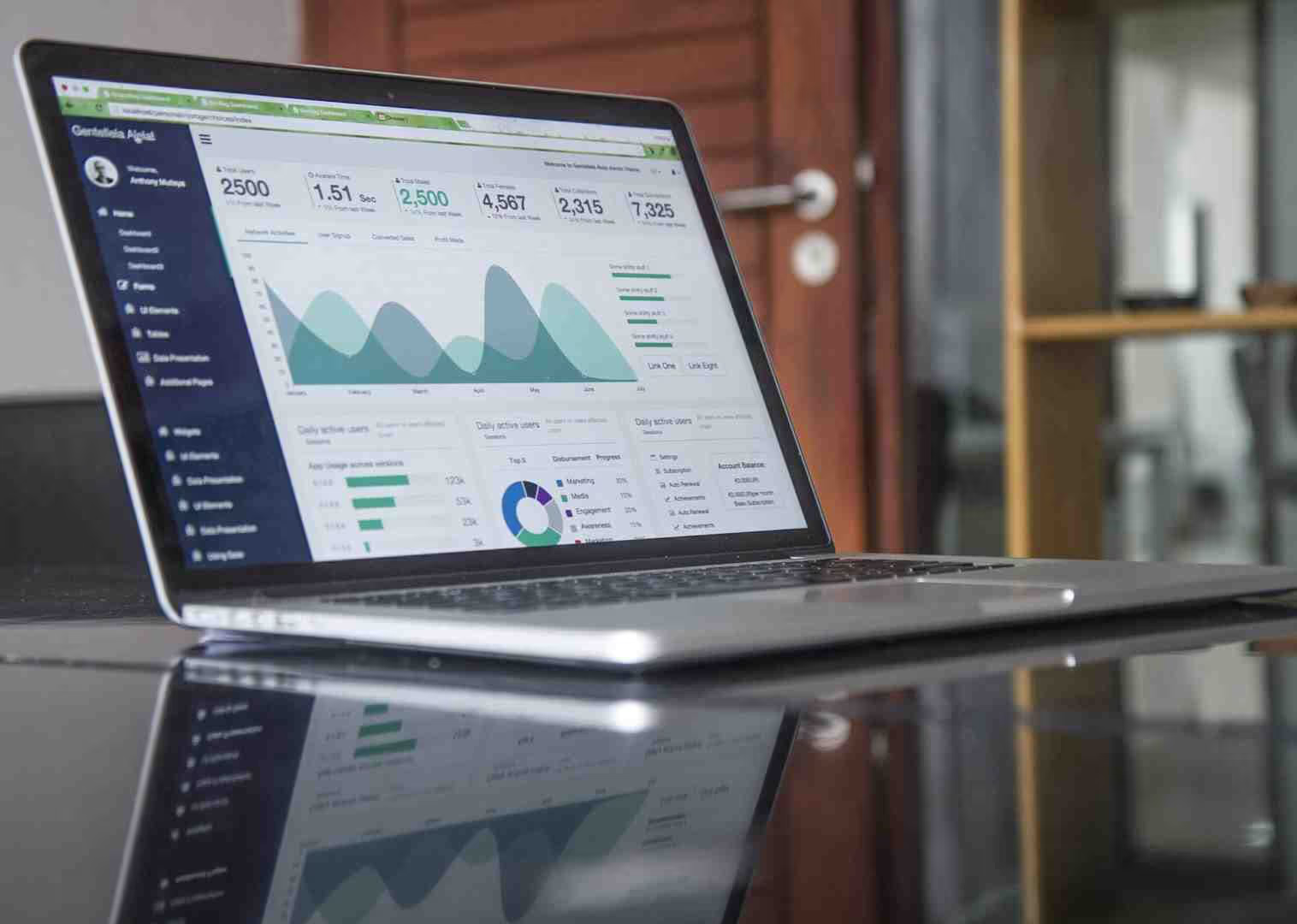
In today's business environment, waiting until the end of the month or quarter for financial reports is like driving by looking in the rearview mirror. Cloud accounting changes this by providing real-time reporting and dynamic data visualization, offering an immediate, up-to-the-minute view of your financial health.
Imagine logging in and seeing live financial dashboards that instantly show your current cash flow, profitability, and key performance indicators (KPIs). This isn't just about pretty graphs; it's about empowerment. With this level of immediate insight, you can make proactive, data-driven decisions rather than reactive ones. Spot a dip in sales? You can investigate and adjust your strategy right away. See an unexpected expense? You can address it before it becomes a problem.
This capability is particularly vital for effective cash flow management and accurate Business Financial Forecasting. Our expertise at Slate Ridge Accounting & Advisory is in helping businesses track their How to Track KPIs and perform thorough Financial Performance Analysis, and cloud accounting is the engine that makes this possible. It allows us to provide you with the most current information, empowering you to steer your business's financial future with confidence, whether you're in Wilmington or Greenville.
4. Seamless Integration and Business Scalability
A standalone accounting system, no matter how good, limits your business's potential. One of the most powerful aspects of how cloud services benefit accounting is its ability to seamlessly integrate with a vast ecosystem of other business tools. Modern cloud accounting platforms offer extensive API capabilities, allowing them to "talk" to other software and create a unified system.
This means you can connect your accounting software with your payroll and HR systems, customer relationship management (CRM) software, inventory management platforms, e-commerce stores, and more. Imagine a sale being made in your online store, automatically updating your inventory, generating an invoice, and recording the revenue in your accounting system—all without manual intervention. This level of integration streamlines operations, reduces data entry errors, and provides a holistic view of your business. Our AP Automation Services and Cloud Payroll Management are perfect examples of how these integrations create efficiencies.
Beyond integration, cloud accounting excels in scalability. As your North Carolina business grows, your accounting system can effortlessly grow with it. Need to add more users? Done. Want to open up new features or modules for project management or advanced reporting? It's often just a click away. There's no need to invest in new hardware or undergo complex system overhauls. Cloud solutions are inherently flexible, allowing you to easily add or remove users and features as your needs evolve, ensuring your financial infrastructure always supports your ambition.
Ready to explore how these integrations and scalability can transform your business? Start Your Free Consultation with us today.
5. Improved Data Security and Backup
Perhaps the most common initial concern about moving to the cloud is security. It's natural to wonder if your sensitive financial data is truly safe when it's "out there" on the internet. However, we're here to debunk some myths and show you that cloud accounting often provides superior security compared to traditional on-premise solutions.
Many security specialists agree: 61% of them believe cloud-based data and applications are more secure than on-premise alternatives. Why? Because reputable cloud accounting providers invest heavily in security infrastructure, often far beyond what a small or medium-sized business could manage on its own. Their entire business model depends on keeping your data safe.
This includes advanced security measures like bank-level encryption standards, such as AES-256 for data at rest and Transport Layer Security (TLS) 1.3 for data in transit. They employ dedicated security teams, conduct regular audits, and maintain physical security for their data centers.
Crucially, cloud accounting offers automated off-site backups, a vital component of any robust disaster recovery plan. If a disaster strikes your physical location—a fire in your Greensboro office, a flood in Wilmington—your financial data remains safe and accessible in the cloud. You won't lose years of records due to a local hardware failure.
Furthermore, cloud platforms allow for granular user access controls. You can dictate precisely who on your team sees what, ensuring that sensitive information is only accessible to authorized personnel. While cloud providers handle the infrastructure security, it's a shared responsibility; we work with you to ensure your internal practices, like strong passwords and training, further bolster your data's safety. For more on protecting your business, consider our Bookkeeping Service for Small Business.
Challenges and Future Outlook for Cloud Accounting
While the benefits are clear, adopting cloud accounting isn't without its considerations. The journey requires thoughtful migration planning and effective change management to ensure a smooth transition for your team. However, the future of accounting is undeniably digital, and the cloud is at the forefront of this change. Embracing these Modern Accounting Practices is not just about keeping up, but about staying ahead.
Potential Considerations When Migrating
Moving to a new accounting system, especially one that changes how your team works, can be daunting. We understand the "fear of change" that often accompanies such a transition. Businesses might worry about the complexity of the data migration process, ensuring all historical records are transferred accurately.
Choosing the right cloud accounting provider is a critical decision. It’s not just about features; it’s about finding a partner whose solutions align with your specific business needs and growth strategies. We help you steer this choice, ensuring you avoid vendor lock-in and select a system that genuinely empowers your operations.
Staff training is another key consideration. While cloud software is often intuitive, familiarizing your team with new processes and functionalities requires a structured change management strategy. We emphasize the importance of a well-defined migration plan, from initial assessment to post-implementation support, to minimize disruption and maximize adoption. Our team provides Expert Financial Advice to guide you through every step.
The Future Role of Cloud in Digital Change
The cloud isn't just a trend; it's the foundational infrastructure for the next wave of technological innovation in accounting. The future of accounting will increasingly leverage cloud capabilities to integrate advanced technologies like artificial intelligence (AI) and machine learning. These technologies will further automate routine tasks, provide deeper insights from your financial data, and enable more sophisticated financial reporting and forecasting.
Advanced data analytics and the ability to process "big data" will become standard, offering unparalleled insights into business performance and market trends. Cloud platforms are the perfect environment for these powerful tools, allowing them to scale and evolve rapidly.
Furthermore, the cloud will continue to facilitate the growth of remote teams, an increasingly important aspect of modern business, as evidenced by the surge in remote accounting jobs. This ensures that your business, regardless of its physical location in North Carolina, can tap into a wider talent pool and maintain operational flexibility. Cloud accounting is not just a tool; it's a strategic enabler for your Business Growth Strategies in the digital age.
Frequently Asked Questions about Cloud Accounting Benefits
Is cloud accounting more secure than desktop software?
Yes, in many ways, cloud accounting can be significantly more secure than traditional desktop software. While no system is 100% impervious, cloud providers specialize in data security, often investing millions in robust infrastructure, dedicated security teams, and state-of-the-art technologies.
Here's why:
- Dedicated Security Teams: Cloud providers employ experts whose sole job is to protect your data, a resource most small businesses can't afford in-house.
- Advanced Encryption: Your data is protected using industry-standard encryption (like AES-256 for data at rest and TLS 1.3 for data in transit), making it unreadable if intercepted.
- Automated Backups: Data is automatically backed up across multiple secure servers, ensuring business continuity even in a disaster.
- Regular Audits and Updates: Providers constantly monitor for threats and apply updates, often outperforming the security posture of an on-premise system.
- Shared Responsibility Model: While the provider secures the infrastructure, you manage your own access controls and user practices. Human error accounts for 68% of recent cyberattacks. Training your staff to identify phishing attempts and use strong passwords is key to your overall security. For tips on this, check out how to teach employees to avoid phishing.
What are the integration possibilities with other business tools?
The integration possibilities with cloud accounting software are vast and ever-expanding. Modern cloud platforms are designed to be central hubs that connect with a wide ecosystem of third-party applications. This is a huge part of how cloud services benefit accounting.
Common integrations include:
- Payroll and HR Systems: Streamline payroll processing, employee expense management, and HR data.
- CRM Software: Connect sales data directly to your financial records, improving forecasting and customer insights.
- Inventory Management: Automatically update inventory levels as sales occur and purchases are made.
- E-commerce Platforms: Sync sales, returns, and customer data from your online stores.
- Payment Gateways: Reconcile online payments directly within your accounting software.
- Project Management Tools: Track project costs and profitability more accurately.
These integrations eliminate manual data entry between systems, reduce errors, and provide a unified, real-time view of your entire business operation. This holistic approach is crucial for implementing effective Financial Growth Strategies Complete Guide.
How does cloud accounting support business scalability?
Cloud accounting inherently supports business scalability, making it an ideal choice for growing businesses across North Carolina, from startups in Asheville to established firms in Charlotte.
Here's how:
- Flexible Subscription Plans: You can easily upgrade or downgrade your plan to match your current needs, paying only for the features and user capacity required.
- Easy User Management: Adding or removing users is typically a simple process, allowing you to onboard new team members or external advisors instantly without complex installations.
- Feature Expansion: As your business evolves, you can add new modules or integrations for advanced reporting, budgeting, multi-currency support, or other specialized functions without overhauling your entire system.
- No Hardware Limitations: Unlike desktop software that might require expensive server upgrades to handle more data or users, cloud solutions handle increased demand seamlessly on their robust infrastructure.
- Geographic Expansion: If your business expands to new locations within or outside North Carolina, cloud accounting provides a consistent financial management platform accessible from anywhere.
This flexibility allows your accounting system to grow with you, rather than becoming a bottleneck. It's a key factor in how we help businesses Grow Small Business.
Conclusion: Open up Your Business's Potential with Cloud Accounting
The question of how cloud services benefit accounting has a clear and compelling answer: they empower businesses with unparalleled efficiency, real-time insights, robust security, and seamless scalability. From the flexibility of accessing your finances from a coffee shop in Wilmington to the peace of mind that comes with automated backups and bank-level encryption, cloud accounting transforms financial management from a burden into a strategic advantage.
By embracing cloud accounting, you're not just upgrading your software; you're adopting a modern approach that streamlines operations, reduces costs, fosters collaboration, and provides the agility needed to thrive in today's dynamic business landscape. It's a strategic move that positions your business for sustained growth and success.
At Slate Ridge Accounting & Advisory, we specialize in helping businesses like yours harness these powerful benefits. Our cloud-based approach to virtual bookkeeping, financial clean-up, and advisory services is designed to provide you with modern, personalized, and industry-custom financial solutions, helping you track KPIs and forecast growth effectively.
Ready to open up your business's full potential? Get started with Virtual Accounting with Slate Ridge Accounting & Advisory today.
Ready to get started?
Book a free consultation today and let’s explore how Slate Ridge can support your business with expert accounting that’s accurate, timely, and built around your goals.
You Might Also Like
A few more posts we think you’ll enjoy on topics that matter to business owners like you.