

Why Financial Performance Analysis is the Compass for Your Business Journey
Financial performance analysis is the process of evaluating your company's financial health by examining financial statements and calculating key ratios. It transforms raw numbers into actionable insights that guide strategic decisions about growth, operations, and profitability.
This analysis reveals critical aspects of your business, including:
- Liquidity: Your ability to pay bills on time.
- Profitability: Whether you're making money from core operations.
- Solvency: Your capacity to manage long-term debt.
- Efficiency: How well you use resources to generate revenue.
- Growth Trends: If your business is improving, declining, or stagnating.
Many business owners feel overwhelmed by financial statements, wondering: Am I actually making money, or just spinning my wheels? The truth is, you can't manage what you don't measure. Without regular financial analysis, you're making decisions based on gut feeling rather than data.
The good news? You don't need an MBA to understand your business's financial health. By learning to read three core financial statements and a handful of key ratios, you can spot problems, identify opportunities, and make confident decisions. This guide breaks down financial performance analysis into straightforward, actionable steps for busy business owners who need clarity, not complexity.
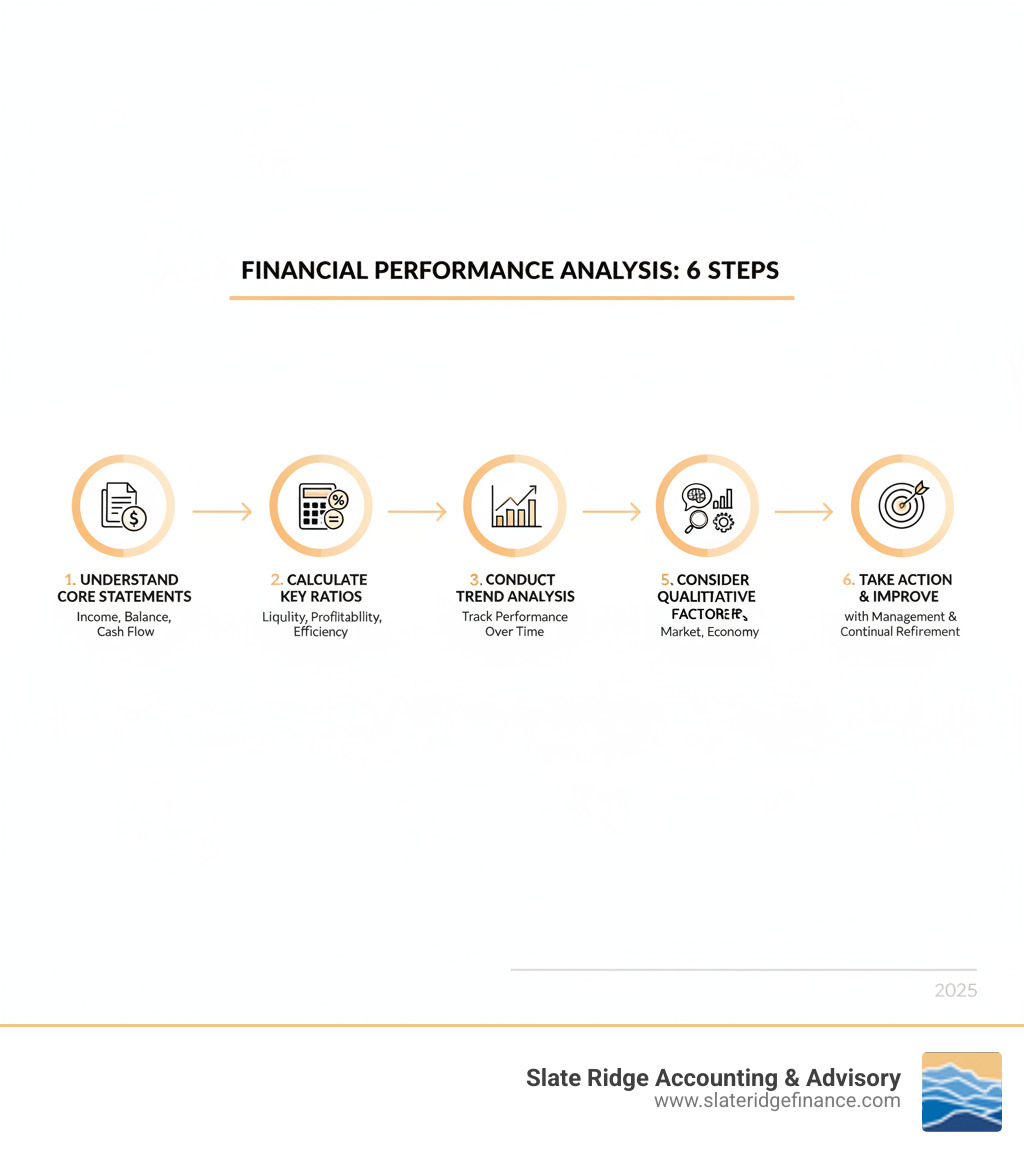
The Foundation: Understanding Your Core Financial Statements
Your financial statements tell your business's story in numbers. Before you can analyze your company's health, you must understand the three core documents that form the foundation of financial performance analysis.
While large corporations follow strict GAAP (Generally Accepted Accounting Principles), consistency is what matters most for small businesses. Using the same accounting methods over time allows for meaningful comparisons and trend spotting. Inconsistent records lead to unreliable conclusions.
If you need help getting your records in order, check out our guide on Financial Statement Preparation.
The Balance Sheet: A Snapshot of Your Business
The balance sheet is a photograph of what your business owns (assets) and owes (liabilities) at a single moment in time. The difference is your owner's equity. It's governed by the fundamental accounting equation: Assets = Liabilities + Owner's Equity. If it doesn't balance, your numbers are wrong.
Your balance sheet reveals your true financial position, showing whether you're building wealth or drowning in debt. It tells lenders and investors what your company value looks like on paper and if you have enough current assets to cover short-term bills.

The Income Statement: Gauging Profitability
If the balance sheet is a photo, the income statement is a movie, showing performance over a period (month, quarter, or year). It answers the key question: Am I making money?
The income statement tracks revenue, Cost of Goods Sold (COGS), and operating expenses. Subtracting all costs from revenue leaves you with net income—your profit or loss.
Surface numbers can be deceiving. For example, Coca-Cola's 2024 revenue increased by 2.86%, but its net income decreased by 0.77% due to higher operating costs. This is why financial performance analysis is crucial—it uncovers the full story. Your income statement reveals trends in sales, expenses, and profit vs. loss, helping you adjust course before small problems grow.
For more on tracking profitability, see our Small Business Financial Reporting Complete Guide.
The Cash Flow Statement: Tracking the Money
You can be profitable and still run out of cash, which is why the cash flow statement is arguably the most critical financial document. It shows what's really happening with your money, breaking down cash movements into three areas: operating activities (day-to-day business), investing activities (buying/selling long-term assets), and financing activities (loans, debt repayment, investor capital).
The key takeaway is that cash vs. profit are not the same. You might record a $10,000 sale as profit, but if the client hasn't paid, you have zero cash. Conversely, a $50,000 loan boosts your cash but isn't profit. The cash flow statement cuts through accounting complexities to show if you have enough actual money to operate and grow.
Understanding how your operations generate cash is vital. Learn more about Operating Cash Flow to master this metric.
Quantitative Deep Dive: Key Ratios for Financial Performance Analysis
Once your financial statements are in order, financial performance analysis gets powerful with financial ratios. These ratios distill rows of numbers into clear, actionable insights about your company's health, acting as Key Performance Indicators (KPIs).
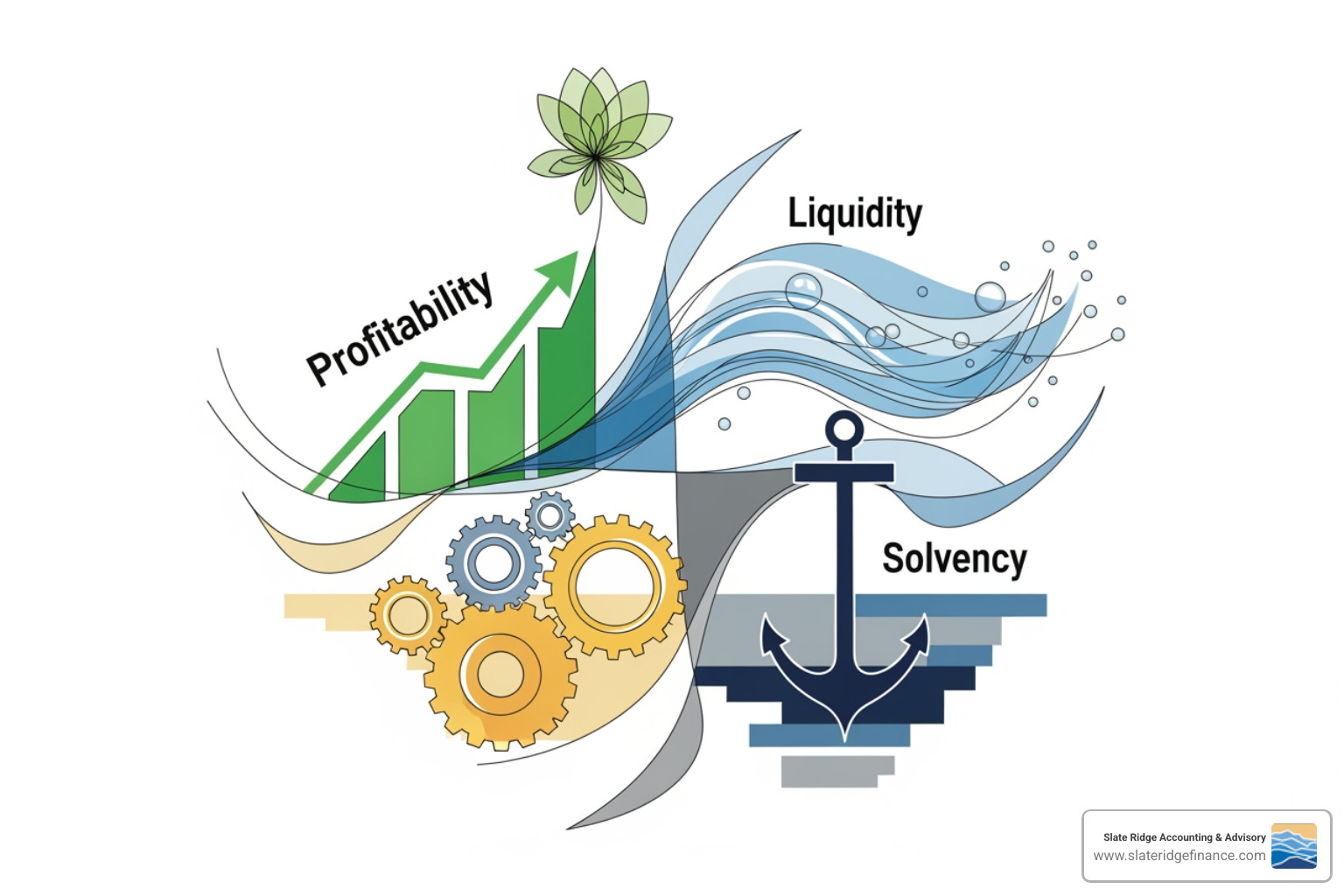
The real power of ratios comes from benchmarking against industry standards, competitors, or your own history. This data interpretation turns raw numbers into strategic direction. If you're wondering which metrics matter most, see our guide on How to Track KPIs.
Liquidity Ratios: Can You Cover Short-Term Bills?
Liquidity ratios measure your ability to cover short-term obligations like payroll and rent.
- Current Ratio (Current Assets / Current Liabilities): A ratio below 2:1 may signal difficulty covering short-term debts, while below 1:1 is a serious red flag.
- Quick Ratio ((Current Assets - Inventory) / Current Liabilities): Also called the acid-test ratio, it excludes inventory for a stricter measure of liquidity. A ratio of 1:1 or higher is generally considered healthy.
- Working Capital (Current Assets - Current Liabilities): This dollar amount shows the funds available for daily operations. Positive working capital is essential, but too much may suggest underinvestment in growth.
Profitability Ratios: How Well Do You Generate Profit?
Profitability ratios reveal how effectively your business converts revenue into profit.
- Gross Profit Margin ((Sales Revenue - COGS) / Sales Revenue): Shows profit after direct production costs. A higher margin indicates efficient production or good pricing.
- Net Profit Margin (Net Income / Total Revenue): The ultimate profitability measure, showing the percentage of revenue that becomes bottom-line profit.
- Return on Equity (ROE) (Net Income / Average Equity): Measures the profit generated for each dollar of owner's investment. A higher ROE indicates effective use of shareholder funds.
- Return on Assets (ROA) (Net Income / Average Assets): Shows how efficiently you use all assets to generate profit. A higher ROA signals operational excellence.
For a deeper dive, look at these key financial ratios.
Leverage (Solvency) Ratios: Assessing Your Debt
Leverage ratios assess your company's debt load and its long-term sustainability.
- Debt-to-Equity Ratio (Total Liabilities / Total Equity): Compares borrowed funds to owner funding. A lower ratio generally means less financial risk, though acceptable levels vary by industry.
- Debt-to-Asset Ratio (Total Debt / Total Assets): Shows the proportion of assets financed by debt. A lower percentage indicates greater long-term stability.
Efficiency Ratios: How Well Do You Use Your Assets?
Efficiency ratios measure how well you manage day-to-day operations.
- Inventory Turnover: Measures how quickly you sell and replace inventory. High turnover is generally positive.
- Asset Turnover: Indicates how effectively you use all assets to generate sales. A higher ratio is better.
- Accounts Receivable Turnover: Measures how quickly you collect payments from customers. High turnover is crucial for healthy cash flow.
Seeing the Bigger Picture: Contextual and Qualitative Analysis
Numbers tell a story, but context is everything. Financial performance analysis becomes truly strategic when you look beyond the math to understand the broader picture.
For example, a drop in profitability might be due to a strategic investment in new equipment, not a loss of competitive edge. To get the full narrative, you must analyze trends, benchmark against your industry, and consider the human and market factors shaping your business. For help acting on these insights, explore our Business Growth Strategies.
Trend Analysis: Your Performance Over Time
A single financial statement is just one moment in time. Trend analysis (or horizontal analysis) involves examining data across multiple periods (months, quarters, years) to spot patterns. Are revenues climbing steadily? Are expenses growing faster than sales? These patterns reveal your business's trajectory.
Year-over-Year (YoY) growth is a key metric. For instance, if revenue grew from $200,000 to $240,000, that's a healthy 20% YoY growth. However, trends can be disrupted by external forces, like the 81.4% plunge in U.S. movie ticket sales in 2020 during the pandemic. Understanding the "why" behind trends is as important as spotting them.
For help using historical data to plan, see our insights on Business Financial Forecasting.
Comparative Analysis: Benchmarking Against Competitors
Is a 15% profit margin good? It depends on your industry. Comparative analysis measures your performance against industry standards and competitors to provide that context.
Vertical analysis is a powerful technique where you express each line item as a percentage of a base figure (like total revenue on an income statement). This makes it easy to compare your cost structure to others, regardless of size. If your Cost of Goods Sold is 40% of revenue while the industry average is 30%, you've identified a potential area for improvement.
For public companies, the SEC's EDGAR database offers financial reports for benchmarking.
The Human Element: Essential Qualitative Factors in financial performance analysis
Qualitative factors are often the missing piece in financial performance analysis. Strong numbers can be misleading if key context is ignored.
- Management experience provides wisdom that doesn't appear on a balance sheet but is crucial for navigating challenges.
- Brand reputation is an invisible asset that can command higher prices and build customer loyalty.
- Market conditions like interest rates, regulations, and supply chain issues can reshape your financial landscape overnight.
When Steve Jobs died in 2011, many questioned Apple's future despite its strong financials. The subsequent success under Tim Cook proved that leadership, culture, and vision are as critical as the numbers. At Slate Ridge, we look beyond spreadsheets to understand your team, market position, and competitive advantages, because your business is more than just numbers.
For strategies integrating these insights, explore our thoughts on Financial Process Optimization.
From Analysis to Action: Financial Performance Management (FPM)
Understanding your numbers is the first step; acting on them is what drives results. While financial performance analysis provides diagnostics, Financial Performance Management (FPM) turns those insights into tangible improvements. FPM is a continuous improvement cycle that aligns strategic planning with real-time data to keep your business on track.
Businesses that accept FPM don't just react to problems—they anticipate them. Learn how optimizing financial workflows leads to better outcomes by visiting More info about Financial Process Optimization.
The FPM Process: A Cycle of Improvement
FPM is a living cycle, not a one-time task. It keeps your business aligned with its strategic vision while staying agile.
- Strategic Planning: Define your long-term business goals.
- Budgeting & Forecasting: Translate goals into concrete financial targets and adapt them as conditions change.
- Monitoring & Reporting: Track actual results against your budget and forecast to spot trends early.
- Analysis: Investigate the "why" behind variances using both quantitative and qualitative data.
- Performance Evaluation: Measure progress against strategic objectives to identify strengths and weaknesses.
- Decision Support & Improvement: Use insights to take action, reallocate resources, and implement changes. This creates a continuous feedback loop, making each cycle smarter than the last.
Best Practices for Accurate Financial Reporting and Analysis
Reliable analysis depends on quality data. Your financial data must be correct, current, complete, and consistent. Without this foundation, you're making decisions based on fiction.
- Solid Accounting Principles: Whether formal GAAP or consistent internal methods, a structured approach is non-negotiable. Learn more at the Financial Accounting Standards Board.
- Leverage Automation: Modern cloud accounting software reduces manual errors and provides real-time reporting.
- Simple, Documented Processes: Clear workflows minimize errors and simplify training.
- Regular Monitoring: Monthly or quarterly reviews allow you to catch issues and opportunities while they're still manageable.
- Accessible Reporting: Use clear summaries and visuals so all stakeholders can understand the data and make informed decisions.
Embracing cloud solutions is a game-changer. Learn more with our insights on Cloud Accounting Services.
Overcoming Common Challenges in financial performance analysis
Implementing effective financial performance analysis and FPM has its problems, especially for growing businesses.
- Data Integration: Data often lives in separate systems (sales, inventory, payroll), making a unified view difficult to achieve manually.
- Resource Constraints: Small businesses operate lean, and dedicating time to deep analysis can feel like a luxury, though not doing so is often costlier.
- Technology Adoption: Teams can be resistant to new software and processes, requiring patience and training.
- Lack of In-House Expertise: Interpreting complex financial data requires specific knowledge and experience.
At Slate Ridge Accounting & Advisory, we help North Carolina businesses overcome these challenges. Our cloud-based solutions and expert advisors bridge these gaps, turning financial management from a source of stress into a competitive advantage. Explore how to transform your operations with our article on Modern Accounting Practices.
Frequently Asked Questions about Financial Performance Analysis
We know diving into financial performance analysis can feel daunting. Here are answers to the most common questions we hear from business owners at Slate Ridge Accounting & Advisory.
What are the first steps to analyzing a company's financial performance?
The journey starts with your three core financial statements: the income statement, balance sheet, and cash flow statement. These provide the foundational data for any analysis.
First, simply read through them to familiarize yourself with the numbers. Then, begin calculating key ratios like the current ratio, net profit margin, and debt-to-equity ratio to get a clearer picture of your liquidity, profitability, and solvency.
Finally, look for trends by comparing current statements to previous periods. This context is where the real insights emerge.
How often should a small business conduct a financial performance analysis?
It depends, but we have some practical guidelines. For internal decision-making, reviewing key metrics monthly or quarterly is ideal. This frequency helps you stay nimble and responsive to opportunities and problems as they arise.
A comprehensive, in-depth analysis should be performed at least annually. This is when you step back to calculate all your ratios, benchmark against industry standards, and assess your overall strategic direction. Annual reviews are also essential for reporting to investors or lenders.
At Slate Ridge, we help clients establish a consistent rhythm that works for their business, as there's no one-size-fits-all answer.
What's the difference between profitability and cash flow?
This is a critical distinction: you can be profitable on paper but still run out of cash.
Profitability, shown on your income statement, is an accounting measure of revenue minus expenses (accrual basis). A transaction is recorded when it occurs, not when cash changes hands. If you invoice a client for $10,000, it's recorded as revenue immediately, even if they pay 60 days later.
Cash flow, detailed on your cash flow statement, tracks the actual money moving into and out of your bank account. That $10,000 payment would only appear in your cash flow when it's actually received.
A company can show a healthy profit but face a cash crunch due to slow-paying customers or large capital investments. Conversely, a business might have strong cash flow but low profitability due to non-cash expenses like depreciation. Both metrics are vital: profitability shows if your business model works, while cash flow shows if you can operate tomorrow.
Take Control of Your Financial Future

You've learned the essentials of financial performance analysis—from understanding your statements to calculating key ratios and benchmarking your business. These aren't just accounting exercises; they are your tools for building a business that truly thrives.
Mastering these skills means you're no longer making decisions in the dark. You can spot warning signs before they become crises, identify growth opportunities, and gain the financial clarity that lets you sleep better at night. You're turning raw data into a strategic roadmap.
At Slate Ridge Accounting & Advisory, we've seen this knowledge transform businesses across North Carolina. When owners understand their numbers, they make bolder, smarter decisions, investing in the right opportunities and growing sustainably.
We are passionate about helping small business owners gain this confidence. Our modern, cloud-based approach provides personalized financial solutions without the stuffy methods of traditional firms. We partner with you, providing the expertise and tools to turn your financial data into actionable insights.
Whether you're struggling with messy books or simply want to make sense of it all, we're ready to help. Our virtual accounting services are designed for busy owners who need clarity, not complexity.
Ready to stop guessing and start knowing? Get expert help with our virtual accounting services and find what financial clarity can do for your business.
Ready to get started?
Book a free consultation today and let’s explore how Slate Ridge can support your business with expert accounting that’s accurate, timely, and built around your goals.
You Might Also Like
A few more posts we think you’ll enjoy on topics that matter to business owners like you.