

Why Your Business Needs Financial Growth Strategies Now
Financial growth strategies are the roadmap businesses use to increase revenue and build long-term value. Yet, fewer than one in four companies outpace their peers in both revenue and profit growth.
Quick Answer: The Core Financial Growth Strategies
- Market Penetration - Sell more to your existing customers
- Product Development - Create new offerings for current markets
- Market Expansion - Enter new geographic or demographic markets
- Diversification - Launch new products in new markets
- Strategic Partnerships - Leverage alliances for mutual growth
- Mergers & Acquisitions - Buy or merge with other businesses
- Capital Allocation - Strategically invest resources for maximum return
The hard truth is that growth is elusive. Before 2020, the typical company grew just 2.8% annually, and only one in eight achieved growth above 10%. Sustaining that momentum is even harder. However, the reward is significant: an extra five percentage points of annual revenue growth can increase your market capitalization by 33% to 45% over a decade.
Growth isn't just about getting bigger; it drives culture, talent retention, and innovation. But most business owners are too busy with day-to-day operations—messy books, tax deadlines, and payroll—to focus on strategy. Without clean financial data and a clear plan, you're flying blind.
This guide breaks down proven financial growth strategies into practical steps for your small business.
Laying the Foundation: Financial Planning and Analysis
Before choosing a financial growth strategy, you must know where your business stands. This is the role of financial planning and analysis (FP&A). It's your business's navigation system, providing the clear data and realistic projections needed before you accelerate.
Growth strategies built on messy books, guesswork forecasts, and mysterious cash flow are doomed to fail. Effective FP&A is about understanding how your business uses capital and what risks you face. It helps you manage capital allocation, practice risk management, and maintain data integrity. Without these fundamentals, even the best strategy will struggle. If you're unsure about your financial foundation, our Expert Financial Advice can help.

The Role of Financial Forecasting
Financial forecasting uses historical data and market trends to make educated projections. It's not about predicting the future perfectly, but about preparing for it. Effective forecasting helps you spot cash flow patterns, know when to invest or tighten the belt, and set achievable financial goals.
A key benefit is scenario modeling. What if sales jump 15%? What if a supplier raises prices? By modeling different scenarios, you can prepare for multiple outcomes instead of being caught off guard. For businesses in North Carolina, from Charlotte to Asheville, accurate forecasting helps manage local market conditions. Our Business Financial Forecasting services provide this clarity. For more detail, see our Financial Forecasting Services: Complete Guide.
Strategic Capital Allocation and Risk Management
Once you have a clear financial picture, you must decide where to invest your money for the best return. This is capital allocation—the strategic resource distribution across opportunities like new technology, hiring, or expansion. Each decision impacts your Return on Invested Capital (ROIC).
Smart allocation also involves choosing the right mix of debt vs. equity financing. At the same time, effective risk management means identifying financial threats before they become crises. Key strategies include hedging (protecting against specific risks like currency swings) and diversification (spreading investments to minimize the impact of any single setback), a topic the CFA Institute covers well in Setting the Record Straight on Asset Allocation. Strong FP&A provides the foundation to pursue growth with confidence.
Core Organic Growth Strategies
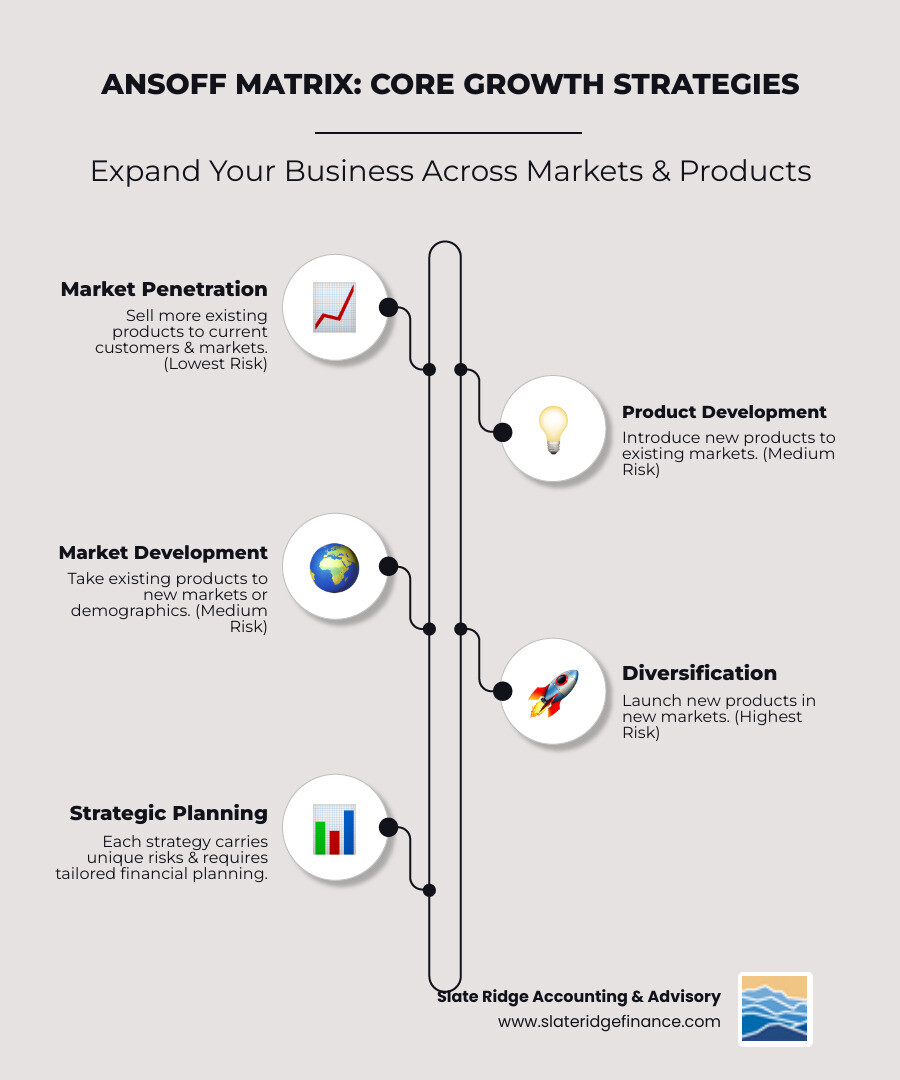
The Ansoff Matrix is a practical framework for understanding financial growth strategies. It organizes options based on whether you are using existing or new products in existing or new markets. Organic growth—expanding from within—is typically safer because it builds on what you already know works.
Starting with your current strengths reduces guesswork. You understand your products, customers, and market. For a broader look at scaling, see our guide on Business Growth Strategies. The original Ansoff framework, from Strategies for Diversification, is still highly relevant.
Market Penetration: Winning More of Your Current Market
The most straightforward growth path is selling more of your current offerings to your existing market. Market penetration is the lowest-risk strategy because you're on familiar turf. The goal is to increase your market share by attracting competitors' customers or encouraging your own to buy more.
Tactics include competitive pricing to stand out, customer loyalty programs to reward repeat business, and, most importantly, improving customer service. Exceeding expectations drives sales and referrals. A Boone restaurant that remembers a regular's order is executing a market penetration strategy. Winning a competitor's customer is a double victory—a sale for you and one less for them. For more tactics, see our guide on how to Grow Small Business.
Product and Service Development: Innovating for Your Base
Once you've maximized your current offerings, the next step is creating something new for the same customers. Product development involves introducing new features, product modifications, or related services. Since you already know your customers' pain points and preferences, this approach has a lower risk of failure.

Think of a Raleigh-based SaaS company adding features based on user feedback or a Wilmington boutique introducing a premium line. Leveraging customer data is your secret weapon; your customer base is an invested focus group. Their feedback and purchasing patterns reveal new opportunities.
This strategy is especially effective in innovative industries like SaaS and Healthcare, where new features and services are constantly in demand. The key is to stay close to your customers, test ideas, and iterate based on their feedback.
Expansion-Focused Financial Growth Strategies
When you hit a growth ceiling, it's time to look beyond your current operations. Expansion-focused financial growth strategies push you into new markets or products. The risk is higher, but so is the potential for breakthrough growth. As McKinsey's research on Courageous growth: Six strategies for continuous growth outperformance shows, bold moves can pay off.
Market Expansion: Taking Your Business to New Places
Market expansion means taking your proven products or services to a new audience. This could involve new geographic locations, targeting new demographic segments, or opening new distribution channels. For example, a successful Hickory bakery might expand to Charlotte, or a B2B software firm could target larger corporate clients.
However, what works in one market may not work in another. Thorough market research is essential before committing resources. For businesses considering international markets, the stakes and opportunities are even greater. Resources like Export Development Canada and the Trade Commissioner Service can provide valuable guidance.
Strategic Partnerships and Alliances
You don't have to grow alone. Strategic partnerships allow you to leverage another company's strengths for mutual benefit. This can take the form of co-marketing arrangements, joint ventures to develop new products, or supply chain synergies to cut costs. These alliances allow you to expand your reach and reduce risk by sharing the investment with a partner who brings different resources to the table.
Mergers and Acquisitions (M&A)
Mergers and acquisitions (M&A) are the most aggressive path to growth, offering immediate scale and capabilities. Companies pursue M&A to acquire competitors, gain technology or expertise, or achieve instant market entry. Microsoft's acquisition of LinkedIn, for example, was a strategic shift that redefined its future.
However, M&A is complex and risky. The biggest challenge is often cultural integration—melding two different organizations. Rushing this process can destroy the value you paid for. A more measured approach is programmatic M&A: making multiple smaller acquisitions over time. This strategy builds M&A capabilities while spreading risk, and research shows it often outperforms both single large deals and purely organic growth.
| Feature | Organic Growth | Mergers & Acquisitions (M&A) |
|---|---|---|
| Pros | Lower risk, builds internal capabilities, less financial strain, cultural fit | Rapid market entry, instant scale, access to new tech/talent, reduced competition |
| Cons | Slower, limited by internal resources, may miss market opportunities | High financial risk, complex integration, cultural clashes, potential overpayment |
| Risk Level | Lower | Higher |
| Speed of Growth | Slower, incremental | Faster, immediate |
| Capital Required | Generally lower, spread over time | Often substantial upfront investment |
| Control | Full control over development | Integration challenges, loss of some control |
Expansion strategies can catapult your business to the next level, but they require careful planning and solid financial analysis.
Executing and Measuring Your Strategy
A brilliant strategy is useless without execution and measurement. The magic happens when you implement your plan and track what's working. This requires clear goals, robust tracking, and a solid implementation plan.
Developing your primary financial growth strategies
Creating an effective strategy is a methodical process. Here are the key steps:
- Evaluate your current financial position. Understand your liquidity, capital structure, and cash flow patterns before charting a course.
- Establish clear financial goals. Set SMART (Specific, Measurable, Achievable, Relevant, Time-bound) goals, like increasing revenue by 15% or improving profit margins by 5%.
- Conduct market analysis. Dig into your industry, study competitors, and identify opportunities to avoid charging into unreceptive markets.
- Create your financial plan. Translate your goals into a roadmap with financial targets, budgets, and scenario modeling to prepare for different outcomes. Our Personalized Financial Solutions can help manage this process.
- Monitor and revise continuously. Markets shift, so regularly review performance against your goals and adapt as needed. Agility is key to thriving.
This systematic approach, supported by Financial Process Optimization, separates sustainable growth from wishful thinking.
Key Performance Indicators (KPIs) for Financial Growth
You can't manage what you don't measure. KPIs are your business's dashboard, telling you if you're on course.
- Revenue Growth Rate: The top-line indicator of sales increases. But growth must be profitable.
- Customer Acquisition Cost (CAC) & Customer Lifetime Value (CLV): CAC is what you spend to get a new customer; CLV is the total revenue they'll generate. A healthy business has a CLV significantly higher than its CAC.
- Profit Margins: These show how efficiently you convert revenue into profit. Low margins can signal trouble even with high sales.
- Return on Investment (ROI): This measures the profitability of specific initiatives, helping you allocate resources effectively.
- Total Shareholder Returns (TSR): For businesses with investors, this measures the total value created for owners.
Modern technology allows for real-time tracking of these metrics. We help businesses set up systems to How to Track KPIs effectively.

Best practices for executing financial growth strategies
Successful execution hinges on a few key practices:
- Base decisions on data, not gut feeling. Use accurate, up-to-date financial data to inform your intuition.
- Stay adaptable and keep learning. View market changes as opportunities and be willing to pivot when a strategy isn't working.
- Communicate clearly. Ensure your team, investors, and customers understand your strategy and progress. Transparency builds buy-in.
- Leverage technology. Use automated finance software to eliminate inefficiencies and free up time for strategic thinking. Our Modern Accounting Practices and Cloud Accounting Services are built on this principle.
Companies that succeed combine clear planning with disciplined execution and continuous learning.
Sustaining Growth: Profitability, Liquidity, and Debt Management
Achieving growth is exciting, but sustaining it is the real challenge. Many businesses grow their revenue only to face a cash crisis. Sustainable growth rests on three pillars: profitability, liquidity, and smart debt management. If any leg is weak, the business can topple. Your financial growth strategies must account for all three.
Your competitive advantage is the engine for profitable expansion, but you must also stay nimble to handle external factors like economic shifts. Our Small Business Financial Reporting: Complete Guide helps you maintain the visibility needed to steer these challenges.
The Role of Profitability in Sustainable Growth
Growth without profit is just expensive noise. This "top-line-only growth" can burn through cash and harm your business. The goal is profitable growth, which strengthens your business with every expansion.
This requires improving margins through strategic pricing, controlling costs by becoming more efficient, and boosting operational efficiency. Streamlining processes from production to accounts receivable reduces waste and frees up cash. Our Tips for Managing Small Business Accounts Receivable and Payable offers practical steps.
Managing Liquidity and Debt for Expansion
Liquidity is your ability to pay bills. As you grow, your cash needs grow even faster for inventory, staff, and marketing. Without proper planning, businesses can grow themselves into a cash crisis. Maintaining sufficient working capital and healthy cash flow is the oxygen your business breathes.
Debt is a tool that can accelerate growth, but too much can become a burden. Smart debt management involves maintaining a healthy debt-to-equity ratio and exploring all financing options, from bank loans to strategic profit reinvestment. The goal is to maintain financial flexibility—the breathing room to respond to unexpected opportunities or challenges without being handcuffed by debt. Our Bookkeeping Service for Small Business provides the accurate records you need to make these smart decisions.
Frequently Asked Questions about Financial Growth Strategies
What are the primary financial strategies businesses can employ for growth?
The primary strategies are often categorized using the Ansoff Matrix:
- Market Penetration: Selling more existing products to existing customers (lowest risk).
- Product Development: Creating new products for existing customers.
- Market Development: Taking existing products to new markets.
- Diversification: Launching new products in new markets (highest risk).
Other key strategies include forming strategic partnerships and alliances to share costs and access new capabilities, and pursuing mergers and acquisitions (M&A) for rapid expansion.
How can companies manage financial risks while pursuing growth?
Growth always involves risk, but it can be managed. Key tactics include:
- Thorough Financial Planning: Use scenario analysis to prepare for different outcomes.
- Maintaining Healthy Liquidity: Ensure you have enough cash on hand to weather unexpected storms.
- Diversification: Spread revenue across different products, markets, or customer segments to reduce dependency on a single source.
- Testing Before Leaping: Pilot new strategies on a small scale to learn and adjust before a full rollout.
What are the most important KPIs for measuring financial growth?
Tracking the right Key Performance Indicators (KPIs) is crucial. The most important ones include:
- Revenue Growth Rate: Shows if your sales are increasing.
- Net Profit Margin: Measures how much profit you keep from each dollar of sales.
- Customer Acquisition Cost (CAC) vs. Customer Lifetime Value (CLV): Ensures the cost to acquire customers is less than the value they bring over time.
- Return on Investment (ROI): Determines if your growth initiatives are profitable.
- Total Shareholder Returns (TSR): Reflects the total value being created for owners.
Our guide on How to Track KPIs can help you set up a dashboard to monitor these metrics.
Conclusion
Growing your business requires a clear roadmap built on solid financial planning and strategies that fit your unique situation. There is no magic formula; the right approach for a Raleigh SaaS company will differ from that of a Hickory manufacturer. The key is to choose the right path—whether it's deeper market penetration, new product development, or strategic acquisitions—and execute it with discipline.
This means tracking the right KPIs, managing cash flow, and ensuring growth is profitable and sustainable. It's about getting better, not just bigger, and building a business that can weather storms and seize opportunities.
At Slate Ridge Accounting & Advisory, we help small businesses across North Carolina implement this process. We know you started your business to pursue a passion, not to become a spreadsheet expert. We provide modern, cloud-based financial solutions that give you clarity and the freedom to focus on what you do best.
Ready to stop spinning your wheels and start building real, sustainable growth? Take control of your business finances with Virtual Accounting services. Let's map out your path forward and turn your growth ambitions into reality.
Ready to get started?
Book a free consultation today and let’s explore how Slate Ridge can support your business with expert accounting that’s accurate, timely, and built around your goals.
You Might Also Like
A few more posts we think you’ll enjoy on topics that matter to business owners like you.