

Why Understanding Small Business Accounting Costs Matters
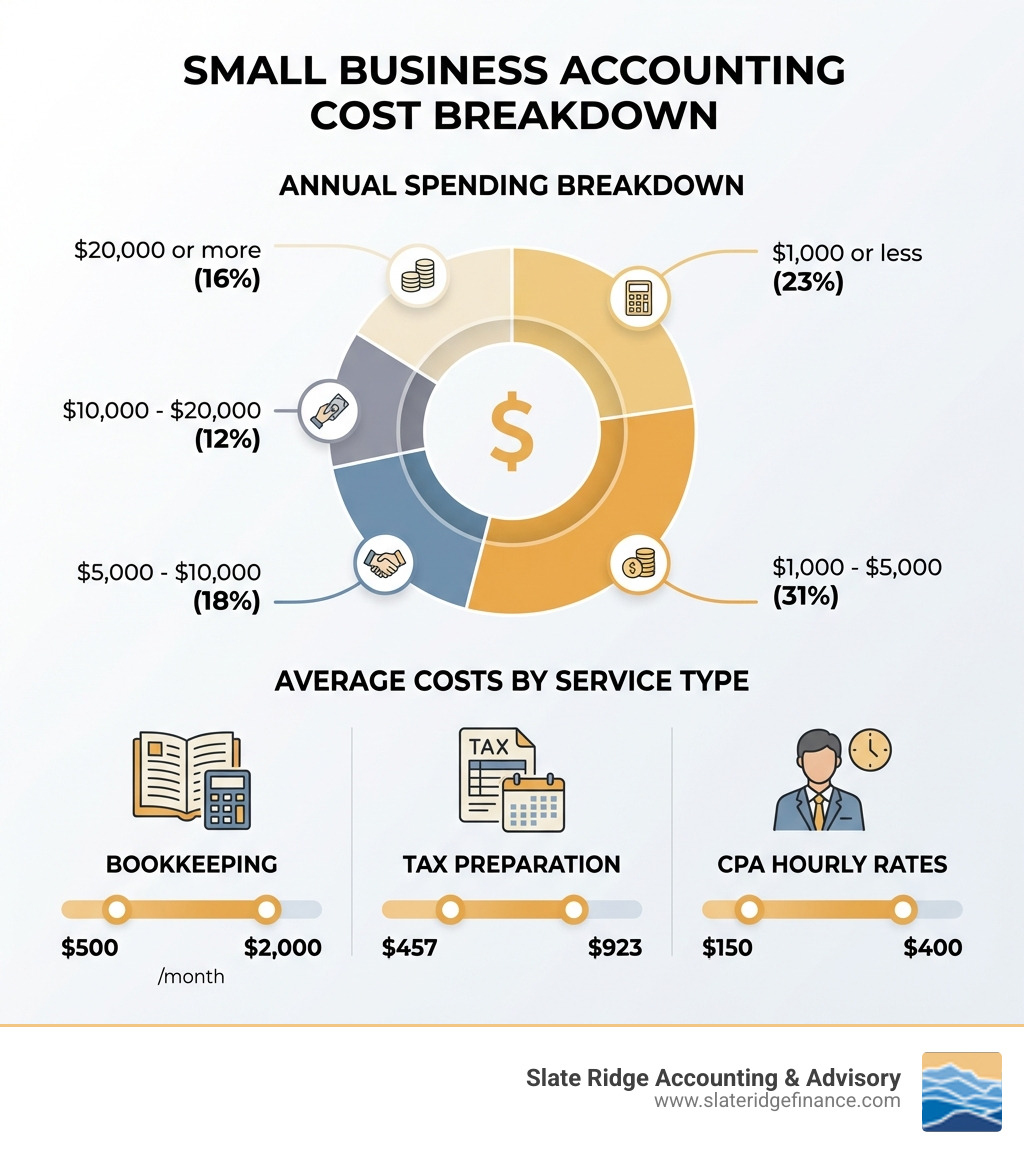
Small business accounting costs typically range from $1,000 to $5,000 per year for basic services, though this varies based on business needs. Here's a quick overview:
Quick Cost Overview:
- Hourly rates: $50-$400 (bookkeepers on the lower end, CPAs on the higher end)
- Monthly packages: $500-$2,500 for ongoing support
- Tax preparation: $457-$923 depending on business structure
- Annual spending: 23% of small businesses spend under $1,000, while 31% spend $1,000-$5,000
As a small business owner, you've likely questioned if accounting costs are worth it while trying to keep overhead low. Consider this: 40% of small business owners spend over 80 hours per year on tax preparation alone. That's two full work weeks you could reclaim to grow your business.
The true cost isn't just the fee; it's the lost deductions, poor decisions from messy books, and potential IRS penalties, which can average $7,000 for mail audits and $65,000 for field audits.
This guide breaks down what small business accounting costs in 2026, explaining the factors that influence pricing and how to get the best value. Whether you're hiring your first bookkeeper or re-evaluating expenses, you'll find clear answers here.
Small business accounting costs terms at a glance:
- cost reduction strategies
- best accounting systems for small businesses
- what type of accountant is best for a small business
A Breakdown of Typical Accounting Fees & Services
Understanding how accounting professionals charge is the first step to managing your small business accounting costs. We offer a range of options to suit your North Carolina business's needs. More info about our tailored accounting services
How Accountants Structure Their Fees
Accounting firms typically use a few common fee structures:
- Hourly Rates: You pay for time spent on your books, with rates from $50 for general accountants to $400 for CPAs. This model is flexible but can lead to unpredictable costs.
- Flat Fees / Project-Based Pricing: This provides cost predictability for specific services like tax preparation. For example, annual business tax prep can range from $733 for partnerships to $923 for C-Corps.
- Fixed Monthly Retainers: A popular option for ongoing services where you pay a consistent monthly fee, making budgeting easier. Industry surveys show 84% of firms use this model, but be aware that 57% may charge for out-of-scope work, so a small contingency budget is wise.
- Value-Based Pricing: Fees are tied to the value a service provides, not just time spent. This is more common for high-level advisory services.
84% of firms use fixed-price agreements according to AICPA survey data
What's Included in Monthly Accounting Packages?
Monthly accounting packages bundle essential tasks, offering a comprehensive way to manage your small business accounting costs.
Packages for North Carolina businesses, like ours, can range from $750 to $2,500 per month, depending on complexity. Here's what's typically included:
- Bookkeeping: Accurate recording and categorization of all financial transactions.
- Bank and Credit Card Reconciliation: Matching your records to bank statements to identify discrepancies.
- Financial Statement Preparation: Monthly or quarterly Profit & Loss (P&L) and Balance Sheet reports to show your business's health.
- Payroll Processing: Managing employee pay, tax filings, and compliance. Costs are typically $5-15 per employee monthly.
- Tax Planning and Preparation: Year-round strategy to minimize tax liabilities, not just annual filing.
- Advisory Sessions: Regular meetings to discuss financial performance, budgeting, and strategic growth.
These packages provide peace of mind and free up your time to focus on your core business. Explore our monthly accounting packages
What Factors Influence Small Business Accounting Costs?
Several factors impact your small business accounting costs, from your business's complexity in North Carolina to the professional you hire. More info on what type of accountant is best for a small business
Understanding the Key Drivers of Your Small Business Accounting Costs
The more complex your business, the higher the accounting costs. Here are the primary drivers:
- Business Structure (LLC, S-Corp, C-Corp, Sole Proprietor): Tax and compliance rules vary by structure. C-Corps are generally the most complex and costly.
- Revenue Level: Higher revenue often means more transactions and greater financial complexity.
- Number of Employees: More employees lead to more complex payroll processing and tax filings.
- Transaction Volume: The number of sales, purchases, and invoices directly impacts the bookkeeping workload and cost.
- Multi-State Operations: Operating in multiple states significantly increases complexity and costs due to varied tax laws and regulations.
- Quality of Your Records: Disorganized records require more cleanup time from your accountant, increasing your bill. Accountants charge an average of $117 extra for messy paperwork.
The CPA Premium: What Credentials Add to Costs
The credentials of your accounting professional also affect your small business accounting costs. A Certified Public Accountant (CPA) often commands a higher fee for good reason.
- CPA vs. Non-Certified Accountant: CPAs have passed a rigorous exam, meet strict educational and ethical standards, and require continuing education. This expertise justifies their higher average salary ($79,944 vs. $58,546 for non-CPAs).
- Specialized Skills: Many CPAs specialize in specific industries, bringing targeted knowledge that can uncover unique savings and steer complex regulations.
- Audit Representation: Only CPAs can represent you before the IRS during an audit, providing significant peace of mind.
- Financial Statement Audits: CPAs are the only professionals authorized to sign audited financial statements, which may be required for loans or a business sale.
While a CPA's hourly rate is higher, their expertise can prevent costly errors and uncover tax savings that provide a strong return on investment for your North Carolina business.
PayScale data on CPA salaries/Salary)
In-House vs. Outsourced: A Full Cost Comparison
Deciding whether to hire an in-house accountant or outsource is a major decision when managing small business accounting costs. Let's break down the true financial implications.
| Cost Factor | In-House Bookkeeper (Annual) | Outsourced Bookkeeping (Annual) |
|---|---|---|
| Salary/Fees | $49,210 (Median BLS 2024) | $6,000 - $30,000 ($500-$2,500/mo) |
| Benefits (42% of wage) | $20,668 | $0 |
| Recruiting Costs | $5,000 - $10,000 (one-time) | $0 |
| Management Overhead | $2,000 - $4,000 (10-15 hrs/mo) | $0 |
| Software/Tools | Variable | Included in service |
| Training/Development | Variable | Included in service |
| Total Estimated Cost | ~$70,000 - $85,000+ | ~$6,000 - $30,000 |
| Flexibility | Limited | High (scale up/down) |
| Scalability | Low | High |
| Expertise Access | Single individual | Team of specialists |
The Hidden Costs of an In-House Hire
Hiring an in-house accountant involves more than just their salary. These hidden expenses can significantly inflate your small business accounting costs. For an in-house bookkeeper in North Carolina with a median wage of $49,210 (May 2024), the true cost is much higher. You must also factor in:
- Benefits: A major cost, adding approximately 42% to wages for things like health insurance and retirement. That's an extra $20,668 on a $49,210 salary. The 42% benefits multiplier from BLS data
- Recruiting Costs: Finding the right person can cost $5,000 to $10,000 in job postings, background checks, and fees.
- Training and Onboarding: New hires need time and resources to learn your specific systems.
- Management Overhead: Supervising an employee consumes valuable executive time, often 10-15 hours per month.
- Office Space and Equipment: Costs for a desk, computer, software, and supplies.
- Payroll Taxes and Insurance: Your share of FICA taxes and worker's compensation.
In total, an in-house bookkeeper can easily cost a North Carolina business over $70,000 annually—a substantial burden for many small businesses. More info on small business payroll costs
The Economics of Outsourcing to a Professional Firm
Outsourcing to a firm like Slate Ridge Accounting & Advisory offers significant economic advantages and more predictable small business accounting costs.
- Predictable Fees: Fixed monthly retainers (often $500 to $2,500) make budgeting simple.
- Significant Cost Savings: Outsourcing can be 40-60% cheaper than a full-time hire, as you don't pay for benefits, recruiting, or office space.
- Access to a Team of Experts: You gain access to a diverse team of bookkeepers, accountants, and CPAs, ensuring broad expertise and consistent coverage.
- Leveraging Technology: Benefit from the latest accounting software and automation tools without the direct cost.
- Scalability and Flexibility: Easily scale services up or down as your business needs change.
- Focus on Your Core Business: Free up your time to concentrate on revenue-generating activities.
Learn about our virtual bookkeeping solutions
How to Lower Your Accounting Expenses
You can manage your small business accounting costs without sacrificing quality by using smart strategies and technology. More info on cost reduction strategies
How to Lower Your Small Business Accounting Costs
Here are actionable steps to reduce your accounting expenses:

- Maintain Clean and Organized Records: This is the most impactful step. Consistently categorizing transactions and keeping digital receipts reduces the cleanup time your accountant bills for.
- Use Accounting Software Effectively: Implement robust software to automate data entry and streamline the process for your accountant. Explore online accounting software for small business
- Handle Basic Tasks Internally: If comfortable, manage simple bookkeeping tasks like entering invoices to reduce the scope of work for your outsourced team.
- Negotiate a Fixed-Fee Package: Opt for fixed monthly fees instead of hourly billing for predictable budgeting. Clarify the scope to avoid extra charges.
- Hire During the Off-Season: For one-off projects, engaging an accountant outside of the busy tax season (Jan-Apr) may offer better rates.
Leveraging Technology for Smarter Spending
Technology is a game-changer for managing small business accounting costs, automating tasks and improving accuracy.
- Automated Bookkeeping: Cloud platforms can integrate with your bank to automatically import and categorize transactions, reducing manual data entry.
- Receipt Capture Apps: Use apps to snap photos of receipts and automatically extract data, ensuring all expenses are captured.
- Cloud-Based Platforms: Cloud services allow secure, real-time collaboration with your accounting team, saving time.
- Reducing Manual Data Entry: The core benefit of these tools is minimizing manual work, which saves time and reduces human error.
By implementing these solutions, your North Carolina business can make your accounting services more efficient and cost-effective. How cloud services benefit accounting
The Real Risk: What Happens When You Don't Hire an Accountant?
While small business accounting costs may seem daunting, the risks of not hiring a professional can be far greater, leading to financial setbacks and missed opportunities for your North Carolina business.
The High Price of Financial Mistakes
Without professional oversight, the chance of costly mistakes skyrockets:
- IRS Penalties and Fines: Tax errors can lead to substantial penalties. The average mail audit costs $7,000, while a field audit can cost $65,000—far more than professional tax prep.
- Missed Deductions and Credits: An expert can identify all eligible deductions, preventing you from overpaying taxes.
- Inaccurate Financial Reporting: Messy books lead to unreliable reports and poor business decisions.
- Lost Opportunities: Inaccurate financials can prevent you from securing loans or attracting investors.
These mistakes create headaches that divert your attention from growing your business. More info on financial reporting services
When Does Hiring an Accountant Become a Smart Investment?
Hiring an accountant is a strategic investment that pays dividends. Professional help becomes essential at key inflection points:
- Business Growth and Increasing Complexity: As revenue, employees, or markets grow, your finances become more intricate and require expert management.
- Seeking Loans or Investors: You'll need pristine, professional financial statements to secure funding.
- Time Savings: With 40% of owners spending 80+ hours on tax prep alone, an accountant frees up your most valuable asset: your time.
- Needing Strategic Financial Advice: A good accountant acts as a trusted advisor, helping with budgeting, forecasting, and profitability strategies for informed decision-making.
When your time is worth more than the cost of outsourcing, or when financial complexity exceeds your expertise, hiring an accountant becomes a necessary investment. Explore financial growth strategies
Frequently Asked Questions about Accounting Costs
How much does it cost to have an accountant prepare taxes for a small business?
Tax preparation costs for a small business in North Carolina depend on your business structure and financial complexity. Here are the average costs:
- Sole Proprietors: Around $457 for a Form 1040 with Schedule C.
- LLCs and Partnerships: Approximately $733 (Form 1065).
- S-Corporations: About $913 (Form 1120S).
- C-Corporations: Average $923 (Form 1120).
These are averages; costs can increase with higher revenue, multi-state operations, or disorganized records.
Data from the National Society of Accountants
What's the difference between a bookkeeper, an accountant, and a CPA?
Understanding these roles helps you hire the right professional for your small business accounting costs:
- Bookkeeper: Handles daily financial recording, including data entry, categorizing transactions, and bank reconciliations.
- Accountant: Uses the bookkeeper's data to prepare financial statements, analyze performance, and offer tax planning advice.
- Certified Public Accountant (CPA): A licensed accountant with advanced training who can perform all accountant duties plus represent clients before the IRS and sign audited financial statements.
Many North Carolina small businesses use a bookkeeper for daily tasks and an accountant or CPA for higher-level analysis and strategy. More info on what type of accountant is best for a small business
Is it cheaper to do my own accounting with software?
Using accounting software seems cheaper initially, but it has significant trade-offs for your small business accounting costs:
- Initial Cost Savings vs. Time Cost: Software may only be $30-$100 per month, but is it worth the 40-80+ hours you'll spend on tasks like tax prep instead of growing your business?
- Risk of Errors: Without training, it's easy to make mistakes that lead to missed deductions or costly IRS penalties.
- Lost Strategic Insights: Software records data but doesn't offer the strategic advice or financial forecasting an expert provides.
- A Hybrid Approach: A cost-effective solution is to use software for basic data entry and hire a professional for review, reporting, and tax filing. This combines efficiency with expert oversight.
While DIY accounting saves money upfront, the time cost and risk of errors can make it more expensive in the long run. Explore our guide to the best accounting systems for small business
Conclusion: Making a Smart Investment in Your Business's Financial Health
Navigating small business accounting costs can feel like a daunting task, but as we've explored, it's not just an expense—it's a critical investment in the stability and growth of your North Carolina business. From understanding various fee structures to weighing the pros and cons of in-house versus outsourced solutions, making informed decisions about your accounting needs is paramount.
The true cost of accounting isn't just the dollar amount on an invoice; it's the value gained from accurate financial data, strategic tax planning, compliance assurance, and the peace of mind that comes from knowing your finances are in expert hands. It's about freeing up your valuable time to focus on innovation, customer relationships, and scaling your business, rather than wrestling with spreadsheets.
At Slate Ridge Accounting & Advisory, we believe in providing modern, personalized, and industry-custom financial solutions. We help small businesses like yours track KPIs, forecast growth, and make data-driven decisions. By partnering with us, you gain more than just a service provider; you gain a strategic partner dedicated to your financial clarity and success.
Don't let the fear of accounting costs deter you from building a robust financial foundation. The right accounting support can be the catalyst for sustainable growth and long-term profitability. Get a clear picture of your finances with our virtual accounting services
Ready to get started?
Book a free consultation today and let’s explore how Slate Ridge can support your business with expert accounting that’s accurate, timely, and built around your goals.
You Might Also Like
A few more posts we think you’ll enjoy on topics that matter to business owners like you.