

Why Managing Payroll in North Carolina Is More Complex Than You Think
A North Carolina payroll service handles everything from calculating employee wages and withholding taxes to filing state and federal paperwork, so you don't have to. For North Carolina businesses, these services must steer a 4.75% state income tax, unemployment tax rates ranging from 0.06% to 7.00%, and strict compliance requirements with both the NC Department of Revenue and the IRS.
Top North Carolina Payroll Services at a Glance:
| Provider Type | Best For | Key Features |
|---|---|---|
| Local NC Providers | Small to medium businesses seeking personalized support | Deep NC tax knowledge, on-site training, flexible service |
| National Providers | Multi-state operations or large enterprises | Advanced technology, nationwide coverage, extensive HR suites |
| All-Inclusive Services | Businesses wanting one predictable price | Tax filing, direct deposit, compliance support, year-end forms |
Running payroll isn't just about cutting checks. It's a maze of federal tax forms (941s, 940s, W-2s), state withholding requirements, unemployment insurance filings, and new hire reporting deadlines. One miscalculation can trigger IRS audits or NC Department of Revenue penalties. One missed deadline can cost you hundreds in fines.
As one long-term client of a North Carolina payroll provider put it: "What a service! Cost way less than I'd imagined. Definitely made my life easier by saving me a lot of time and stress."
The right payroll partner doesn't just process numbers. They become your compliance safety net, your time-saving automation tool, and your guide through North Carolina's specific regulations. Whether you're a startup in Raleigh or a growing manufacturer in Charlotte, choosing the right service means the difference between payroll headaches and payroll peace of mind.
North Carolina payroll service glossary:
- accounting and payroll services for small business
- cost of payroll services for small business
- cloud payroll management
Why Your North Carolina Business Needs a Dedicated Payroll Service
Imagine trying to steer a dense forest blindfolded. That's often what payroll feels like for business owners trying to handle it all themselves. The intricacies of wages, deductions, taxes, and compliance can quickly overwhelm even the most organized among us. This is why a dedicated North Carolina payroll service isn't just a luxury; it's a necessity for many businesses, especially those in our vibrant state.

Outsourcing your payroll to experts helps alleviate the stress of managing complex regulations and frees up your valuable time. Instead of spending hours wrestling with spreadsheets and tax forms, you can focus on what you do best: growing your business. It's about shifting from a stressed, administrative role to a relaxed, strategic one. A payroll service can offer comprehensive Payroll Management Services that allow you to reclaim your day.
The High Cost of Payroll Errors
We've all heard the saying, "time is money." But with payroll, errors can cost you far more than just time. Incorrect calculations, missed deadlines, or improper filings can lead to significant financial penalties from both state and federal agencies. Think of it this way: one small mistake could trigger an IRS audit, an experience no business owner ever wants to have.
Consider the ripple effects:
- Fines and Penalties: Late or incorrect tax filings can incur hefty fines. For instance, the IRS and the North Carolina Department of Revenue don't take kindly to errors. These penalties can quickly eat into your profits.
- IRS Audits: Persistent errors or red flags can lead to a full audit, which is a time-consuming and stressful process that diverts resources from your core business.
- Inaccurate Paychecks: Employees rely on accurate and timely pay. Errors can lead to frustration, decreased morale, and even legal issues if wages are consistently incorrect.
- Wasted Administrative Hours: Even if you avoid fines, the time spent correcting errors, re-running payroll, and dealing with employee queries adds up. This is time you could be spending on customer service, marketing, or product development.
Understanding the potential costs is crucial. Our Small Business Payroll Cost Guide digs deeper into this topic, highlighting how outsourcing can often be more cost-effective than managing payroll in-house.
Staying Compliant with NC and Federal Laws
North Carolina has its own set of rules that complement federal regulations, creating a layered compliance environment. A specialized North Carolina payroll service is well-versed in these nuances.
Here's what we mean:
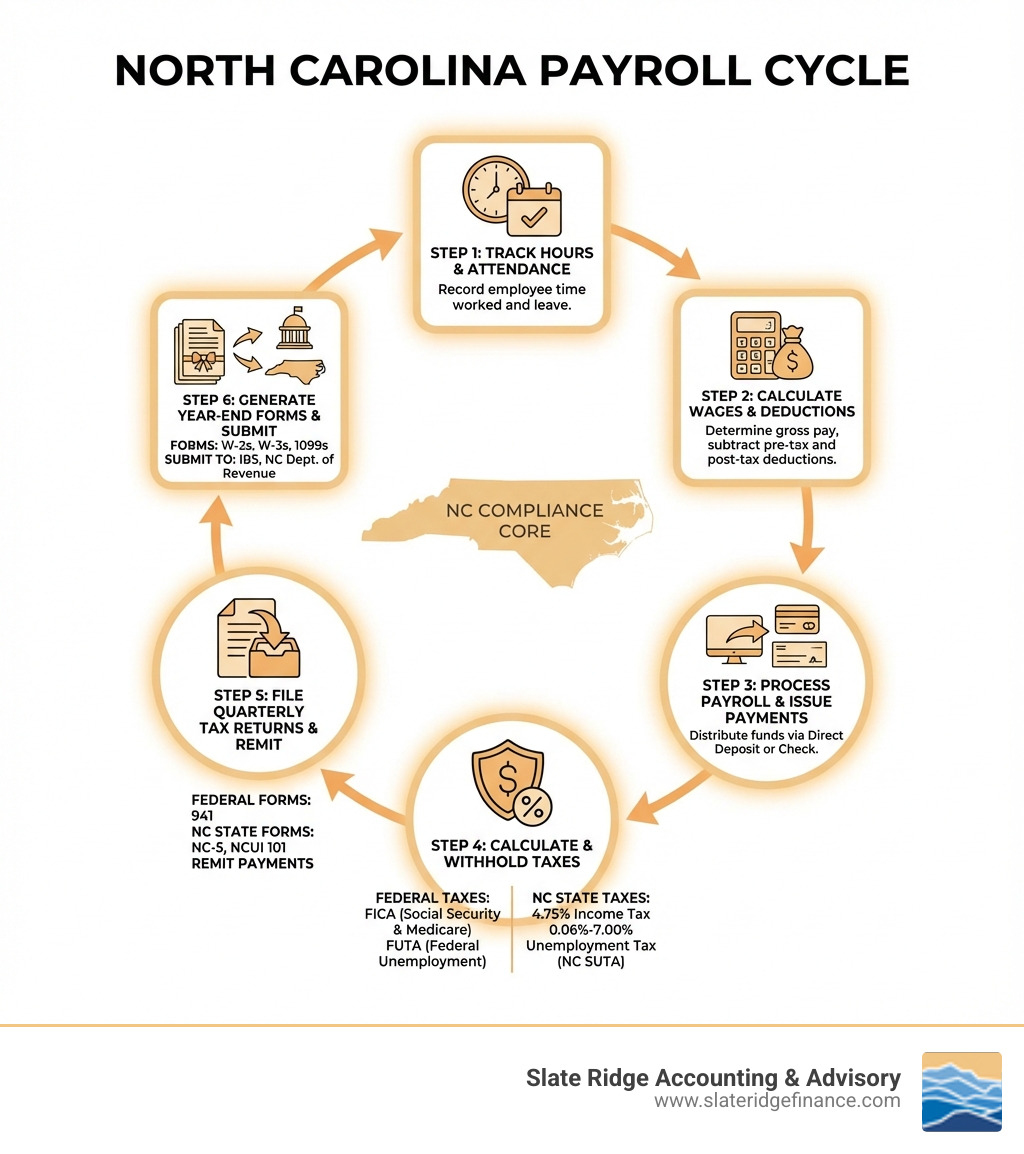
- NC Income Tax Withholding: North Carolina currently has a flat state income tax rate of 4.75%. Your payroll service ensures the correct amount is withheld from each employee's paycheck and remitted to the state.
- State Unemployment Tax (SUTA): The North Carolina unemployment tax rate can vary significantly, ranging from 0.06% to 7.00%. This rate is experience-rated, meaning it changes based on your business's history of unemployment claims. A payroll service tracks these rates and ensures accurate contributions. We recommend regularly checking your North Carolina Department of Revenue account and North Carolina Division of Employment Security account to ensure payments and filings are completed on time and correctly.
- Federal Taxes (FICA, FUTA): Beyond state taxes, there are federal obligations like FICA (Social Security and Medicare) and FUTA (Federal Unemployment Tax Act). A payroll service handles the calculation, withholding, and remittance of these taxes, along with filing forms like the quarterly 941 and annual 940.
- New Hire Reporting: North Carolina, like all states, requires employers to report new hires to the state. This helps in child support enforcement and detecting unemployment insurance fraud. Your payroll partner ensures these reports are filed promptly.
Staying compliant is an ongoing challenge, as tax laws and regulations are constantly changing. A good payroll service acts as your vigilant partner, staying on top of these shifts to keep your business protected from potential fines and penalties.
Core Features of a Top North Carolina Payroll Service
When we talk about a top-tier North Carolina payroll service, we're not just talking about someone who cuts checks. We're talking about a comprehensive partner that brings automation, accuracy, and security to the forefront of your operations.

A modern payroll provider leverages technology to streamline processes, minimize errors, and give you peace of mind. They offer solutions that integrate seamlessly into your existing business framework, becoming an indispensable part of your team. For a deeper dive into what makes a great payroll partner, check out our insights on Business Payroll Companies.
Essential Tax and Payment Processing
At the heart of any payroll service are the fundamental tasks that keep your employees paid and your business compliant.
- Automated Tax Calculation: This is where the magic happens. A robust system automatically calculates gross pay, pretax and post-tax deductions, and all relevant federal and North Carolina state taxes. This eliminates manual errors and ensures accuracy.
- Federal & State Tax Filing: Your payroll service will handle the timely and accurate filing of all required federal tax forms (e.g., Form 941, Form 940, W-2, W-3) and North Carolina state forms (e.g., NC-5, NCUI 101). They will also ensure these payments are remitted correctly to the respective tax agencies. A provider can act as a Reporting Agent, authorized to pay federal and state payroll taxes on your behalf. However, city, county, and school district payroll taxes are typically excluded, and you remain responsible for those.
- Direct Deposit: The days of paper Paychecks are largely behind us. Direct deposit is a standard, convenient feature, allowing employees to receive their wages directly into their bank accounts. Some services even offer flexible options for depositing into multiple accounts.
- Garnishment Management: If an employee has wage garnishments (e.g., child support, tax levies), your payroll service can manage the complex calculations and disbursements, ensuring compliance with legal orders.
- Year-End W-2/1099 Forms: At the close of the year, your service will prepare and distribute W-2 forms for employees and 1099 forms for independent contractors, as well as file them with the IRS and the state.
Technology and Software Integration
A standalone payroll system is a missed opportunity. The best services offer seamless integration with other essential business software, creating a unified ecosystem.
- Cloud Payroll Management: Modern payroll solutions are typically cloud-based, offering accessibility anytime, anywhere. This allows for remote management and greater flexibility. Our article on Cloud Payroll Management explores the benefits in detail.
- Accounting Software Sync: Imagine your payroll data automatically flowing into your accounting software like Xero. This eliminates manual data entry, reduces errors, and ensures your financial records are always up-to-date. Many services integrate with popular accounting software to streamline small business payrolls, syncing data between the platforms.
- Time Tracking Integration: Your payroll service should easily connect with your time and attendance system. This ensures accurate hourly wage calculations, tracks PTO accruals, and provides real-time labor management insights. Many leading services emphasize integration with time and attendance.
- HR Platform Connectivity: Beyond just payroll, many services integrate with HR platforms, allowing for a holistic approach to employee management. This can include features for benefits administration, new hire onboarding, and employee record-keeping.
- Employee Self-Service Portals: Empowering employees with access to their pay stubs, W-2s, and the ability to manage personal information through a secure online portal or mobile app is a common and highly valued feature. This reduces administrative burden on your team. For more on how these systems can work for you, see our piece on Payroll and Billing Software.
Additional HR and Administrative Support
Many leading North Carolina payroll service providers go beyond basic payroll to offer a suite of HR and administrative support services. This can be a game-changer, especially for small to medium-sized businesses that may not have a dedicated HR department.
- Benefits Administration: Managing employee benefits (health insurance, 401(k)s, etc.) can be complex. Some payroll services offer support in administering these benefits, including deductions and reporting.
- HR Compliance Assistance: Beyond payroll taxes, businesses must comply with various labor laws. Providers can offer guidance on HR best practices, employee handbooks, and regulatory changes to help you stay compliant.
- Workers' Compensation: While not always included, some services can help manage workers' compensation premiums, often integrating them with payroll.
- New Hire Onboarding: Streamlining the onboarding process for new employees, from paperwork to benefits enrollment, is another valuable service some providers offer.
- Employee Relations/Communications: Some providers offer assistance with employee relations, communication strategies, and even recruitment services. For a comprehensive look at these offerings, explore our article on Payroll Administration Services.
Local vs. National Providers: What's the Right Choice?
Choosing between a local North Carolina payroll service and a national provider is a common dilemma. Both have distinct advantages, and the "right" choice often depends on your specific business needs, size, and geographic footprint.
| Feature | Local NC Providers | National Providers |
|---|---|---|
| Personalized Service | Often more hands-on, dedicated account managers, on-site support | May involve call centers, tiered support, less personalized |
| Local Tax Knowledge | Deep expertise in NC-specific laws and regulations, local nuances | Broad knowledge across all 50 states, might lack specific local depth |
| Technology Scale | Cloud-based platforms, integrations, but potentially less cutting-edge | State-of-the-art, extensive HR suites, advanced integrations |
| Pricing Structure | Can be competitive, all-inclusive options, flexible deals | Often tiered, per-employee fees, potential for hidden costs |
| Flexibility | More adaptable to unique business needs, custom solutions | Standardized processes, less room for highly customized solutions |
| Geographic Reach | Focused on North Carolina cities like Asheville, Charlotte, Raleigh | Nationwide and often international capabilities |
Here's a list of key questions to ask a potential provider:
- How do you handle North Carolina state income tax and unemployment tax filings?
- Do you offer local, in-person support or training if needed?
- What is your typical client base in North Carolina (e.g., small business, specific industries)?
- What are your specific pricing models, and what's included?
- How do you ensure data security and compliance with privacy regulations?
- What integrations do you offer with accounting, time tracking, or HR software?
- Can you provide references from other North Carolina businesses?
Benefits of a Local North Carolina Payroll Service
For many businesses in North Carolina, especially small to medium-sized enterprises, a local provider offers distinct advantages that national companies often can't match.
- Personalized Support: Local providers often emphasize a "singular focus on service" and personalized attention. You might get a dedicated specialist who truly understands your business, rather than a rotating cast of call center representatives. Some even offer on-site training and in-person support, which can be invaluable. This personalized touch can be a huge benefit for businesses in areas like Greensboro, NC, Wilmington, NC, Asheville, NC, Boone, NC, Charlotte, NC, Hickory, NC, Raleigh, NC, and Greenville, NC.
- Deep Knowledge of NC-Specific Laws: While national providers cover all states, a local North Carolina payroll service lives and breathes NC regulations. They are intimately familiar with the nuances of our state's income tax, unemployment laws, and any specific local ordinances that might affect payroll in your area. This specialized knowledge can be critical for avoiding compliance pitfalls.
- Community Focus: Local providers serving Raleigh, Charlotte, and other NC cities often position themselves as trusted partners for local small and medium businesses. This community focus can translate to a more collaborative and responsive relationship.
- Flexibility: Local providers may be more adaptable to unique business needs or specific industry requirements. They might offer more customized solutions and be quicker to respond to unusual requests compared to larger, more standardized national operations.
When a National Provider Might Make Sense
While local services offer many benefits, national providers also have their place, especially for businesses with particular needs.
- Multi-State Operations: If your business has employees in multiple states, a national provider that offers tax services in all 50 US states can simplify multi-state payroll processing. They have the infrastructure and expertise to handle the varying tax laws and regulations across different jurisdictions.
- Large-Scale Enterprise Needs: Larger businesses or those with complex organizational structures might benefit from the extensive resources and advanced HR suites offered by national providers. These companies often cater to businesses of all sizes, from small to large, and across numerous industries.
- Extensive HR Suites: National players often have comprehensive HR platforms integrated with their payroll services, offering advanced features for talent management, benefits administration, and compliance that might go beyond what a local provider offers. Many national providers offer HR solutions to optimize various aspects of people management.
- Brand Recognition: For some businesses, the established brand and perceived stability of a national provider can offer an added layer of reassurance.
Understanding Costs and Finding the Right Fit for Your Business
Navigating the cost structures of payroll services can feel like another maze. It's not always a straightforward price tag, as different providers use various models and offer a range of services. Our goal is to help you understand these options so you can find the best value for your North Carolina payroll service needs.
When evaluating costs, consider not just the upfront price but also potential hidden fees and the scalability of the service. What might be affordable for a startup in Raleigh could quickly become expensive for a growing business in Charlotte.
Pricing Models Explained
Payroll service pricing typically falls into a few common models:
- Per-Employee-Per-Month (PEPM): This is one of the most common models. You pay a set fee for each active employee per month. This can be predictable, but costs can fluctuate with your headcount.
- Base Fee + Per-Employee: Many services combine a fixed base fee (e.g., monthly or per payroll run) with an additional per-employee charge. This covers the core service while scaling with your team size.
- All-Inclusive Pricing: Some local providers offer an "all-inclusive" pricing structure. This typically means one flat fee covers basic payroll processing, tax filings, direct deposit, and standard reporting, providing predictability without nickel-and-diming for every feature. Many highlight their "reasonable cost" and ability to save clients money.
- A la Carte Services: Many providers allow you to add on services like HR support, time and attendance, or benefits administration for an additional fee. This makes it easy to start with online payroll and add other services as needed. This allows for customization but requires careful tracking of your total spend.
It's crucial to get a clear breakdown of what's included in any quoted price and to ask about potential hidden costs like setup fees, year-end processing fees, or fees for off-cycle payroll runs.
Choosing a Service for Your Business Size
The ideal North Carolina payroll service will align with your business's current size and future growth plans.
- For Startups and Small Businesses: If you're just starting out or have a small team (1-19 employees), simplicity and affordability are often key. Services that offer intuitive online platforms, automated tax filings, and efficient direct deposit are essential. Our guides on Payroll Services for Startups and Small Business Online Payroll Services offer custom advice. Many local and online providers specialize in small to medium businesses.
- For Medium Businesses: As your business grows (20-49 employees, or even up to 100s), your needs become more complex. You might require more robust HR support, advanced time tracking integrations, or detailed reporting. Many providers serving the Piedmont-Triad and beyond can customize solutions for companies with one employee or hundreds, offering stress-free HR & Payroll for medium businesses.
- For Larger Businesses: Businesses with 50+ employees, especially those with multi-state operations or complex benefits structures, often benefit from the comprehensive solutions offered by national providers. These services can handle large-scale payroll, extensive HR management, and specialized industry requirements. Many cater to numerous industries, including construction, manufacturing, retail, and healthcare.
- Industry-Specific Needs: Some industries have unique payroll considerations (e.g., tipped employees, prevailing wages, union contracts). When choosing a provider, inquire if they have experience with your specific industry. Some providers cater to numerous industries, including construction, manufacturing, retail, and healthcare.
The best fit is a provider that offers the right balance of features, support, and cost-effectiveness for your unique North Carolina business.
Conclusion: Streamline Your Payroll and Focus on What Matters
Navigating the complexities of payroll in North Carolina doesn't have to be a headache. By partnering with the right North Carolina payroll service, you can transform a daunting administrative burden into a streamlined, compliant, and efficient process.
We've explored how dedicated payroll services offer crucial benefits, from mitigating the high costs of errors and ensuring strict compliance with both federal and North Carolina state laws, to providing essential features like automated tax processing, seamless software integrations, and valuable HR support. We've also weighed the pros and cons of local versus national providers, emphasizing the personalized support and deep local tax knowledge that North Carolina-based companies bring to the table.
The key takeaway is clear: choosing the right payroll partner frees up your time, reduces stress, and allows you to focus on what truly matters—growing your business in North Carolina's thriving economy.
For a holistic approach that integrates expert payroll advice with your overall financial strategy, explore our virtual accounting services. We're here to help your North Carolina business thrive, from Asheville to Wilmington, and everywhere in between.
Ready to get started?
Book a free consultation today and let’s explore how Slate Ridge can support your business with expert accounting that’s accurate, timely, and built around your goals.
You Might Also Like
A few more posts we think you’ll enjoy on topics that matter to business owners like you.