

Why Choosing the Right Financial Professional Matters
What type of accountant is best for a small business? It depends on your business size, complexity, and specific needs:
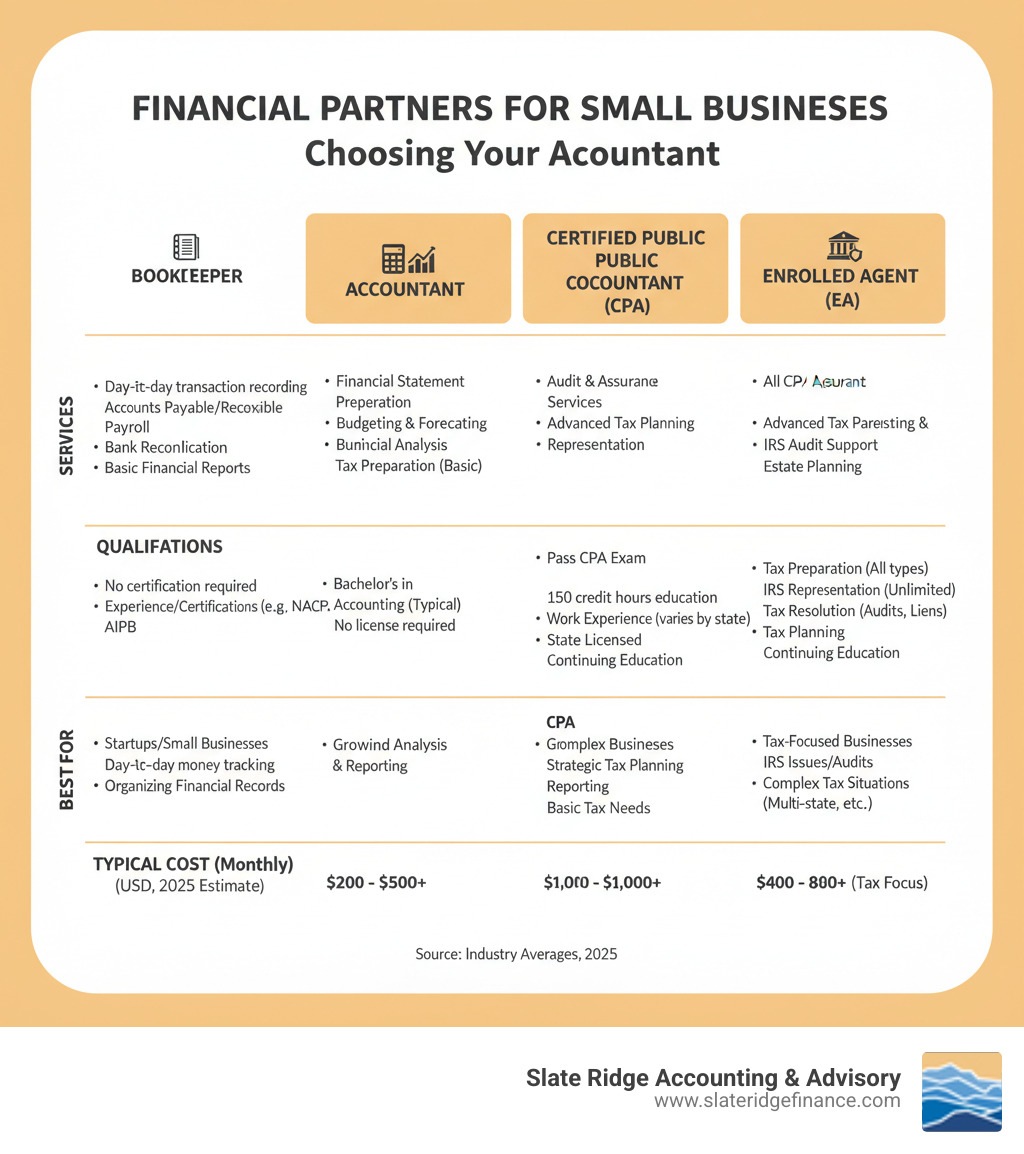
- Bookkeeper: Best for startups and sole proprietors needing basic transaction recording and bill pay ($30-70/month for software or $200-500/month for services)
- General Accountant: Ideal for established businesses requiring financial statements, budgeting, and basic financial advice ($60-175/hour)
- Certified Public Accountant (CPA): The gold standard for growing businesses needing tax strategy, audit support, IRS representation, and strategic financial planning ($175-400/hour)
- Enrolled Agent (EA): Tax specialists perfect for businesses with complex tax situations, multi-state operations, or IRS issues ($150-300/hour)
As a small business owner, you wear too many hats. If you're staring at spreadsheets at midnight or Googling "what's the difference between cash and accrual accounting," you're not alone.
Managing your business finances isn't just about IRS compliance. It's about having a financial co-pilot to spot opportunities, warn you of risks, and help you make smarter decisions. The right professional can save you money, help you grow faster, and give you back time to focus on your business.
But which type of accountant do you actually need? A bookkeeper, CPA, or Enrolled Agent? The alphabet soup of credentials and varying rates can be overwhelming.
The good news is that you don't need to figure this out alone. Understanding the key differences between these professionals will help you match your business needs with the right expertise—and avoid paying for services you don't need or skimping on the strategic guidance that could transform your business.
Understanding the Key Players: Who Does What?
To answer what type of accountant is best for a small business, you must understand the key players. The distinctions matter for your budget and for getting the right expertise. Just as you wouldn't hire a heart surgeon for a broken arm, different financial professionals serve different purposes. Let's meet the team:

Bookkeeper: The Foundation of Your Finances
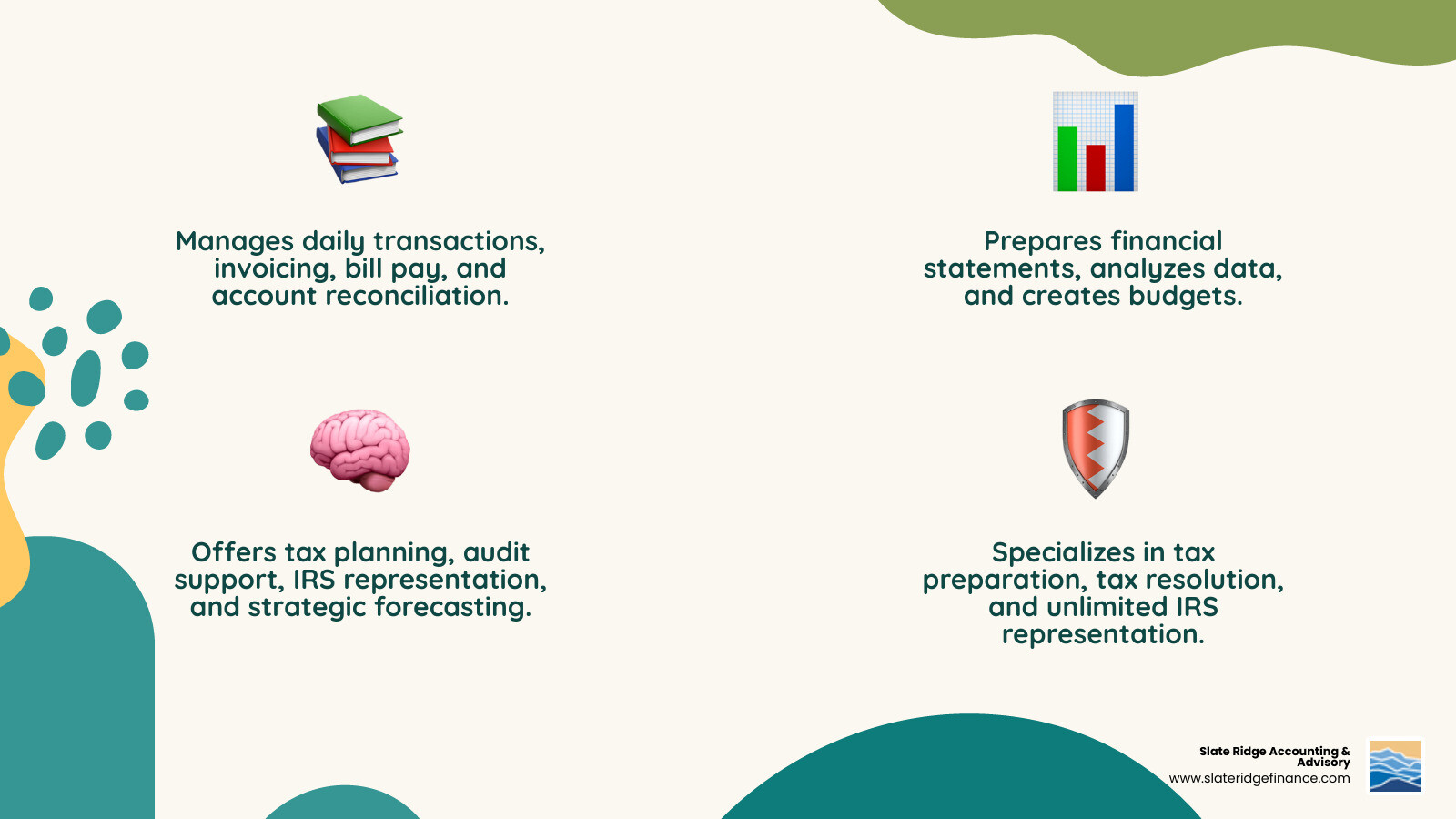
Your bookkeeper ensures every financial transaction is recorded accurately, tracking the daily flow of money from sales to bill payments. This is critical; without clean records, everything else falls apart. They handle inventory purchases, record revenue, send invoices, pay bills, and reconcile bank accounts to catch discrepancies early.
Here's something interesting: many times, the same person provides both bookkeeping services and accounting services, especially in smaller businesses. The line between these roles can blur, which is actually good news if you're just starting out.
At Slate Ridge, our Bookkeeping Service for Small Business covers all these essential daily tasks. We've seen too many businesses struggle because they underestimated the importance of accurate bookkeeping. In fact, we wrote about 3 Bookkeeping Myths That Could Be Costing You Money because these misconceptions can really hurt your bottom line.
General Accountant: The Analyst and Reporter
A general accountant takes the bookkeeper's raw data and transforms it into useful financial statements that tell your business's story. They prepare income statements, balance sheets, and cash flow statements. These reports are tools that show your profitability, cash flow, and overall business health.
Beyond just preparing reports, accountants help with budgeting and can offer basic financial advice. They'll spot trends in your numbers—like seasonal fluctuations or expense categories that are growing too fast. The key difference here is that general accountants don't need a specific license or certification. Many have accounting degrees, but there's no state exam or regulatory board overseeing them.
Our Financial Statement Preparation service helps you get those clear, accurate reports that banks want to see when you're applying for a loan or that you need when making big business decisions.
Certified Public Accountant (CPA): The Gold Standard Strategist
Now we're talking about the heavyweight champion of the accounting world. A Certified Public Accountant has earned their credentials through rigorous exams, specific education requirements, state licensing, and ongoing continuing education (usually around 40 hours every year).
This matters because CPAs can do things other accountants can't. They can sign audit reports, which is essential if you're seeking investors or working with certain lenders. They have unlimited rights to represent you before the IRS, which is huge if you ever face an audit. And they're trained in advanced tax planning strategies that can save you serious money.
A CPA isn't just recording transactions or preparing statements—they're thinking strategically about your entire financial picture. They're identifying tax deductions you didn't know existed, helping with Business Financial Forecasting to plan your growth, and advising you on major business decisions like whether to buy or lease equipment.
Yes, CPAs cost more. But for growing businesses with complexity, investors, or significant tax obligations, they're worth every penny. They're not just keeping you compliant—they're helping you build wealth.
Enrolled Agent (EA): The Tax Specialist
If CPAs are generalists who can do everything, Enrolled Agents are laser-focused specialists. An EA has earned their credential directly from the IRS by passing a comprehensive three-part exam covering every aspect of the tax code.
What makes EAs special is their unlimited representation rights before the IRS. They can represent any taxpayer, for any tax issue, before any IRS office. If you're facing an audit, dealing with back taxes, or navigating collections, an EA is your best friend.
EAs are perfect for businesses with complex tax situations—maybe you operate in multiple states, you're dealing with sales tax in different jurisdictions, or you have complicated deductions. They excel at tax preparation and tax resolution. While a CPA might offer broader business advisory services, an EA dives deep into the tax code.
The National Association of Enrolled Agents maintains a directory if you're looking for one of these tax specialists. For many small businesses, especially those without complicated business structures but with tricky tax situations, an EA offers the perfect balance of expertise and cost.
So what type of accountant is best for a small business? It depends entirely on where you are in your business journey and what challenges you're facing. Let's look at how to match your specific needs with the right professional.
What Type of Accountant Is Best for a Small Business?
Here's the truth: what type of accountant is best for a small business depends on your current stage. A startup's needs differ greatly from a business managing multi-state operations. Your size, complexity, industry, and growth stage all determine which professional offers the best return on investment. Let's break down what makes sense at different stages.
For Startups and Sole Proprietors
When you're starting out, your main concerns are tracking income and expenses, separating business and personal funds, and filing taxes correctly. For these foundational needs, a bookkeeper is often your best starting point. They can set up a simple system, handle invoicing, and keep transactions organized, providing a solid financial foundation. Searching for a "Bookkeeper Near Me" can connect you with local professionals.
Before you even hire anyone, though, it's worth understanding whether the IRS sees your venture as a legitimate business or just a hobby. The distinction matters for tax purposes, and the IRS has specific guidelines about whether Is your business a hobby? or a profit-seeking enterprise. Even if you're technically still in hobby territory, talking to an accountant early can help you structure things correctly from day one.
For tax filing, a general accountant can handle straightforward returns. But if you're self-employed with specific tax considerations—like home office deductions, vehicle expenses, or quarterly estimated payments—an Enrolled Agent might be worth the investment. They specialize in tax matters and can help you steer the unique challenges that come with self-employment income.
For Growing Businesses with Employees
Once you start hiring employees, your financial world gets significantly more complex. You're now dealing with payroll taxes, workers' compensation, benefits administration, and a whole new set of federal and state regulations. Our Payroll Management Services can help you steer these waters without getting overwhelmed.
Growing businesses also tend to need financing for expansion, whether that's a line of credit, equipment loans, or SBA funding. Lenders want to see solid financial reporting before they'll hand over money, and they need to trust that your numbers are accurate and professionally prepared. Our Small Business Financial Reporting Complete Guide walks through exactly what banks and lenders expect to see.
At this stage, a CPA becomes increasingly valuable. While a general accountant can prepare your financial statements, a CPA brings strategic tax planning to the table. They'll help you structure your business to minimize tax liability, identify every legitimate deduction, and plan ahead for quarterly payments so you're never caught off guard. They can also guide you through the transition from cash to accrual accounting if your business reaches that threshold.
Cash flow management becomes critical as you grow, and a CPA's strategic oversight helps you make informed decisions about when to expand, when to hold back, and how to keep money flowing smoothly through your business. Think of them as a strategic partner, not just someone who shows up at tax time.
For Complex or High-Growth Businesses
When your business reaches a certain level of sophistication, the question of what type of accountant is best for a small business with complex needs becomes mission-critical. Maybe you're operating in multiple states, each with different tax requirements. Perhaps you're preparing for an audit, managing relationships with investors, or exploring acquisition opportunities.
These scenarios demand the highest level of expertise. A dedicated CPA or specialized accounting firm is essential when you're dealing with multi-state operations, audit requirements, investor relations, or merger and acquisition advisory. They bring not just technical knowledge, but strategic insight that can literally save or make you millions of dollars.
Advanced financial forecasting becomes crucial at this level. You need to model different scenarios, stress-test your assumptions, and prepare for various growth trajectories. Our Financial Forecasting Services Complete Guide explains how sophisticated forecasting can transform your decision-making from reactive to proactive.
At this stage, your accountant isn't just keeping you compliant—they're actively driving business value. They're helping you structure deals, optimize your tax position across multiple jurisdictions, prepare for potential exits, and provide the financial intelligence that sophisticated investors expect to see. The right CPA becomes one of your most important strategic advisors, sitting alongside your attorney and business consultant as part of your core team.
Finding, Vetting, and Hiring Your Ideal Accountant
Once you've figured out which type of financial professional you need, it's time to actually find one. This isn't something you want to rush—after all, this person will have access to your most sensitive financial information and will play a crucial role in your business's success. Let's walk through how to find, evaluate, and ultimately choose your ideal accountant.

Where to Find a Reputable Accountant
Start with word-of-mouth recommendations from other business owners in your network, especially those in your industry. They can provide honest feedback and understand your specific challenges.
Beyond your personal network, professional organizations maintain directories that can help you find qualified professionals in your area. The AICPA online directory is the go-to resource for finding CPAs, while the IRS Directory of Preparers lists tax preparers who hold professional credentials recognized by the IRS, including Enrolled Agents. You can verify an Enrolled Agent's status directly on IRS.gov to ensure their credentials are current. State CPA societies also maintain directories and can help you find professionals with local expertise.
If you're looking for a firm led by women professionals, the AFWA website for women professionals provides a specialized directory. The National Association of Enrolled Agents is another excellent resource if you're specifically seeking tax expertise.
Before you commit to anyone, take a few minutes to check their history with the Better Business Bureau. And if they're preparing tax returns for compensation, make sure they have a Preparer Tax Identification Number (PTIN)—it's required by law.
Key Qualifications and Experience to Look For
Start by verifying their credentials. If someone claims to be a CPA, confirm it through state licensing boards or the AICPA directory. For Enrolled Agents, check the IRS Directory of Preparers. This sounds basic, but it's a critical step that too many people skip.
Industry-specific experience matters more than you might think. An accountant who works primarily with restaurants understands inventory accounting and tip reporting in ways that someone who mainly serves tech startups doesn't. They'll know the common pitfalls in your industry, the typical tax deductions you should be claiming, and the financial benchmarks you should be hitting. When you're interviewing potential accountants, ask about their experience with businesses like yours.
Technology proficiency isn't optional. Your accountant should be comfortable with cloud accounting platforms and modern collaboration tools. This isn't just about convenience—it's about getting real-time insights into your business instead of waiting until month-end to see where you stand. Ask what software they use and how they share information with clients.
Don't overlook communication skills. A brilliant accountant is useless if they can't explain complex concepts in understandable terms. During initial conversations, note if they use jargon or communicate clearly. As the Five ways small businesses can choose the right accounting firm notes, assessing communication style is crucial.
Finally, think about whether they take a proactive versus reactive approach. A reactive accountant processes your numbers and files your taxes. A proactive accountant looks for ways to optimize your tax strategy, spots potential cash flow problems before they become crises, and helps you think strategically about your business's financial future. One source we reviewed emphasized that a good accountant should "offer insights into processes that can help a business succeed and save money"—not just keep you compliant. During your conversations, ask what they'd do to help your business beyond the basics. Their answer will tell you a lot.
In-House Accountant vs. Outsourced Firm
One of the biggest decisions you'll face when determining what type of accountant is best for a small business is whether to hire someone in-house or work with an external firm. Both options have their place, but the right choice depends on your specific situation.
Let's talk about cost first, because that's usually top of mind. If you hire a staff accountant, you're looking at a median salary of $77,200 per year (or $37.14 per hour), according to the United States Bureau of Labor Statistics. But that's not the whole picture—you'll also pay for benefits, payroll taxes, office space, and equipment. When you work with an accounting firm or independent accountant, you'll typically pay between $60 and $400 per hour, with an average of $175 per hour. At first glance, the hourly rate might seem high, but you're only paying for the time you actually need.
Access to specialized expertise is where external firms really shine. When you hire one in-house accountant, you get their particular skill set. When you work with a firm, you get access to an entire team with diverse specializations—someone who excels at tax strategy, someone who's great at financial forecasting, someone who handles complex compliance issues. Our Virtual Accounting services are built around this model, giving you specialized expertise custom to your specific needs without the commitment of multiple full-time salaries.
Scalability is another major advantage of outsourcing. Your financial needs aren't constant—they ebb and flow with your business cycles and growth stages. An external firm can scale up during tax season or when you're preparing for a loan application, then scale back during quieter periods. An in-house employee represents a fixed cost whether you need 40 hours of accounting work that week or 10.
That said, an in-house accountant can be valuable for managing daily transactions and treasury functions if your business has reached a certain size. But even then, many businesses find the sweet spot is combining basic in-house bookkeeping with external strategic advisory services. This hybrid approach lets you handle the day-to-day while still getting high-level analysis and strategic advice from experienced professionals. Many of our clients have finded that Remote Accounting Solutions give them the best of both worlds—consistent support without the overhead of an additional employee.
For most small businesses, especially those just starting to grow, outsourcing provides more flexibility, broader expertise, and better value. You get to focus on what you do best—running your business—while leaving the financial complexity to professionals who do this every day.
Maximizing the Value of Your Accountant
Here's the thing about hiring an accountant: they're not just there to keep the IRS off your back. The right financial professional becomes a genuine strategic partner who helps you spot opportunities, avoid costly mistakes, and build something bigger than you could manage alone.
Budgeting for Accounting Services
Let's talk about the elephant in the room: cost. How much will it cost? Most small businesses spend between $1,000 and $5,000 annually on accounting services, though this varies widely based on your needs and business complexity.
You'll typically encounter two pricing structures. Hourly rates range from $60 to $400 per hour, with CPAs generally commanding higher fees than bookkeepers or general accountants. Alternatively, many firms offer monthly retainers that bundle services into predictable packages. Our Monthly Accounting Packages are designed exactly for this purpose—giving you consistent support without surprise bills.
Here's how we think about it: a skilled accountant should save your business more money than they cost. Through strategic tax planning, catching errors before they become expensive problems, and helping you make smarter financial decisions, the right professional pays for themselves. It's not an expense—it's an investment in your business's financial health and future growth.
Leveraging Your Accountant for Business Growth
Once you've found the right accountant, don't just hand them a shoebox of receipts and call it a day. The best financial relationships go far beyond basic compliance.
Strategic tax planning is where many accountants truly earn their keep. They can help structure your business operations to minimize tax liability while staying completely within the law. A good accountant knows which expenses qualify as ordinary and necessary expenses and can identify deductions you didn't even know existed. They're thinking ahead to next year's tax return while you're still focused on this quarter's sales.
Your accountant should also help with financial process optimization. Are you spending hours each month on tasks that could be automated? Is your invoicing system creating cash flow problems? Our Financial Process Optimization services tackle exactly these issues, streamlining workflows so you can focus on what you do best.
KPI tracking might sound like corporate jargon, but it's actually pretty simple: knowing which numbers matter most to your business and watching them closely. Your accountant can help identify these key performance indicators and create systems to track them effectively. Understanding How to Track KPIs transforms vague feelings about business performance into concrete data you can act on.
When it comes time to secure financing—whether you're applying for a business loan or talking to potential investors—your accountant becomes invaluable. Lenders and investors want professional, accurate financial statements and realistic projections. Your accountant can prepare these documents in a way that presents your business in the best possible light while remaining completely honest. This expertise is a cornerstone of effective Business Growth Strategies.
The Role of Technology and Software
Modern accounting has been transformed by technology, and that's mostly good news for small business owners. Cloud accounting has changed the game completely, allowing you and your accountant to access your financial data from anywhere, at any time. Our Cloud Accounting Services leverage this flexibility to provide seamless support no matter where you're located.
Automation handles the tedious stuff—data entry, bank reconciliations, invoice generation—freeing your accountant to focus on the strategic thinking that actually moves your business forward. Real-time data means you're never working with outdated information, and collaboration tools make it easy to share documents, ask questions, and get answers quickly. We specialize in helping businesses choose and implement the right Online Accounting Software Small Business solutions for their specific needs.
But here's what's important to understand: technology doesn't replace your accountant. It amplifies their expertise. Software can crunch numbers and generate reports, but it can't interpret what those numbers mean for your business. It can't advise you on whether now is the right time to hire another employee or expand to a new location. It can't represent you before the IRS or help you steer a complex tax situation.
The sweet spot is where technology meets human expertise. At Slate Ridge Accounting & Advisory, we combine cutting-edge accounting software with personalized, industry-custom guidance. The technology handles the routine tasks efficiently, while our team provides the strategic insights, proactive advice, and genuine partnership that help your business thrive. That's what determining what type of accountant is best for a small business ultimately comes down to: finding a partner who uses modern tools to deliver old-fashioned, personalized service.
Conclusion: Investing in Your Financial Future
You've made it through the alphabet soup of financial professionals, and hopefully, the answer to what type of accountant is best for a small business feels a lot clearer now. Whether you need a bookkeeper to establish your financial foundation, a general accountant to analyze your numbers, a CPA to guide your strategic growth, or an Enrolled Agent to steer complex tax situations, the right choice depends entirely on where your business is today and where you want it to go tomorrow.
Here's what matters most: your accountant shouldn't just be someone who crunches numbers once a year at tax time. They should be a trusted advisor who knows your business inside and out, someone who can spot opportunities you might miss and warn you about risks before they become problems. Think of them as your financial co-pilot, helping you steer the sometimes turbulent skies of small business ownership.
The investment you make in the right financial professional pays dividends far beyond their fees. You'll sleep better knowing your books are accurate and your taxes are optimized. You'll make smarter decisions based on real financial data instead of gut feelings. And you'll free up precious time to focus on what you do best—running and growing your business.
At Slate Ridge Accounting & Advisory, we've built our practice around being exactly that kind of strategic partner. We don't believe in one-size-fits-all solutions or cookie-cutter approaches. Instead, we provide modern, personalized, and industry-custom financial solutions designed specifically for your North Carolina business. Whether you need virtual bookkeeping to get your foundation solid, financial clean-up to untangle past messes, or advisory services to plan your next phase of growth, we're here to help you track the KPIs that matter and forecast with confidence.
Your business deserves more than just compliance—it deserves a financial partner who's invested in your success. Ready to find out what that partnership could look like? Get expert virtual accounting services to grow your business with Slate Ridge Accounting & Advisory. Let's build your financial future together.
Ready to get started?
Book a free consultation today and let’s explore how Slate Ridge can support your business with expert accounting that’s accurate, timely, and built around your goals.
You Might Also Like
A few more posts we think you’ll enjoy on topics that matter to business owners like you.