

What Growth Strategy Consulting Actually Is (And Why It Matters)
Growth strategy consulting is a specialized form of business advisory that helps companies identify where demand is moving, design a clear plan to capture it, and execute that plan in a way that builds lasting, profitable growth — not just short-term revenue spikes.
Here's a quick breakdown of what it covers:
- What it is: Expert guidance on where to grow, how to compete, and how to fund and execute that growth
- Who it's for: CEOs, founders, and strategy leaders who need an outside perspective to cut through complexity
- What it delivers: A prioritized growth roadmap tied to real market data, customer insights, and financial targets
- How it differs from general consulting: It focuses specifically on revenue acceleration, market expansion, and commercial model design — not just operational efficiency
- Why it works: 71% of the fastest-growing businesses have a documented growth strategy in place, and companies with written growth plans grow 30% faster than those without
The core idea is simple: growth isn't a target you set — it's a thesis you build. The best companies have a clear hypothesis about where demand is heading, and they build their business to meet it before competitors do.
But here's where most businesses get stuck. They chase growth by expanding products, cutting prices, or entering new markets — without a clear plan. That leads to eroded margins, wasted resources, and strategies that get board approval in Q1 and quietly die by Q3.
That's exactly the problem growth strategy consulting is designed to solve.
As Caroline and Joe at Slate Ridge Accounting & Advisory, we've seen how the financial side of growth — forecasting, cash flow, pricing, and KPI tracking — is often the missing link between a great strategy and real results.
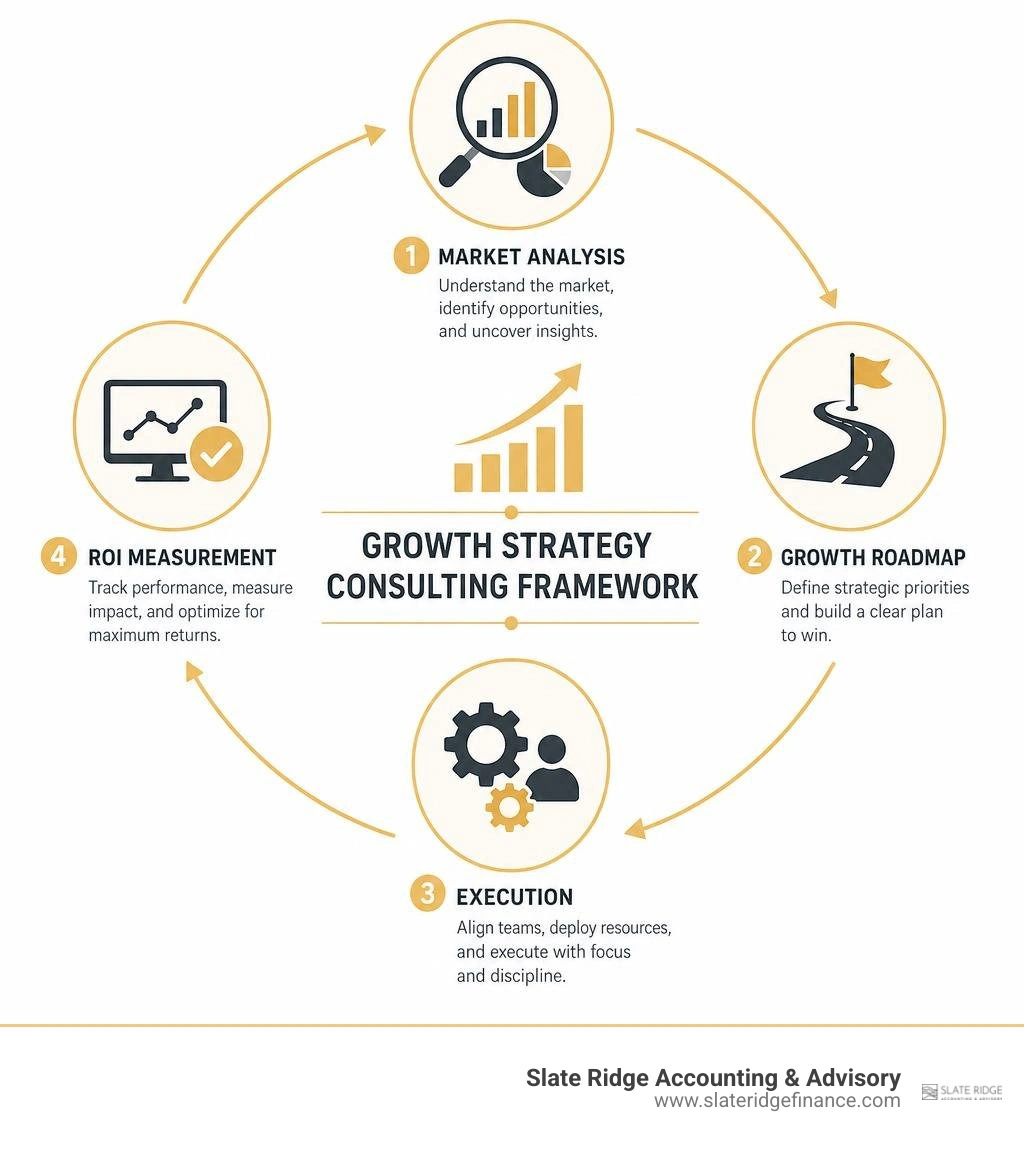
Growth strategy consulting vocabulary:
What is Growth Strategy Consulting?
At its core, growth strategy consulting is the art and science of helping a business expand its top and bottom lines. While general management consulting might focus on restructuring HR departments or streamlining supply chains, growth strategy consultants are laser-focused on market opportunity, customer acquisition, and capital deployment.
Think of it this way: if general management consulting is about making the engine run smoother, growth strategy consulting is about steering the car onto a faster, more profitable highway.
For businesses across North Carolina—from the bustling tech hubs of Raleigh and Charlotte to the growing local enterprises in Asheville, Wilmington, and Hickory—this means answering the hard questions:
- Which new customer segments should we target?
- Are we pricing our products based on the actual value we deliver, or are we leaving money on the table?
- Should we expand organically by building new capabilities, or inorganically through acquisitions?
By partnering with experts who specialize in business growth strategies, leaders can transition from defensive, reactive decision-making to offensive, proactive market-shaping.
Corporate Strategy vs. Growth Strategy Consulting
It is easy to confuse corporate strategy with growth strategy, but they serve fundamentally different purposes in capital deployment and value creation.
- Corporate Strategy is primarily about capital allocation across a portfolio. It answers the question: "How do we distribute our resources, cash, and attention among our various business units?" It is high-level, portfolio-focused, and often structural.
- Growth Strategy Consulting is about capital deployment to drive revenue acceleration and market positioning. It answers the question: "How do we make this specific business unit grow faster and more profitably?"
While corporate strategy might decide to acquire a new company, growth strategy designs the commercial engine, optimizes the pricing architecture, and shapes the go-to-market (GTM) system to ensure that acquisition actually pays off. It bridges the gap between high-level investment theses and the ground-level reality of customer demand. To dive deeper into how these elements align financially, explore our guide on financial growth strategies.
Why Growth Strategy Consulting is Essential in 2026
We are living in a business climate defined by rapid shifts. As of July 2026, market complexity has expanded faster than most internal strategy teams can absorb. Traditional playbooks no longer work because:
- Digital Disruption and AI Multipliers: Technology is blurring traditional industry boundaries. Companies that once only sold physical products are now orchestrating digital ecosystems.
- Organic Optimization Limits: Many businesses have squeezed all the efficiency they can out of their existing operations. Cost-cutting has hit a ceiling; the only way forward is genuine revenue expansion.
- Economic and Geopolitical Uncertainty: Shifting interest rates, regional supply chain changes, and localized market dynamics mean businesses must remain incredibly agile.
When market dynamics shift this quickly, relying solely on internal perspectives can lead to strategic blind spots. An outside growth consultant brings cross-industry insights, specialized data tools, and an objective lens. They help you challenge organizational habits and provide the expert financial advice required to make bold, calculated moves without risking your core business.
Key Components of a Sustainable Growth Strategy
A successful growth strategy is not a single, massive gamble. It is a balanced, working system of interlinked components. To ensure your business compounds value over decades rather than burning out after a temporary spike, your strategy must master three core areas:
- Market Segmentation: Moving away from broad demographics to target high-margin "demand spaces"—specific customer needs and occasions where your business has a clear "right to win."
- Customer Retention & Lifetime Value (LTV): Scaling is incredibly expensive if you are constantly replacing churning customers. Sustainable growth prioritizes customer experience (CX) and retention to maximize lifetime value.
- Value-Based Pricing: Pricing is the most powerful lever for profitability. Yet, research shows most companies leave 5% to 15% of their revenue on the table due to pricing under-investment. A strong growth strategy aligns your pricing architecture directly with your customers' willingness to pay.
To visualize how these strategies manifest, let's look at the two primary paths to expansion:
Organic vs. Inorganic Growth Paths
Choosing how to scale is one of the most critical decisions a leadership team will make. Here is how organic and inorganic growth compare:
| Dimension | Organic Growth | Inorganic Growth |
|---|---|---|
| Primary Mechanism | Internal capabilities, product innovation, GTM optimization, and geographic expansion. | Mergers and acquisitions (M&A), joint ventures, and strategic partnerships. |
| Speed to Market | Slower, requiring systematic building and scaling of internal resources. | Rapid, allowing instant access to new markets, products, or customer bases. |
| Control & Integration | High control; built directly into the existing company culture and operating model. | Complex; requires significant effort to integrate systems, cultures, and processes. |
| Capital Requirement | Typically funded through operational cash flow, making it lower-risk but slower. | Requires substantial upfront capital, debt, or equity dilution. |
| When to Choose | When you have strong core capabilities and want sustainable, highly controllable expansion. | When speed is critical, or when entering a market with high barriers to entry. |
For early-stage enterprises, navigating this choice requires a solid foundation. Utilizing specialized advisory services for startups can help ensure your capital is funneled into the path that yields the highest return on investment.
Balancing Scale with Profitability
There is a dangerous trap in the business world: chasing scale at the expense of profitability. We have all seen the cautionary tales of companies that expand rapidly by slashing prices or spending aggressively on customer acquisition, only to watch their margins collapse.
True growth is about profitable growth—increasing your bottom line, not just your top-line revenue or customer count.
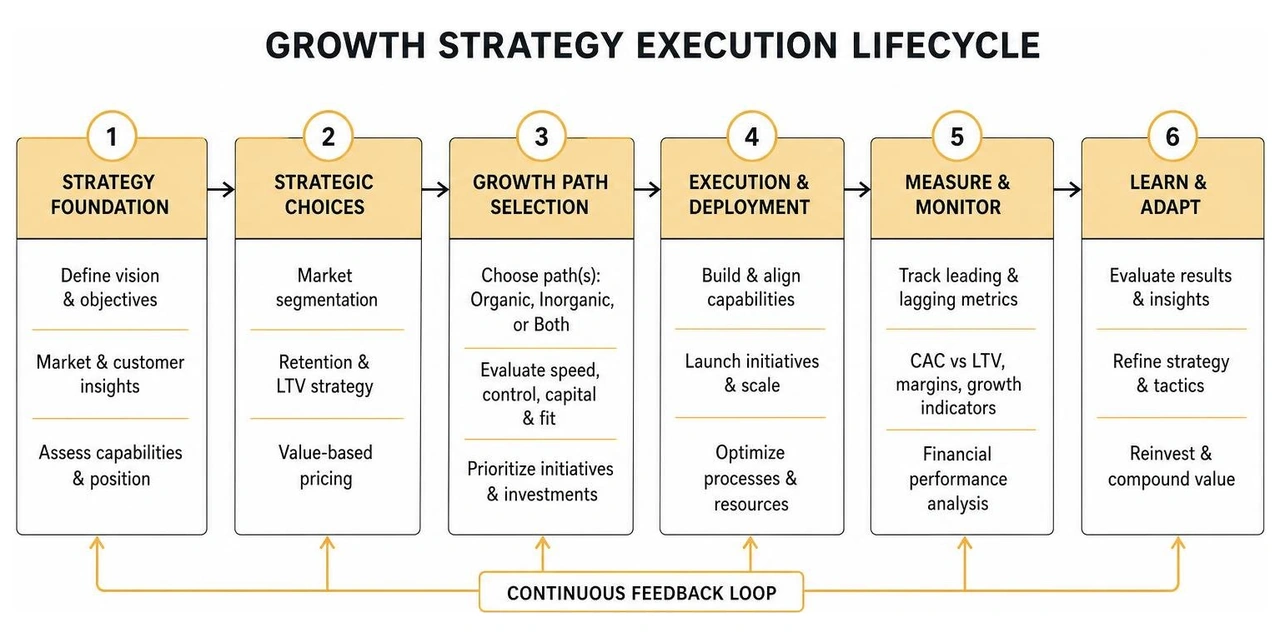
To keep your expansion healthy, you must balance scale with margin preservation. This is where a rigorous financial performance analysis becomes indispensable. By tracking metrics like Customer Acquisition Cost (CAC) relative to Customer Lifetime Value (LTV), gross margin percentages, and contribution margins by product line, you can ensure you aren't "buying" unprofitable revenue.
Sometimes, the smartest strategic move is actually to shrink to an advantaged core—improving returns on your most profitable offerings—before attempting to scale outward.
How Consultants Identify and Execute Growth Opportunities

How do growth strategy consultants actually find the hidden pockets of opportunity in your market? They don't guess, and they don't rely on generic templates. Instead, they use a demand-first strategy rather than a model-first strategy.
- Model-first strategy starts with the company's existing portfolio and looks for minor, incremental extensions. (e.g., "We make blue widgets, let's make red widgets.")
- Demand-first strategy starts by looking at where market demand is moving, identifying unmet customer needs, and then designing or adapting the business to meet those needs.
By analyzing changing customer priorities, mapping competitive landscapes, and identifying emerging profit pools, consultants help you place strategic bets with a high probability of success.
The Role of Data, Customer Insights, and Market Analysis
Modern growth strategy consulting is deeply data-driven. Consultants leverage advanced analytics to scan both public and proprietary data, mining unstructured web sources, transaction history, and customer feedback to find non-obvious insights.
For instance, by clustering geographic data and analyzing store-level performance, a consumer brand might discover hidden market share opportunities in specific North Carolina city clusters that their competitors are overlooking.
This level of precision is made possible through systematic business performance tracking. By translating customer experience (CX) insights into quantitative metrics, businesses can predict which product features, marketing campaigns, or pricing models will yield the highest return.
Navigating Challenging Market Conditions and Downturns
When the economy tightens, many businesses default to a defensive crouch: they freeze hiring, slash marketing budgets, and pause all growth initiatives.
However, economic downturns actually present unique opportunities to capture market share. Growth strategy consultants help businesses navigate these periods by focusing on resilience and double-down strategies:
- Protect the Core: Identify your most profitable, loyal customer segments and defend them fiercely.
- Optimize Pricing: Instead of slashing prices (which erodes brand value and margins), use value-based pricing adjustments or bundle services to protect profitability.
- Targeted Cost Optimization: Implement smart cost reduction strategies to eliminate waste, freeing up capital to reinvest in high-ROI growth channels.
- Acquisition of Distressed Assets: For cash-rich companies, downturns are the perfect time to acquire competitors, technology, or talent at a discount.
Overcoming the Strategy Execution Gap
The sad truth of corporate life is that 50% to 60% of strategies fail to deliver on their promises. This is known as the strategy execution gap.
Strategies rarely fail because the slide deck wasn't pretty enough. They fail because they are:
- Decoupled from operating reality: Assuming the organization has capabilities, talent, or technology that simply do not exist.
- Decoupled from the budget: Failing to properly fund the new initiatives, expecting teams to execute a new strategy on a legacy operational budget.
- Decoupled from accountability: Creating a beautiful plan, but leaving it without a specific leader who is personally on the hook for the numbers.

Typical Engagement Models and Measuring ROI
To bridge the execution gap, growth strategy consulting has evolved beyond the traditional "hand over a 100-page deck and wave goodbye" model. Today, engagements are structured to drive fast traction and measurable outcomes:
- Strategy Sprints: High-intensity, 8-to-12-week engagements designed to diagnose a specific bottleneck, optimize a pricing model, or build a beachhead strategy for a new market.
- Fractional Leadership & Co-Delivery: Consultants embed themselves directly into your leadership team as fractional operators (CFOs, CMOs, COOs). They work alongside your staff to implement the strategy in real time.
- Outcome-Based Retainers: Aligning consulting fees directly with the performance of the strategy, measured through clear KPIs.
To ensure your investment is paying off, you must track outcome-focused metrics. Setting up a dedicated KPI dashboard setup allows you to monitor revenue acceleration, margin expansion, and customer acquisition costs in real time, turning abstract strategic goals into daily operational targets.
Building Internal Capabilities for Long-Term Success
The ultimate goal of any consulting engagement should be to make the consultants obsolete. A top-tier firm doesn't just deliver a plan; they build a capability foundation within your business.
Through a co-delivery model, your internal teams work side-by-side with external experts, learning how to conduct demand space mapping, run pricing experiments, and analyze customer feedback. This systematic knowledge transfer ensures that when the engagement ends, your team has the skills, tools, and processes to sustain and iterate on that growth.
Learning how to track KPIs and maintain financial models internally is what transforms a one-time growth spurt into a permanent culture of compounding success.
Selecting the Right Growth Strategy Consulting Partner
Choosing a growth partner is a major decision. If you hire a firm that relies on rigid, standardized templates, you will likely end up with a strategy that doesn't fit your local market or operational reality.
Instead, look for partners who emphasize cross-functional integration—understanding how your brand, product, finance, and go-to-market systems must interact to drive compounding growth.
What CEOs and Strategy Leaders Should Look For
When evaluating potential growth strategy consulting partners, look beyond the brand name on the presentation. Here is a checklist of critical criteria:
- Operator Experience: Have the consultants actually run businesses, scaled startups, or managed P&Ls themselves? Or are they career theorists who have only ever built slide decks?
- Financial and Analytical Rigor: Do they ground their recommendations in hard numbers, cash flow forecasting, and margin analysis?
- Customization vs. Templates: Do they take the time to understand your unique competitive advantages, or are they forcing your business into a pre-packaged framework?
- Post-Delivery Support: Do they offer embedded execution support, or do they exit the moment the planning phase is complete?
- Local Market Context: If you are a North Carolina business, do they understand the regional economic landscape, talent pools, and regulatory environment of areas like Charlotte, Raleigh-Durham, or Greensboro?
Emerging Trends: AI, Platforms, and Ecosystems
As we navigate 2026, the strategic landscape is being reshaped by several emerging trends that any forward-thinking growth partner must master:
- Platform Economics & Interaction Fields: Shifting from traditional linear supply chains to orchestrating networks of users, partners, and producers.
- AI as an Operational Multiplier: Deploying agentic AI tools and machine learning not just to cut costs, but to hyper-personalize customer experiences and identify non-obvious market opportunities.
- Ecosystem Strategy: Creating strategic alliances that allow your business to capture value across adjacent industries, turning your product into a hub for customer activity.
Frequently Asked Questions about Growth Strategy
What is the difference between organic and inorganic growth?
Organic growth is achieved internally by optimizing existing operations, launching new products, or expanding your customer base. Inorganic growth is driven externally through mergers, acquisitions, joint ventures, or strategic partnerships to rapidly acquire market share.
Why do so many growth strategies fail during execution?
Most growth strategies fail because they are decoupled from the company's actual operating capabilities, lack dedicated budget funding, or do not establish clear, individual accountability for delivering the strategic targets.
How do you measure the ROI of a growth strategy consulting engagement?
ROI should be measured using specific, outcome-based KPIs defined before the project begins. These typically include top-line revenue acceleration, gross and net margin expansion, improvements in Customer Lifetime Value (LTV), and faster executive decision-making cycles.
Conclusion
A successful growth strategy is not built on guesswork, and it certainly isn't built on a static PowerPoint deck that sits in a drawer. It is a dynamic, working system that requires a deep understanding of your customers, a clear view of where market demand is moving, and—most importantly—absolute financial clarity.
Without clean books, real-time KPI tracking, and precise financial forecasting, even the most brilliant growth strategy can run aground on cash flow constraints or eroded margins.
At Slate Ridge Accounting & Advisory, we help businesses across North Carolina—from Asheville to Wilmington—build the financial foundation necessary to support bold, sustainable expansion. Whether you need virtual bookkeeping to clean up your historical data, real-time KPI dashboards to monitor your progress, or forward-looking financial forecasting to plan your next big move, we are here to help you grow with confidence.
Ready to turn your strategic ambitions into profitable reality? Get started with virtual accounting services today, and let's build a growth engine that compounds for years to come.
Ready to get started?
Book a free consultation today and let’s explore how Slate Ridge can support your business with expert accounting that’s accurate, timely, and built around your goals.
You Might Also Like
A few more posts we think you’ll enjoy on topics that matter to business owners like you.