

Choose an Accountant Who Supports Growth All Year
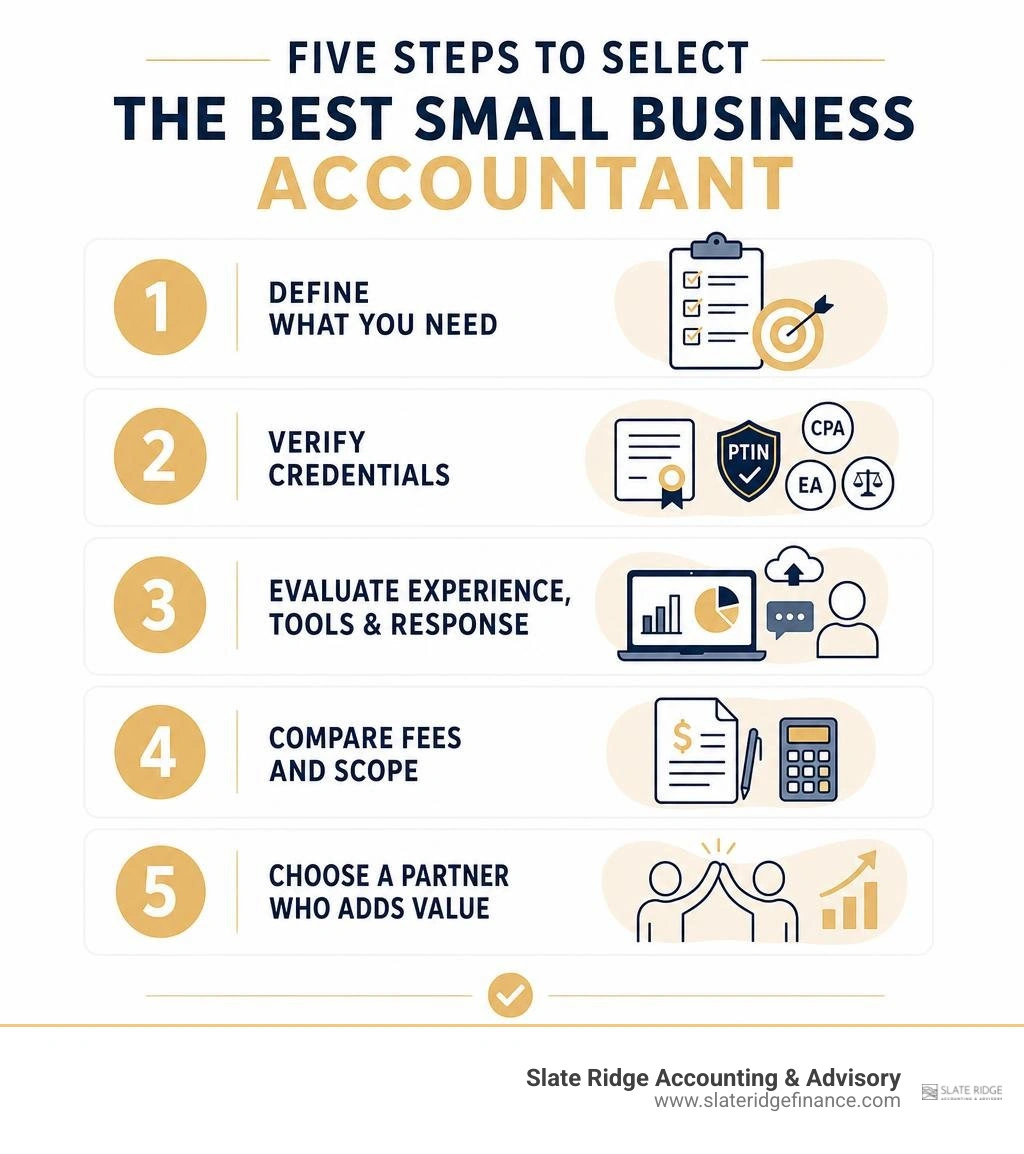
The best accountants for small business do more than file a return in spring. Look for a qualified professional who understands your industry, keeps your books and tax plan on track year-round, explains numbers clearly, and can help with cash flow, payroll, compliance, and growth decisions.
Use this quick checklist before you hire:
- Define what you need: tax planning, bookkeeping, payroll, forecasting, or all of the above.
- Verify credentials, including an IRS PTIN and, when relevant, CPA, Enrolled Agent, or attorney licensing.
- Ask about industry experience, cloud accounting tools, audit support, and response times.
- Compare fees and scope in writing. Small-business tax services may use flat fees, hourly billing, or an annual retainer.
- Choose a partner who offers proactive advice, not just tax-season data entry.
A strong accountant can help you spot deductible costs, plan estimated taxes, and make cleaner financial decisions before a problem becomes expensive. Caroline and Joe at Slate Ridge Accounting & Advisory help business owners turn financial records into practical insight for the next stage of growth.
Glossary for best accountants for small business:
- small business accounting advice
- what type of accountant is best for a small business
- best accounting firm for small business
What Services Small-Business Tax Advisors and Accountants Provide
Many entrepreneurs start out wearing every hat in their company, including the green visor of a self-taught bookkeeper. However, as transactions multiply, regulations evolve, and operational demands expand, basic DIY recordkeeping becomes a liability. A certified small-business tax advisor provides much more than a routine calculation of what you owe the government. They serve as a strategic co-pilot, ensuring complete financial oversight, identifying operational efficiencies, and protecting your entity against costly compliance penalties.
Small-business accountants evaluate how every dollar moves through your organization. They analyze entity structures—helping you understand when transitioning from an LLC to an S-Corporation makes financial sense—and establish real-time compliance monitoring across local, state, and federal jurisdictions. By examining your core operations, a dedicated financial professional spots hidden tax deductions, prevents cash flow bottlenecks, and helps you make calculated hiring or purchasing investments.
Strategic Tax Planning and Year-Round Compliance
The traditional model of dropping off a shoebox of crumpled receipts every March is dead. Waiting until tax season to review your financial performance leaves zero room for strategy. Once December 31 passes, most opportunities to lower your tax liability evaporate.
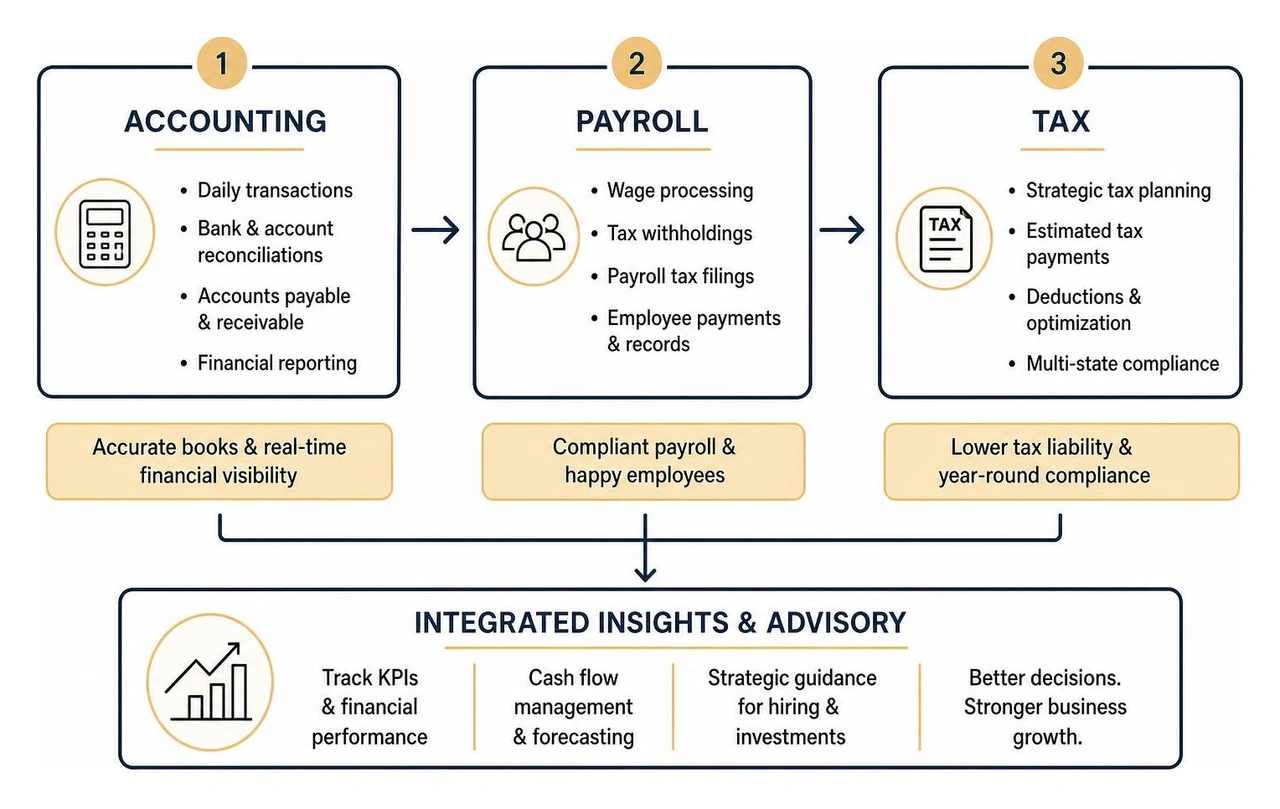
True tax advisory is an active, 365-day engagement. We focus heavily on tax minimization strategies that keep your capital inside your enterprise. This includes:
- Calculating accurate quarterly estimated tax payments to prevent costly IRS underpayment penalties.
- Structuring owner compensation, shareholder distributions, and retirement contributions for maximum tax efficiency.
- Optimizing depreciation schedules for equipment, vehicles, and real property.
- Tracking multistate sales tax nexus obligations so that selling across state lines does not trigger unexpected state audits.
Advisors who rely on a modern cloud accounting services guide ensure that your financial data synchronizes seamlessly with current tax legislation, giving you complete clarity throughout the year.
Bookkeeping, Payroll, and Cash Flow Advisory
Clean books are the foundation of accurate tax returns and smart management decisions. When bookkeeping is neglected, profit and loss statements turn into works of fiction, making it impossible to evaluate your company's actual health.
An experienced firm handles daily reconciliations, accounts payable and receivable, and comprehensive accounting and payroll services for small business. By automating wage distribution, payroll tax withholdings, and mandatory quarterly filings, you eliminate one of the single largest sources of administrative headaches.
Beyond basic recordkeeping, forward-thinking advisors help you track core Key Performance Indicators (KPIs) like customer acquisition cost, gross margins, and burn rate. Pairing monthly financial hygiene with structured financial forecasting and planning allows you to model revenue projections, stress-test your cash reserves, and navigate volatile market conditions with confidence.
Types of Small-Business Tax Advisors and Credentials
Not every financial professional carries the same qualifications, licenses, or legal representation rights. Understanding the alphabet soup of credentials ensures you hire an advisor whose capabilities match your operational scale and legal needs.
At a minimum, anyone who prepares federal tax returns for compensation must possess an IRS Preparer Tax Identification Number (PTIN). However, a PTIN is simply an identification number, not a guarantee of expertise or advanced training. When evaluating prospective candidates, you will primarily encounter three specialized categories of professionals.
Certified Public Accountants and Tax Attorneys
Certified Public Accountants (CPAs) are licensed by state regulatory boards after completing rigorous accounting curricula, passing a demanding four-part uniform examination, and satisfying extensive direct experience requirements. CPAs must adhere to strict continuing education standards and ethical codes. They possess unlimited representation rights before the IRS, meaning they can advocate on your behalf during audits, payment inquiries, and formal appeals. Beyond tax preparation, CPAs excel at financial statement audits, holistic business advisory, and internal control structuring.
You can easily verify a CPA's active license, disciplinary record, and standing using the national CPA Verify online database or your specific state's accountancy board portal.
Tax Attorneys are licensed legal specialists who have completed law school, passed a state bar examination, and focused their legal practice on taxation law. While they generally command higher rates, tax attorneys are invaluable for complex legal disputes, corporate restructuring, high-stakes IRS litigation, and intricate partnership agreements where attorney-client privilege is essential.
Enrolled Agents and PTIN-Certified Preparers
Enrolled Agents (EAs) hold the highest credential awarded directly by the Internal Revenue Service. Unlike CPAs who are regulated at the state level, EAs earn federal authorization. To obtain this credential, an advisor must either pass a comprehensive, three-part Special Enrollment Examination covering individual, business, and representation taxation, or have completed at least five consecutive years of full-time employment at the IRS in a role applying and interpreting tax code.

Like CPAs and attorneys, Enrolled Agents maintain unlimited representation rights before all administrative levels of the IRS. They are dedicated tax specialists whose technical knowledge makes them ideal partners for tax preparation, proactive tax mitigation, and IRS controversy resolution.
You can verify an Enrolled Agent's credentials by searching the official IRS Directory of Federal Tax Return Preparers with Credentials and Select Qualifications, which allows business owners to search by location, name, and specific license category.
How to Select the Best Accountants for Small Business
Selecting an accountant is one of the most critical vendor decisions your business will make. You are not just hiring someone to balance ledgers; you are inviting an advisor into the deepest operational mechanics of your enterprise.

Vetting Steps to Find the Best Accountants for Small Business
Finding a reliable partner requires a methodical vetting process rather than choosing the first name that appears on an internet search.
- Evaluate Your Internal Needs: Outline whether you require simple tax return filing, cleanup of messy historical books, ongoing payroll management, or strategic virtual CFO advisory.
- Search Verified Directories: Check the IRS database, the American Institute of CPAs (AICPA) directory, and the National Association of Enrolled Agents (NAEA) roster.
- Check Regional Directories and Community Reputation: Review established regional networks, check Better Business Bureau listings, and evaluate trusted business directories, such as local North Carolina accounting options and regional tax specialists who understand local tax nuances.
- Solicit Peer Referrals: Talk to other business founders in your industry to learn who manages their books and how responsive those providers are during crunch periods.
- Confirm Credentials and Disciplinary History: Always check the CPA Verify directory or state licensing boards to verify that your prospective candidate holds an active, unblemished license.
Key Questions to Ask the Best Accountants for Small Business
When scheduling discovery calls with shortlisted firms, treat the conversation like an executive interview. Use these essential questions to test their operational alignment:
- What experience do you have in my specific industry? (Every sector—from SaaS to construction—carries unique tax credits, depreciation schedules, and revenue recognition rules.)
- What accounting tech stack do you use? (Ensure they leverage modern cloud platforms like QuickBooks Online or Xero rather than outdated desktop software.)
- Are you available year-round, or do you scale back significantly after April? (A tax advisor who goes dark for seven months of the year cannot help you navigate dynamic business decisions.)
- How will you represent my business if we are audited by the IRS or a state Department of Revenue? (Confirm whether audit defense is included in their scope or billed separately.)
- What is your primary communication cadence and expected response time? (Establish clear boundaries regarding monthly reviews, quarterly check-ins, and emergency inquiries.)
- Can you provide references from current clients with businesses of similar size and complexity?
Typical Costs and Fee Structures for Small-Business Accountants
Understanding typical fee structures helps you budget effectively and select an engagement model that matches your transaction volume and advisory requirements. Small-business accounting pricing generally falls into three models: flat fees, hourly billing, or comprehensive monthly/annual retainers.
| Fee Structure | Typical Cost Range | Best Suited For | Key Advantages |
|---|---|---|---|
| Flat Fee | $500 – $5,000 per project | Annual tax return filing, single entity formations, or initial historical cleanups | Predictable cost; defined project milestones without surprise overages |
| Hourly Rate | $150 – $500 per hour | Ad-hoc tax consultations, audit defense, or specialized forensic accounting | Pay strictly for time used; flexible for unpredictable, short-term needs |
| Annual / Monthly Retainer | $1,000 – $10,000+ per year (or $250 – $1,500+/mo) | Integrated bookkeeping, payroll, monthly reporting, and year-round tax advisory | Continuous support, proactive tax minimization, and smooth cash flow budgeting |
Pricing varies based on your operational complexity. An e-commerce business processing thousands of micro-transactions across twenty states requires a different level of bookkeeping infrastructure than a boutique consultancy with five monthly invoices. When reviewing pricing proposals, always demand a clear written scope of work outlining deliverable deadlines, included software subscriptions, and additional rates for out-of-scope requests.
Frequently Asked Questions About Small-Business Accountants
What is the difference between a CPA and an Enrolled Agent?
The primary difference lies in their licensing authority and scope of practice. CPAs are licensed at the state level by state accountancy boards; their training spans auditing, broad financial analysis, business law, and general accounting in addition to tax code. Enrolled Agents are licensed federally by the U.S. Department of the Treasury and specialize almost exclusively in taxation and tax representation. Both have unlimited representation rights before the IRS.
How much should a small business expect to pay an accountant?
Costs vary based on business size, transaction volume, and the scope of work. Basic annual tax return filing typically costs between $500 and $2,500, while hourly advisory rates range from $150 to $500. For comprehensive services combining monthly bookkeeping, payroll, quarterly tax filings, and proactive advisory, businesses typically invest between $300 and $1,500 per month on a retainer model.
Why is year-round tax advisory better than seasonal tax prep?
Seasonal tax preparation is reactive: it simply documents what already happened in the past year. Year-round tax advisory is proactive: it allows you to implement legal tax minimization strategies, alter business entities, adjust estimated payments, and plan major capital investments before year-end deadlines close. Year-round oversight eliminates surprise tax liabilities and gives you accurate financial statements to guide operational growth.
Conclusion
Finding the right accounting partner transforms your financial back office from a stressful administrative chore into a competitive engine for sustainable growth. When your financial statements are reconciled, your payroll is automated, and your tax strategy is managed by seasoned professionals, you can focus all your energy on delighting customers and growing your enterprise.
At Slate Ridge Accounting & Advisory, we provide modern, cloud-based financial management tailored specifically to small businesses. Whether you need your historical books cleaned up, seamless ongoing bookkeeping and payroll, or forward-looking financial forecasting, our team is here to help you scale.
Explore our virtual accounting solutions today to see how modern financial advisory can empower your business.
Ready to get started?
Book a free consultation today and let’s explore how Slate Ridge can support your business with expert accounting that’s accurate, timely, and built around your goals.
You Might Also Like
A few more posts we think you’ll enjoy on topics that matter to business owners like you.