

Why Financial Planning for Small Business is Your Secret Weapon

Financial planning for a small business is not just about tracking numbers. It is about building a practical roadmap to success that you can refer to every day as you run and grow your company. Despite its importance, only 32% of business owners have a written financial plan, which means most are still steering their business by gut feel alone.
In Canada alone, more than a million small businesses are operating, and in the United States millions more form the backbone of the economy. Whether you are in a busy city like Charlotte or a thriving community like Asheville, having a clear plan is one of the biggest differentiators between businesses that thrive and those that struggle.
Financial planning for a small business includes:
- Creating financial statements (income statement, balance sheet, cash flow statement)
- Building forecasts for sales, expenses, and cash needs
- Setting budgets to control spending and allocate resources
- Managing cash flow to ensure you can pay bills and invest in growth
- Planning for taxes to minimize liability and avoid surprises
- Mitigating risks through insurance and emergency funds
- Preparing for the future with retirement, succession, and exit strategies
As a small business owner, you are juggling countless responsibilities, and financial planning often falls to the bottom of the list until a cash crunch hits or a growth opportunity passes by.
A financial plan acts like a crystal ball for your business, showing you where you are headed and helping you make decisions based on facts, not fear. It is the key to preventing problems rather than just reacting to them.
Whether you are just starting out or ready to scale, a solid financial plan transforms messy records and administrative chaos into clear insights and confident action.
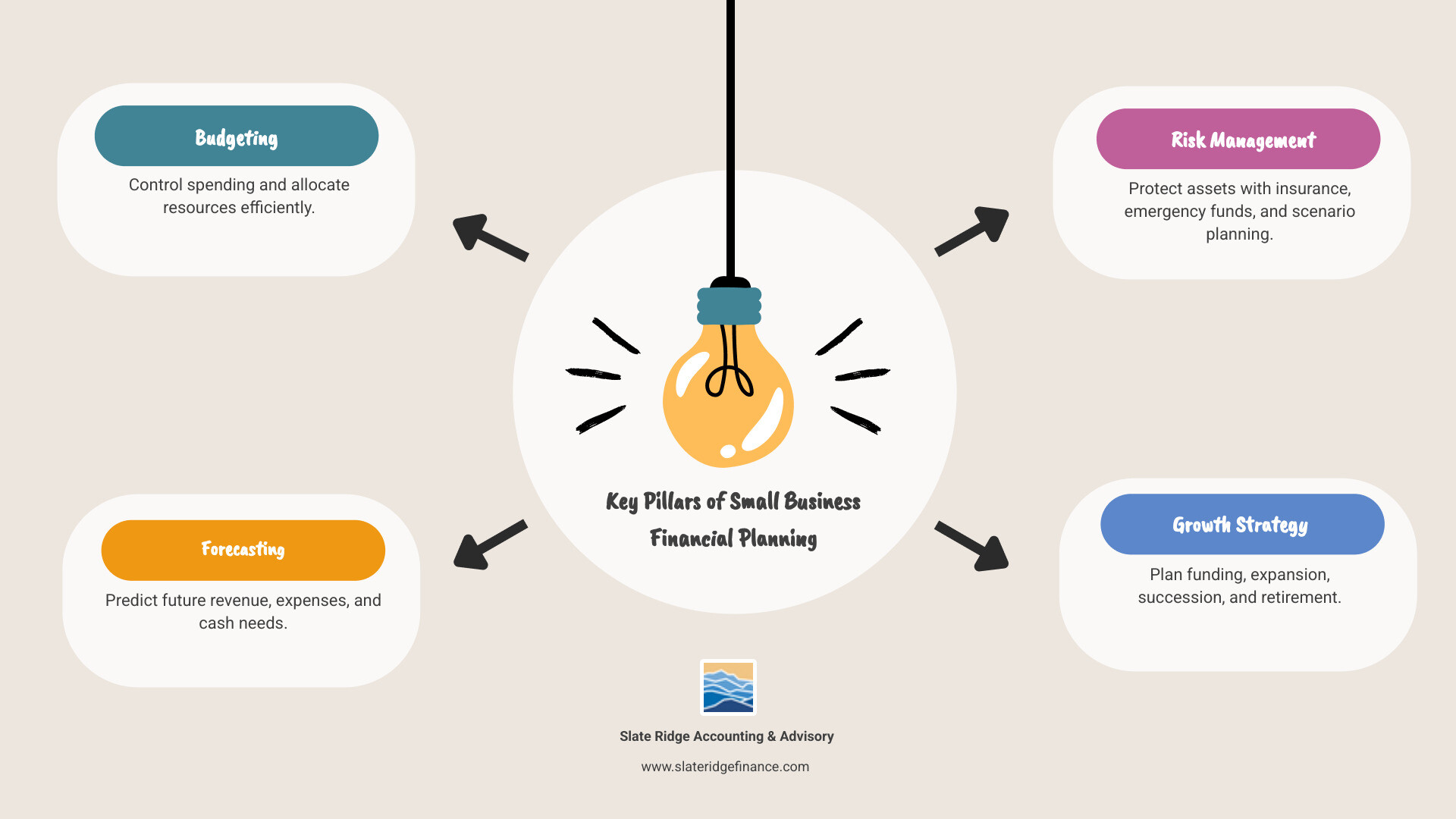
The Blueprint for Success: Why Financial Planning for Small Business is Non-Negotiable
Every small business owner dreams of success, but the path isn't always clear. This is where financial planning small business strategies become indispensable. A clear financial roadmap helps businesses avoid common pitfalls like cash flow shortages and missed growth opportunities, allowing them to thrive, not just survive.
A robust financial plan empowers you to make informed decisions, align operations with your long-term vision, and achieve your goals. It’s about understanding your cash flow to fuel sustainable growth. When seeking funding, a well-articulated financial plan is non-negotiable, as it demonstrates your business's financial health and potential to partners. For more insights on boosting your business's economic trajectory, explore our guide on More info about Financial Growth Strategies.
Core Components of a Financial Plan
A comprehensive financial planning small business strategy is built upon several foundational elements. These components work together to provide a holistic view of your company's financial past, present, and future.
Financial Statements: These are the backbone of your financial understanding.
- Income Statement (Profit & Loss): This statement shows your revenues and expenses over a period, revealing your net profit or loss. It's like a report card for your business's operational performance.
- Balance Sheet: A snapshot of your assets, liabilities, and equity at a specific point in time. It tells you what you own, what you owe, and your net worth.
- Cash Flow Statement: This critical document tracks the actual cash coming into and going out of your business from operating, investing, and financing activities. It's the pulse of your business, indicating its liquidity.We understand that preparing these can be complex, which is why we offer dedicated Financial Statement Preparation services to ensure accuracy and clarity.
Sales and Expense Forecasts: Looking ahead, these projections estimate your future revenue and operational costs. We use historical data, market trends, and strategic goals to create realistic forecasts that guide decision-making.
Budgets: A budget is a detailed plan for how you expect to spend and earn money over a specific period. It helps us allocate resources efficiently, control costs, and measure our financial performance against a benchmark.
Break-Even Analysis: This helps us determine the sales volume (in units or revenue) needed to cover all our costs—both fixed and variable. Knowing our break-even point is crucial for pricing strategies and understanding profitability thresholds.
These components are often integral parts of a larger business plan. If you're just starting out or refining your strategy, a solid template can be incredibly helpful. You can find excellent resources, including a Business plan template from BDC, to guide you through this process.
Building Your Financial Foundation: Day-to-Day Management and Tools

Effective financial planning small business operations require proactive, day-to-day management. Setting up financial systems for efficiency from the start saves countless headaches and allows us to focus on growing the business. This means establishing clear boundaries, optimizing cash flow, and leveraging the right tools to streamline financial processes.
Separating Personal and Business Finances
One of the most crucial steps in financial planning small business owners can take is to clearly separate personal and business finances. Blurring these lines, especially in the early stages, can lead to significant complications.
- Separate Bank Accounts and Credit Cards: This is non-negotiable. Using distinct accounts and cards provides a clear audit trail, simplifies tax prep, and protects your personal assets from business liabilities.
- Paying Yourself: Establish a consistent method for owner compensation, whether through draws (sole proprietorships) or a salary/dividends (corporations). This choice has significant tax implications, and we can help you determine the optimal strategy.
- Avoiding Commingling Funds: Resist the urge to pay personal bills from business accounts or vice versa. This practice creates accounting nightmares and can undermine the legal distinction between you and your business.
By establishing these clear boundaries, you simplify your accounting and reinforce the legal and financial integrity of your business. To ensure you're following the best protocols, we recommend reviewing our guide on Learn about Accounting Best Practices for Small Business.
Mastering Cash Flow Management
Cash flow is the lifeblood of any small business. Mastering cash flow management is a cornerstone of effective financial planning small business owners must prioritize.
- Tracking Inflows and Outflows: Diligently monitor all cash moving in and out of the business to gain real-time financial insights and identify trends.
- Cash Flow Projections: Forecast future sales and expenses to predict cash surpluses or deficits, allowing you to prepare for lean times and seize opportunities.
- Building a Cash Reserve: Aim to save 3-6 months of operating expenses in a cash reserve. This buffer is crucial for navigating unexpected downturns or covering emergency costs.
- Managing Accounts Receivable: Invoice clients promptly and consistently follow up on overdue payments. Clear payment terms and aging summaries are vital tools.
- Managing Accounts Payable: Strategically manage bill payments to optimize cash flow, which may include negotiating longer payment terms with suppliers.
Effective cash flow management also often involves strategic cost reduction. For more on optimizing your spending, visit our guide on Effective Cost Reduction Strategies.
Essential Tools and Resources for Modern Businesses
Effective financial planning small business operations are significantly improved by leveraging the right technology. Modern tools offer efficiency, accuracy, and invaluable insights.
Here are some essential categories of tools and resources we recommend:
- Cloud Accounting Software: These platforms are game-changers, automating data entry, generating real-time financial reports, and simplifying tax preparation. They provide a clear, instant view of our financial health.
- Budgeting and Forecasting Tools: Specialized tools help create detailed budgets, track spending, and build robust financial forecasts. They often integrate with accounting software for a seamless experience.
- Payment Processing Solutions: Streamlining how you accept payments from customers and pay suppliers is crucial for cash flow and can reduce administrative burden.
We are experts in navigating the landscape of modern financial technology. Find how these solutions can transform your operations by exploring our Explore our Cloud Accounting Services.
Fueling Growth and Mitigating Risk

As our small business grows, financial planning evolves from survival to strategic growth and asset protection. This phase of financial planning small business strategies requires balancing ambition with prudence. We aim to make astute financial decisions that fuel expansion while fortifying our assets against threats like market volatility, economic downturns, and unforeseen liabilities.
Exploring Your Funding Options
Growth often requires capital, and understanding the various funding options is a critical part of financial planning small business owners must master. The "best" option depends on our business stage, risk tolerance, and equity preferences.
Here's a comparison of common funding options:
| Funding Option | Equity Required | Repayment Obligations | Capital Allotment (Typical) |
|---|---|---|---|
| Bootstrapping | 0% (owner retains full equity) | None (self-funded, organic growth) | Low to moderate (limited by owner's personal resources) |
| Business Loans | 0% (debt, not equity) | Regular principal and interest payments | Moderate to high (depends on creditworthiness and business plan) |
| Angel Investors | 25-45% (significant equity stake) | None (investors take equity, expect return on investment) | High (can provide substantial capital) |
| Crowdfunding | Often 0% (rewards or donation-based) | None (unless rewards are delivered) | Low to moderate (varies widely by campaign and platform) |
Bootstrapping, while offering full control, can be slow and limit diversification. Exploring external funding can offset personal risk and accelerate growth. When seeking funding, a well-developed business idea is paramount. To learn more about changing your ideas into a profitable venture, consult Developing your business idea for funding.
Navigating Small Business Tax Implications
Proactive tax planning is a vital component of financial planning small business strategies. The goal is to minimize tax liability through legitimate deductions and credits.
- Self-Employment Tax: If you're a sole proprietor or partner, you'll pay self-employment tax for Social Security and Medicare. For 2024, the maximum earnings subject to the Social Security portion is $168,600.
- Estimated Tax Payments: Since taxes aren't automatically withheld, most business owners must make quarterly estimated tax payments to the IRS to cover income and self-employment taxes.
- Business Deductions: Deductible expenses—like office supplies, rent, and business travel—reduce your taxable income. Meticulous record-keeping is essential to maximize these deductions.
- Tax Credits: Beyond deductions, various tax credits for activities like R&D or specific hiring practices can directly reduce your tax bill.
- Impact of Business Structure: Your business structure (sole proprietorship, LLC, S-Corp, C-Corp) significantly impacts your tax obligations and should be part of your overall financial strategy.
Navigating tax law can be daunting. We recommend consulting the IRS Tax Guide for Small Business for details. Additionally, managing payroll is a critical service we provide through our Payroll Management Services.
Essential Risk Management Strategies
Risk is inherent in business, but intelligent financial planning small business owners can employ strategies to mitigate threats.
- Business Insurance: A cornerstone of risk management.
- Key Person Insurance: Protects against the financial loss if a crucial employee becomes disabled or passes away.
- Liability Insurance: Shields the business from claims of injury, property damage, or professional errors.
- Business Interruption Insurance: Compensates for lost income when operations are halted by a covered event.
- Emergency Fund: A robust cash reserve (3-6 months of expenses) acts as a critical financial safety net, allowing the business to weather unexpected revenue dips without taking on debt.
- Scenario vs. Continuity Planning:
- Scenario Planning: This involves creating financial strategies for various future outcomes (e.g., best-case, worst-case) to guide long-term decisions.
- Business Continuity Planning: This focuses on immediate operational recovery after a sudden disaster like a fire or cyberattack.
- Cybersecurity: In a digital world, protecting data and systems is paramount. Invest in robust cybersecurity measures and consider cyber insurance to mitigate this growing risk.
Planning for Your Future and Your Business's Legacy
While day-to-day operations are critical, truly comprehensive financial planning small business strategies extend far into the future. It’s about building a legacy, integrating personal wealth goals with business objectives, and ensuring a smooth transition for the business, whether it's passed down, sold, or wound down.
Succession and Exit Planning
Every business owner will eventually leave their business. How that happens has profound implications, which is why succession and exit planning are vital aspects of financial planning small business owners need to consider early.
- Business Valuation: The first step is getting a professional valuation to understand what your business is worth based on assets, earnings, and market conditions.
- Selling the Business: If selling is the goal, plan for market timing, potential buyers, and sale terms. Preparing a business for sale can take years.
- Passing to Family/Employees: Transferring ownership to family or employees requires mentorship and a clear financial structure, like a gradual buyout.
- Buy-Sell Agreements: For businesses with multiple owners, a buy-sell agreement dictates what happens if one owner leaves, becomes disabled, or passes away, ensuring business continuity.
- Creating a Clear Exit Strategy: A defined plan for selling, passing on, or closing the business minimizes stress and maximizes value.
Strategic planning for these transitions can significantly impact your financial outcomes. For more detailed strategies, refer to our guide on More on Business Growth Strategies.
Retirement Planning for Entrepreneurs
As a small business owner, robust retirement planning is a non-negotiable aspect of financial planning small business owners should prioritize. You have unique options for saving for your future.
- SEP-IRA (Simplified Employee Pension Individual Retirement Account): A popular choice for its ease of setup and significant contribution limits. As the employer, you contribute to an IRA for yourself and any eligible employees.
- Solo 401(k): Excellent for self-employed individuals with no employees (other than a spouse). It allows for both "employee" and "employer" contributions, enabling potentially larger savings than a SEP-IRA.
- Saving 15% of Pretax Income: As a benchmark, experts recommend saving at least 15% of your pretax income for retirement to build a sufficient nest egg.
- Tax-Advantaged Accounts: Use accounts like SEP-IRAs and Solo 401(k)s to let your savings grow tax-deferred, significantly boosting your long-term returns.
For more specific details on SEP-IRAs, the IRS provides comprehensive information on [IRS information on SEP-IRAs](https://www.irs.gov/retirement-plans/retirement-plans-faqs-regarding-seps#:~:text=A%20Simplified%20Employee%20Pension%20(SEP,(a%20SEP%2DIRA).).
The Importance of Estate Planning
Estate planning is a critical component of financial planning small business owners need to protect their legacy and loved ones. A proper plan helps your family and business avoid significant legal and financial challenges.
- Protecting Personal Assets: An estate plan ensures your personal assets are distributed according to your wishes, avoiding costly probate.
- Providing for Loved Ones: It allows you to designate guardians for minor children and ensure your family's financial security.
- Minimizing Tax Exposure: A well-structured plan can significantly reduce estate taxes, passing more of your wealth to your heirs.
- Business Continuation Instructions: Your estate plan can include clear instructions on how the business should proceed in the event of your incapacitation or death, preserving its value.
- Wills and Trusts: These are the primary tools of estate planning, outlining asset distribution and offering complex asset protection.
Frequently Asked Questions about Small Business Financial Planning
How does financial planning differ for sole proprietorships versus corporations?
The choice of business structure significantly impacts financial planning small business strategies. Key differences include:
- Tax Implications:
- Sole Proprietorship: Business income is reported on the owner's personal tax return, and the owner pays self-employment taxes on all profits.
- Corporation (S-Corp/C-Corp): As a separate legal entity, a corporation offers more complex tax options. C-Corps face corporate taxes plus taxes on dividends ("double taxation"), while S-Corps are "pass-through" entities that avoid corporate-level tax. Owners can take a salary to reduce self-employment tax liability.
- Liability Protection:
- Sole Proprietorship: The owner has unlimited personal liability for business debts.
- Corporation: Offers limited liability protection, shielding personal assets from business debts.
- Administrative Complexity:
- Sole Proprietorship: Simple to set up with minimal administrative requirements.
- Corporation: More complex to establish and maintain, requiring formal filings and stricter record-keeping.
- Paying Yourself:
- Sole Proprietorship: Owners take draws from business profits.
- Corporation: Owners can be paid a salary and/or receive dividends, allowing for strategic tax planning.
Understanding these differences is crucial. For a deeper dive, refer to our Guide to types of business ownership. We also provide specialized services for More on Small Business Financial Reporting.
How often should I review my business financial plan?
Financial planning small business efforts are an ongoing process. Regular reviews are critical to keeping your business on track.
- Regular Reviews are Key: Review your plan annually at a minimum. However, quarterly reviews are ideal for tracking progress against goals, and monthly check-ins on key metrics like cash flow are highly beneficial.
- Adjust as Needed: Don't wait for a scheduled review if circumstances change. Revisit your plan immediately after major business events (like landing a big contract) or in response to significant market shifts.
Consistent monitoring helps compare actual results with projections. For an in-depth look at how we can help you track your performance, explore our See our Financial Performance Analysis services.
What are the common financial challenges faced by small businesses and how can they be overcome?
Proactive financial planning small business strategies are essential to overcoming common challenges.
- Cash Flow Gaps: Often, income doesn't align with expenses, creating shortages.
- Overcome: Use cash flow forecasting, build a 3-6 month cash reserve, and diligently manage receivables and payables.
- Insufficient Capital: A lack of funding can limit investment and growth.
- Overcome: Explore diverse funding options, maintain a lean budget, and focus on early profitability to self-fund growth.
- Poor Budgeting: Uncontrolled spending leads to wasted resources.
- Overcome: Create a detailed budget, track all expenses, and regularly compare actuals to your plan.
- Tax Surprises: An unexpected tax bill can hurt cash flow and profitability.
- Overcome: Work with a financial professional for proactive tax planning, maximize deductions, and make timely estimated payments.
- Commingling Finances: Mixing personal and business funds creates accounting chaos and legal risks.
- Overcome: Strictly maintain separate accounts and credit cards for the business.
Many of these challenges can be mitigated through diligent financial forecasting and expert advice. We are here to help you turn challenges into opportunities. Find out how we can assist you with Get Expert Financial Advice.
Conclusion: Partnering for Financial Clarity and Growth
When only a fraction of small businesses operate with a written financial plan, embracing comprehensive financial planning small business strategies sets us apart. It's the difference between reacting to financial surprises and proactively shaping our future. From understanding our daily cash flow to planning for our eventual retirement or business exit, a robust financial plan is our most powerful tool for stability and growth.
At Slate Ridge Accounting & Advisory, we don't just provide services; we partner with you to transform financial data into actionable insights. We believe every small business deserves clarity, control, and a clear path to success. Our modern, personalized, and industry-custom financial solutions, including virtual bookkeeping, financial clean-up, and advisory services, are designed to help you track key performance indicators, forecast growth, and make informed decisions.
Don't leave your financial future to chance. Take control, gain clarity, and open up the full potential of your business. Get started with our Virtual Accounting services today!.
Ready to get started?
Book a free consultation today and let’s explore how Slate Ridge can support your business with expert accounting that’s accurate, timely, and built around your goals.
You Might Also Like
A few more posts we think you’ll enjoy on topics that matter to business owners like you.