

Why Cost Reduction Strategies Matter More Than Ever
Cost reduction strategies are systematic approaches businesses use to permanently lower expenses while maintaining or improving quality and growth potential. Unlike short-term cost cutting, which often sacrifices value for quick savings, strategic cost reduction focuses on optimizing operations and eliminating waste.
Quick Overview of Effective Cost Reduction Strategies:
- Operational Optimization - Streamline processes using lean principles and eliminate waste
- Technology & Automation - Automate administrative tasks for up to 200% ROI in year one
- Supplier Management - Renegotiate vendor contracts to save an average of 9.2% on total contract value
- Inventory Control - Implement just-in-time systems to reduce storage costs by 20-30%
- Human Capital - Accept remote work models and focus on retention to cut hiring costs
- Financial Management - Optimize cash flow and payment terms to improve liquidity
You're facing pressure to cut costs. Maybe it's inflation, slowing sales, or a desire to free up capital for growth. The problem is, 82% of businesses missed their cost reduction targets in 2023. They approached it as a one-time slashing exercise, not a strategic process.
Successful cost reduction isn't about "doing less with less." It's about doing more with what you have. It makes your business smarter, not smaller. Companies that take a strategic approach don't just survive lean times—they emerge stronger, with resources to reinvest in innovation and competitive advantages.
This guide will walk you through proven frameworks and actionable strategies to achieve sustainable cost savings, from comprehensive cost analysis to leveraging technology, all while avoiding common pitfalls.
Developing Your Foundational Cost Reduction Framework
Before jumping into tactics, you need a solid blueprint. A deliberate, data-driven approach to cost reduction strategies aligns with your long-term business goals. This foundation rests on understanding your spending, creating a cost-conscious culture, and knowing the difference between a quick fix and a lasting solution.

Conduct a Comprehensive Cost Analysis
You can't reduce what you don't measure. A cost analysis is a systematic evaluation of all expenditures that moves you from gut feelings to data-driven decisions. Without it, you risk cutting costs in areas that drive value while missing the real problem spots.
Here's a simple approach:
- Categorize costs: Group expenses into fixed, variable, direct, and indirect buckets to see the full picture.
- Identify cost drivers: Pinpoint what causes high expenses in each category (e.g., materials, labor).
- Analyze spending patterns: Review historical data to spot trends, seasonal spikes, or anomalies.
- Benchmark against industry standards: Compare your costs to similar businesses to see where you might be overspending.
For a deeper dive, our Small Business Financial Reporting Complete Guide can help.
Foster a Cost-Conscious Culture
Cost reduction is everyone's job, not just the CFO's. The most successful cost reduction strategies occur when every team member understands how their actions impact the bottom line. This is about empowerment, not penny-pinching.
- Empower leaders with budget autonomy to encourage ownership and efficiency.
- Communicate transparently about financial goals and challenges to get buy-in.
- Invest in employee training on basic financial literacy so they can spot waste in their daily work.
- Recognize and reward innovative cost-saving ideas to encourage creative thinking.
Engaged employees are more productive, which naturally reduces the resources needed to achieve results.
Set Clear Goals and Differentiate Strategies
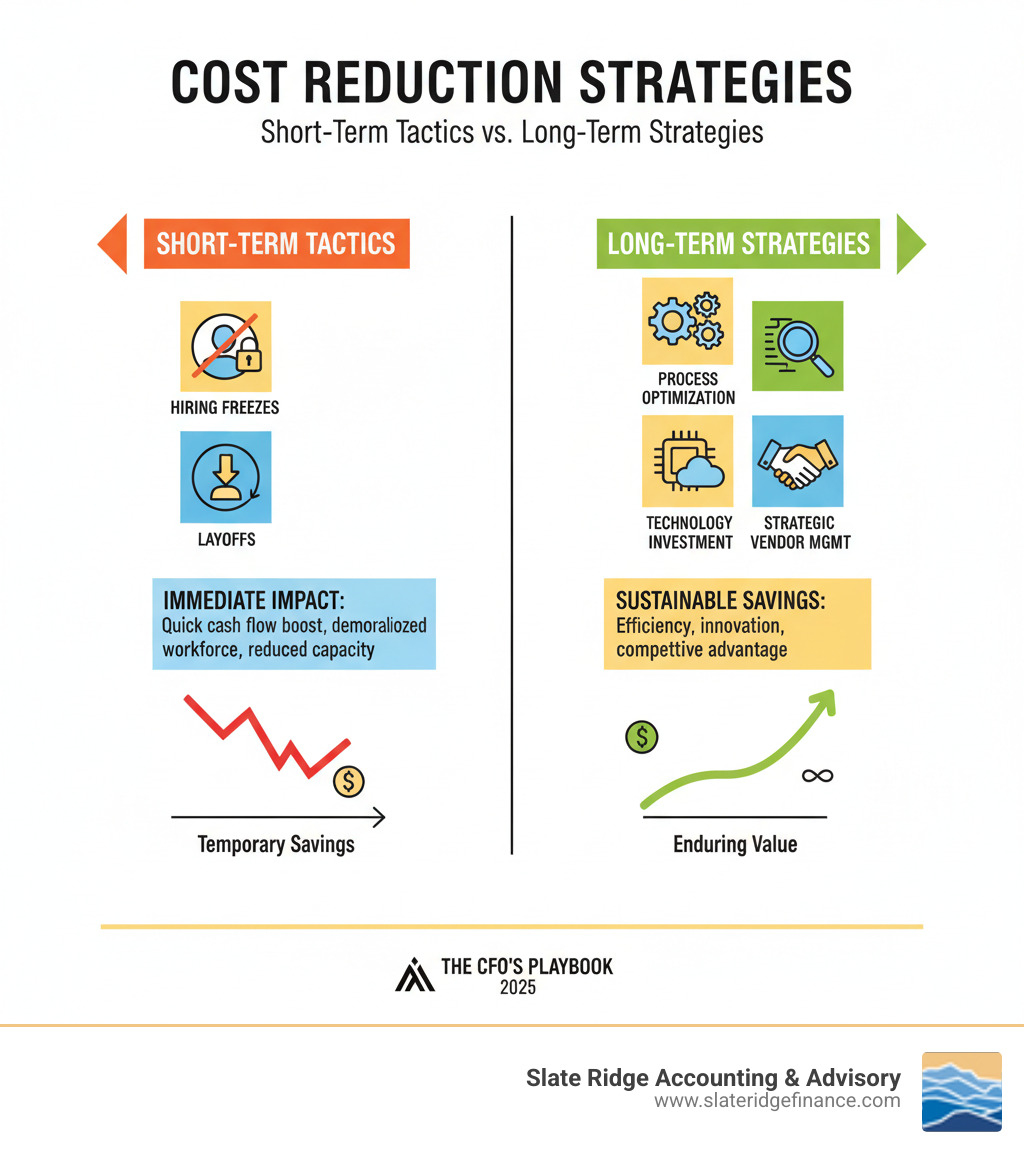
Not all cost-saving efforts are equal. Understanding the difference between short-term tactics and long-term strategies is critical.
Short-term cost cutting is reactive, providing immediate relief through measures like hiring freezes or slashing discretionary spending. These tactics can stop the bleeding but risk damaging morale and delaying critical investments.
Long-term cost reduction strategies (cost optimization) are proactive and strategic. They involve permanent structural changes like process optimization and technology investments that improve efficiency without harming value or growth.
The key is to pursue both in the right proportion. Start with "quick wins" to build momentum, but focus most of your energy on sustainable, systemic improvements that align with your business goals. Cutting costs in a way that hinders innovation or customer service is counterproductive.
| Feature | Short-Term Cost Cutting | Long-Term Cost Reduction (Optimization) |
|---|---|---|
| Objective | Immediate cash savings, survive crisis | Sustainable efficiency, re-invest for growth |
| Approach | Reactive, often arbitrary | Proactive, strategic, data-driven |
| Impact | Temporary relief, potential negative consequences | Permanent structural change, improved value |
| Focus | Expense elimination (e.g., hiring freeze) | Process improvement, technology, strategic sourcing |
| Risk | Damaged morale, reduced quality, stunted growth | Requires investment, change management |
| Example | Halting all non-essential travel | Implementing remote work model, automating accounting |
For more guidance, see our insights on Business Growth Strategies.
Optimizing Operations and Human Capital for Efficiency
True cost reduction strategies involve scrutinizing how you operate day-to-day. Operational waste and inefficient use of human capital are like money quietly slipping through your fingers. By streamlining processes and managing teams thoughtfully, you can open up significant savings while boosting productivity. It's about working smarter, not harder.

Streamline Key Operational Processes
Operational inefficiencies are like small leaks that collectively drain your resources. Systematically improving processes plugs these leaks and generates real savings by eliminating waste, reducing errors, and speeding up workflows.
- Accept lean principles to identify and eliminate any activity that doesn't add value for the customer.
- Use the 5S methodology (Sort, Set in order, Shine, Standardize, Sustain) to organize the workplace, reduce waste, and increase productivity.
- Eliminate all forms of waste, including wasted time in meetings, wasted motion in poor layouts, or wasted talent on mundane tasks.
- Map your processes to visually identify bottlenecks, redundancies, and steps that can be removed or redesigned for greater efficiency.
For more insights, visit our page on Financial Process Optimization.
Manage Human Resources Effectively
Managing your people effectively is a key area for cost reduction strategies—not by cutting staff, but by optimizing how you work.
- Accept remote/hybrid work. Flexible work models can significantly reduce overhead costs like office space and utilities. Data shows employees can be 24% more productive working remotely, and nearly 35% of professionals now work this way.
- Focus on employee retention. Hiring a new employee costs around $4,700 on average. Retaining talent through competitive benefits and a positive culture avoids these costs. Plus, engaged employees are more productive.
- Outsource non-core functions. Convert fixed salary costs into variable costs by outsourcing tasks like payroll or IT. This provides access to specialized expertise and reduces administrative burden, allowing you to scale services as needed.
For a comprehensive guide on payroll, see our Small Business Payroll Cost Guide.
Master Inventory Management to Minimize Waste
Inventory can be a silent profit killer. Too much ties up cash and incurs storage costs; too little leads to lost sales. Effective inventory management is a critical cost reduction strategy.
- Implement Just-in-Time (JIT) inventory. This system aims to receive goods only as they are needed, minimizing storage costs and waste. Explore the benefits of a just-in-time (JIT) inventory system.
- Improve demand forecasting. Use historical sales data and market trends to predict future demand more accurately, preventing both overstocking and stockouts.
- Reduce storage costs. The cost of holding inventory can be 20-30% of its value. Optimizing inventory levels directly reduces rent, insurance, and handling costs.
- Consider Vendor-Managed Inventory (VMI). In a VMI system, your supplier manages your inventory levels, reducing your administrative burden and improving efficiency.
Leveraging Technology and Financials for Smart Savings
Many businesses are sitting on potential savings because they're stuck managing finances the old way. Technology isn't just for staying current—it's one of the most powerful cost reduction strategies available. Paired with smart financial management, it can open up dramatic improvements to your bottom line.

Harness Technology for Automation and Insight
Imagine freeing up your team from repetitive tasks like data entry, expense tracking, and invoice management. That's the promise of technology.
- Automate accounting. Software that automatically categorizes expenses and handles bill payments can deliver an ROI of up to 200% in the first year, according to the London School of Economics. This frees up your team for more strategic work.
- Audit your software. Most companies use only half the software they pay for. Gartner research shows you can save up to 30% by optimizing licenses. A simple quarterly audit of SaaS subscriptions can reveal which tools are sitting idle.
- Use cloud computing. Instead of buying expensive servers, pay only for the IT infrastructure you use. This converts large capital expenses into manageable operational costs and provides flexibility to scale.
- Centralize expense management. Dedicated software provides visibility into spending, streamlines approvals, and catches questionable expenses before they are paid.
Our Cloud Accounting Services can help you implement these technologies effectively.
Implement Smart Financial Management Strategies
While technology handles the mechanics, smart financial strategy determines how you use your resources. This is where cost reduction strategies become true financial optimization.
- Optimize cash flow. Manage the timing of money coming in and going out. Negotiate longer payment terms with suppliers (e.g., 60 days instead of 30) to create an interest-free loan. Offer small discounts to customers for early payment to accelerate incoming cash.
- Manage your debt. Regularly review your debt structure. Refinancing high-interest loans into lower-rate options can free up significant cash each month that can be reinvested in growth.
- Negotiate payment terms. Everything is negotiable. Reliable customers have leverage. Suppliers often prefer the certainty of a committed relationship over squeezing every dollar immediately.
Our guide on Tips for Managing Small Business Accounts Receivable and Payable provides detailed approaches for optimizing your cash flow.
Mastering Strategic Sourcing and Supplier Relations
One of the most overlooked savings opportunities lies with your suppliers. Many businesses let vendor contracts roll over year after year, leaving money on the table. Strategic sourcing and smart supplier management are powerful cost reduction strategies that don't require sacrificing quality—in fact, they often improve it.

Effective cost reduction strategies for Vendor Negotiation
Most vendors build flexibility into their pricing and expect you to negotiate. If you're not asking for better terms, you're likely overpaying.
Any contract that hasn't been reviewed in over three years is a prime candidate for savings. Markets change, your needs evolve, and new competitors emerge. Schedule annual contract reviews to assess whether each vendor still provides value at a competitive price.
As your business grows, so does your buying power. Use this leverage to command volume discounts or preferential treatment. Don't hesitate to solicit bids from multiple suppliers to gain market intelligence and strengthen your negotiating position.
According to a World Commerce & Contracting study, companies save an average of 9.2% on their total contract value through effective negotiation. Approach these discussions as partnership conversations focused on mutual benefit.
Consolidate Suppliers and Centralize Purchasing
As businesses grow, they often accumulate a fragmented list of suppliers, which quietly drains resources through diluted buying power and increased administrative work. Consolidating suppliers and centralizing purchasing are effective cost reduction strategies that streamline operations.
Supplier consolidation means pooling your purchasing power. Placing larger orders with fewer vendors translates directly to better pricing, improved payment terms, and superior service. It also simplifies operations with streamlined invoicing and payment processing, easier communication, and better quality control.
Centralized purchasing provides a bird's-eye view of all spending, allowing you to spot duplicate purchases and identify bulk buying opportunities. Implementing e-procurement software takes this a step further by automating ordering, enforcing purchasing policies, and reducing "maverick spending"—off-contract purchases that miss out on negotiated rates.
For practical guidance on managing payables, check out our Accounts Payable Complete Guide Small Business.
Measuring Success and Avoiding Common Pitfalls
Implementing cost reduction strategies is an ongoing process that requires constant attention and adjustment. The challenge is knowing whether your efforts are paying off and avoiding the common traps that derail most initiatives.
Key Metrics for Measuring Your Cost Reduction Initiatives
Effective measurement requires looking at multiple dimensions of your business, not just the financial ones. Companies that establish clear performance indicators achieve a productivity gain of 10 to 15% on average. To get there, you need to track the right things.
- Financial Ratios: Monitor your gross, operating, and net profit margins to see if efficiency gains are hitting the bottom line. Also, track Return on Investment (ROI) for specific initiatives and improvements in cash flow and liquidity.
- Productivity and Efficiency Metrics: Is labor productivity improving? Are processes faster? Are you fully utilizing your software licenses? These metrics show if you're truly becoming more efficient.
- Employee Satisfaction and Turnover: A spike in turnover is a red flag that your strategies may be damaging morale, leading to higher hiring and training costs down the road.
- Customer Satisfaction and Retention: Keep a close eye on your Net Promoter Score (NPS) and customer retention rates. Saving money at the expense of your customers is a losing game.
For more detailed guidance on tracking these vital indicators, check out our guide on How to Track KPIs.
Common Pitfalls to Avoid When Implementing cost reduction strategies
Even with the best intentions, cost reduction strategies can go sideways. Be aware of these common mistakes:
- Ignoring employee morale: Cutting costs without transparent communication creates fear and resentment, leading to lower productivity and higher turnover. Engage your team; they often have the best ideas.
- Sacrificing quality: Using cheaper materials or rushing production saves money in the short term but damages your brand reputation and leads to customer churn, which is far more expensive to fix.
- Cutting "good" costs: Not all expenses are equal. Some costs, like marketing and employee training, are investments in growth. Cutting them can stifle innovation and new customer acquisition.
- Making decisions without data: Gut feelings are not a strategy. Without a thorough cost analysis, you risk making arbitrary cuts that harm the business.
- Failing to monitor and adapt: Cost reduction is not static. Continuously monitor results to ensure a strategy is working as intended and adjust course when necessary.
- Focusing only on short-term gains: Quick fixes don't address underlying issues. Prioritize sustainable cost optimization that builds long-term resilience and frees up resources for future growth.
Frequently Asked Questions about Cost Reduction Strategies
Here are answers to common questions business owners have about navigating cost reduction strategies.
What is the difference between cost reduction and cost cutting?
Cost reduction is a strategic, long-term approach to permanently lower expenses while maintaining or improving quality and growth potential. It's about making your business smarter and more efficient.
Cost cutting, in contrast, is often a reactive, short-term tactic to slash expenses quickly. While it can provide immediate relief, it often comes with negative consequences like damaged morale or compromised quality, potentially harming the business in the long run.
How can a small business start implementing cost reduction?
Starting is more straightforward than it seems. Follow these steps:
- Conduct a cost analysis: First, understand exactly where your money is going.
- Target large expenses: Identify your top 3-5 expense categories, as these offer the biggest opportunities.
- Find "quick wins": Look for easy changes with immediate impact, like renegotiating an old contract or canceling unused software subscriptions. This builds momentum.
- Plan for long-term improvements: Simultaneously, explore bigger changes like process optimization or adopting remote work to reduce overhead.
- Involve your team: Communicate openly and ask for ideas. Your employees on the front lines often know where waste occurs.
How do you measure the success of a cost reduction strategy?
Success isn't just one number; it requires a holistic view. You need to track a mix of financial and non-financial Key Performance Indicators (KPIs).
- Financial Metrics: Look for improvements in your profit margins (gross, operating, and net), a lower cost of goods sold (COGS), and healthier cash flow.
- Non-Financial Metrics: Monitor customer satisfaction scores (like NPS) and employee retention rates. If these numbers drop, your cost savings may be coming at a hidden price. Also, track productivity metrics to ensure efficiency is genuinely improving.
Success means spending smarter while maintaining the value you deliver to customers and the positive experience you provide for your team.
For more detailed guidance on tracking these vital indicators, check out our guide on How to Track KPIs.
Conclusion: Make Every Dollar Count for Sustainable Growth
We've covered a lot of ground, from deep cost analysis to leveraging technology and strengthening supplier relationships. But this isn't an ending; it's the beginning of a continuous cycle of improvement. Effective cost reduction strategies are not about scarcity—they are about making your business smarter and more resilient.
When you eliminate waste and optimize processes, you free up capital. That money becomes available for innovation, market expansion, or technology upgrades that fuel sustainable growth. Companies that take this strategic approach don't just survive tough times; they emerge stronger and more competitive.
For businesses across North Carolina—from Asheville to Raleigh—these principles apply. But implementing them effectively takes time and expertise. It often requires an outside perspective to spot the opportunities you might be missing.
That's where we come in. At Slate Ridge Accounting & Advisory, we help businesses transform their financial operations and open up hidden savings. Our cloud-based approach allows us to provide personalized, modern financial solutions that drive real results, no matter where you are.
Ready to turn these strategies into action and make every dollar work harder for your business?
Ready to get started?
Book a free consultation today and let’s explore how Slate Ridge can support your business with expert accounting that’s accurate, timely, and built around your goals.
You Might Also Like
A few more posts we think you’ll enjoy on topics that matter to business owners like you.