

Why Payroll Accounting Matters for Your Small Business

Payroll accounting for small business is the process of calculating employee wages, withholding taxes, making payments, and filing tax forms accurately and on time. It ensures your team is paid correctly while keeping you compliant with federal and state laws.
Here's what you need to know:
- Gross pay - Calculate total wages before deductions
- Withholdings - Deduct federal, state, and FICA taxes
- Employer taxes - Pay your share of Social Security, Medicare, and unemployment taxes
- Tax filing - Submit quarterly Form 941 and annual Form 940
- Record-keeping - Maintain payroll records for at least 4 years
For small business owners, payroll can be overwhelming. A single mistake can lead to unhappy employees, IRS penalties, and sleepless nights.
The good news is you're not alone. Nearly 80% of small businesses plan to digitize their HR efforts. Modern payroll solutions automate calculations, send tax reminders, and integrate with accounting software.
However, payroll mistakes are common and costly. With an average of 15 errors per payroll period, businesses see only an 80% accuracy rate. Late tax deposits alone can cost 2-15% of the unpaid amount in penalties.
Whether you manage payroll yourself, use software, or outsource, understanding the fundamentals is key. This guide covers everything from calculating gross pay to choosing the right solution.
Let's start with the basics and work our way through the complete payroll process.
Quick payroll accounting for small business terms:
- accounting best practices for small businesses
- best accounting systems for small businesses
- virtual tax preparation
Understanding the Fundamentals of Payroll Accounting
Payroll might seem like a simple exchange of work for pay, but it's a multi-layered process. For North Carolina small businesses, understanding the core components is the first step to successful payroll accounting for small business.
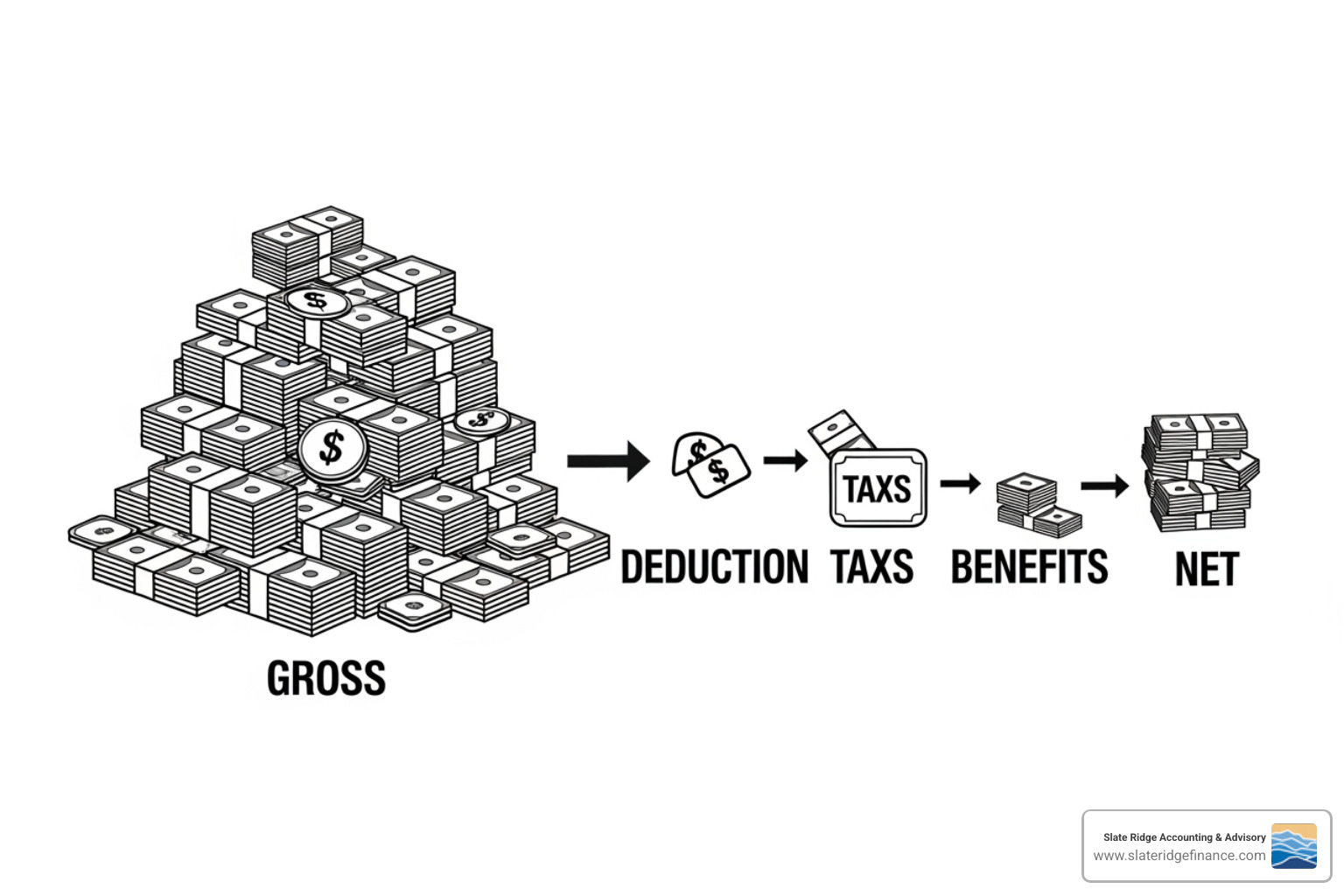
At its heart, payroll involves calculating gross wages, making employee deductions, accounting for employer taxes, and arriving at net pay. These all contribute to payroll liabilities—the amounts your business owes to employees and government agencies.
First, you need a Federal Employer Identification Number (FEIN) from the IRS. This 9-digit number is essential for hiring, banking, and tax purposes. You can Apply online for free at IRS.gov.
You must also register with North Carolina agencies for state tax IDs for income tax withholding and unemployment insurance. North Carolina also requires workers' compensation insurance before hiring. Check with the NC Department of Labor to ensure full compliance.
Key Components of Payroll Accounting for Small Business
Let's explore the numbers that make up each paycheck:
Gross Pay Calculation: This is total earnings before deductions. For hourly staff, it's hours worked multiplied by their rate (plus overtime). For salaried staff, it's their annual salary divided by pay periods. Federal law (FLSA) requires overtime at 1.5 times the regular rate for hours over 40 in a workweek. Always check North Carolina's specific overtime regulations.
Pre-tax Deductions: These are taken from gross pay before taxes are calculated, reducing an employee's taxable income. Examples include 401(k) contributions and health insurance premiums.
Post-tax Deductions: These are taken after taxes are withheld. Examples include wage garnishments and Roth 401(k) contributions.
FICA Taxes (Social Security and Medicare): Both employees and employers contribute to these federal taxes.
- Social Security Tax: Employees and employers each pay 6.2% of wages up to an annual limit.
- Medicare Tax: Employees and employers each pay 1.45% of all wages. High-income earners pay an additional 0.9% Medicare tax.
Federal and State Income Tax Withholding: Based on an employee's Form W-4 and state forms, you must withhold federal and state income taxes and remit them to the government.
Employer-Paid Taxes: Beyond matching FICA contributions, businesses also pay:
- FUTA (Federal Unemployment Tax Act): A federal tax to help fund unemployment benefits, typically 6% on the first $7,000 of wages, though credits can reduce this rate.
- SUTA (State Unemployment Tax Act): North Carolina's state unemployment tax, paid to the NC Department of Commerce.
Legal and Compliance Requirements
Navigating payroll's legal landscape is paramount for any North Carolina small business.
Employee New Hire Paperwork: Before an employee's first day, they must complete:
- Form W-4: Determines federal income tax withholding.
- Form I-9: Verifies eligibility to work in the U.S.
- State Withholding Forms: North Carolina may require its own withholding forms.
- Direct Deposit Authorization: A convenient, common practice requiring employee consent.
New Hire Reporting: North Carolina law requires you to report all new hires to the state's reporting agency to assist with child support enforcement. You must register as an employer with the appropriate state agencies to meet all local new hire reporting and tax requirements.
Record-Keeping Rules: The Fair Labor Standards Act (FLSA) and the IRS have strict rules for how long you must keep payroll records. Generally, you must retain them for several years to protect your business during audits.
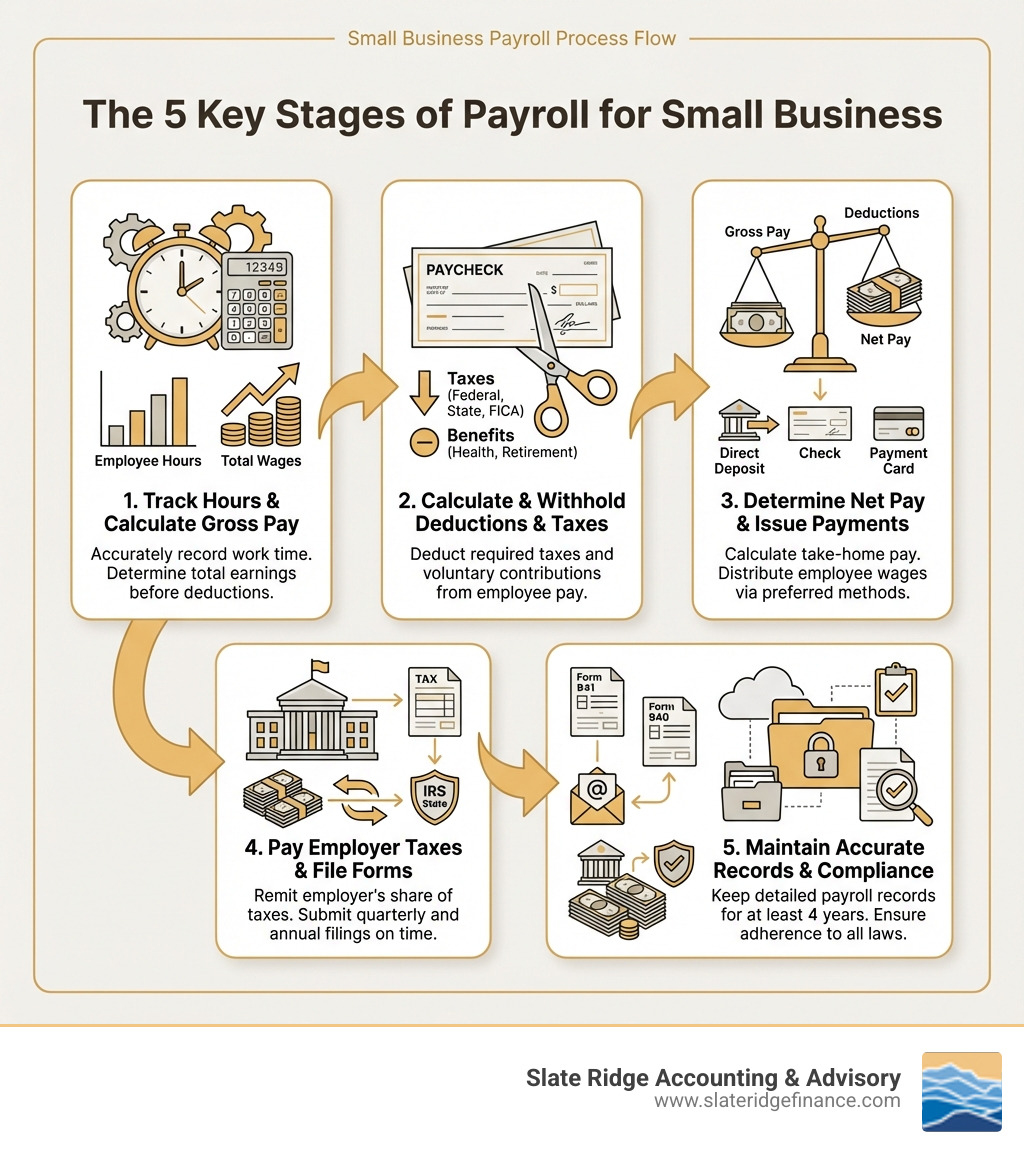
A Step-by-Step Guide to Processing Payroll
Processing payroll accurately is a cornerstone of responsible business ownership. Understanding each step is vital, whether you do it yourself or use software.

Here's a breakdown of the process for your North Carolina business:
- Choose a Pay Schedule: Decide how often to pay employees (weekly, bi-weekly, semi-monthly, or monthly), following North Carolina law.
- Track Employee Hours: Use a reliable system to track hours for hourly employees.
- Calculate Gross Pay: Sum up all regular hours, overtime, and other earnings.
- Calculate Deductions and Taxes: Apply federal and North Carolina withholdings, FICA taxes, and other deductions.
- Issue Payments: Distribute net pay via direct deposit, paper checks, or pay cards.
- Pay Payroll Taxes: Remit all withheld taxes and employer contributions to federal and state agencies.
- File Tax Forms: Submit required quarterly and annual tax forms.
- Store Records: Maintain meticulous records of all payroll activities.
For a detailed walkthrough, you can review our guide on How to Do Payroll Yourself in 9 Easy Steps.
Calculating Pay and Withholdings
This step requires precision.
Hourly vs. Salaried Pay:
- Hourly: Multiply hours worked by the hourly rate, including overtime at 1.5 times the regular rate for hours over 40 per week (FLSA). Always check North Carolina's specific wage and hour laws.
- Salaried: Divide the annual salary by the number of pay periods. A salary does not automatically exempt an employee from overtime; they must meet specific FLSA duties and salary tests.
Overtime Calculations: The federal minimum for overtime is 1.5 times the regular rate after 40 hours per week for non-exempt employees. Miscalculating overtime is a common and costly mistake.
Using Tax Tables: Use federal tax tables (from Publication 15-T) and North Carolina's state tables to determine the correct income tax withholding based on employee forms. This also includes calculating FICA taxes.
Calculating Net Pay: This is the employee's take-home pay: Gross Pay - Pre-tax Deductions - Taxes - Post-tax Deductions.
Creating Pay Stubs: Provide each employee a detailed pay stub showing gross pay, all deductions, and net pay. North Carolina has specific requirements for what to include.
Direct Deposit vs. Paper Checks: Direct deposit is convenient and fast, but paper checks or pay cards are alternatives.
Filing Taxes and Year-End Reporting
Timeliness is critical to avoid penalties when fulfilling your obligations to the government.
Tax Deposit Schedules: The IRS assigns you a federal tax deposit schedule (monthly or semi-weekly) based on your past tax liability. It's crucial to follow it. Use the Electronic Federal Tax Payment System (EFTPS) for all federal tax deposits.
Quarterly Filings: File Form 941 (Employer's Quarterly Federal Tax Return) each quarter to report income, Social Security, and Medicare taxes. You'll also have quarterly filings for North Carolina.
Annual Filings: At year-end, you must:
- File Form 940, the Employer’s Annual Federal Unemployment (FUTA) Tax Return, by January 31st.
- Issue a Form W-2 to each employee and a Form 1099-NEC to independent contractors by January 31st. File copies with the appropriate government agencies.
Year-End Reconciliation: Review all payroll records, filings, and payments for the year to ensure everything balances. This is a critical step before submitting final reports.
Choosing Your Payroll Solution: DIY, Software, or Outsourcing
Choosing how to manage your payroll accounting for small business is a significant decision that impacts your time, budget, and compliance risk. The three main paths are DIY, using payroll software, or outsourcing.
Here's a quick comparison:
| Feature | Manual DIY (Spreadsheets) | Payroll Software | Outsourced Services |
|---|---|---|---|
| Cost | Low upfront (your time) | Moderate (monthly fees) | Highest (monthly fees + per employee) |
| Time Commitment | High | Low | Very Low (minimal input) |
| Compliance Risk | High | Moderate (automated) | Lowest (expert handling) |
| Scalability | Low | Moderate to High | High |
| Expertise Needed | High | Low to Moderate | None |
| Control | High | Moderate | Low |
Many start with manual spreadsheets. This method is low-cost but time-consuming, error-prone, and doesn't scale. You'll still need to transfer data to official tax forms.
Cloud Payroll Management solutions, or payroll software, offer a middle ground with significant automation and integration benefits.
Outsourcing your payroll to a professional service like our Accounting and Payroll Services for Small Business provides the highest level of expertise and peace of mind, allowing you to focus on your core business.
The Benefits of Using Payroll Software
For many small businesses, payroll software strikes the perfect balance. Over 50% of businesses use payroll software for good reason.
- Automated Calculations: Software automatically calculates gross pay, deductions, and net pay, drastically reducing human error.
- Tax Filing and Automation: Get timely tax reminders and automate quarterly (Form 941) and annual (Form 940, W-2s) filings with the IRS and North Carolina agencies.
- Direct Deposit: Most software facilitates direct deposit, making payments seamless for employees.
- Employee Self-Service: Portals allow employees to view pay stubs and update personal info, reducing your administrative burden.
- Reduced Errors: Automation minimizes the likelihood of expensive mistakes.
- Time Savings: Tasks that take hours manually can be done in minutes, freeing you up to focus on growth.
- Integration with Online Accounting Software for Small Business: Seamless integration with accounting platforms simplifies reconciliation and financial reporting.
To understand the financial implications, check out our Small Business Payroll Cost Guide.
When to Outsource Your Payroll
Outsourcing becomes the most strategic choice for many businesses, especially those with:
- Complex Payroll Needs: A mix of employee types, pay rates, commissions, or garnishments that are too complex to manage in-house.
- Multiple States: Navigating tax laws for employees in different states is complex and high-risk. Outsourcing ensures compliance across all jurisdictions.
- Lack of Time or Expertise: If you spend hours on payroll or worry about mistakes, it's time to outsource. Your time is better spent on revenue-generating activities.
- Desire for Peace of Mind: Transfer the burden of compliance, deadlines, and potential penalties to experts.
- Access to HR Support: Many outsourced providers, including our Payroll Administration Services, offer integrated HR support, which is invaluable for businesses without a dedicated HR department.
- Focusing on Business Growth Strategies: Outsourcing frees you from administrative tasks, allowing you to focus on growing your business.
Advanced Payroll Considerations and Common Mistakes
Payroll can be a minefield of errors. Understanding common pitfalls is crucial for your North Carolina business.
Some of the most frequent and costly mistakes include:
- Employee Misclassification: Incorrectly classifying workers as independent contractors instead of employees.
- Overtime Errors: Failing to correctly calculate and pay overtime.
- Late Tax Payments: Missing federal or North Carolina tax deposit deadlines. Late tax deposits cost 2-15% of the unpaid amount.
- Inaccurate Record-Keeping: Not maintaining proper documentation.
- Forgetting Fringe Benefits: Failing to properly tax certain non-cash benefits.
Avoiding Employee Misclassification
This is one of the costliest mistakes a small business can make. The distinction between an employee and an independent contractor is critical for taxes and labor law compliance.
Employee vs. Independent Contractor:
- Employees are subject to your control over how work is done. You withhold taxes from their wages and pay unemployment taxes.
- Independent Contractors are in business for themselves. You control the result, not how the work is done. You don't withhold taxes but report their payments on Form 1099-NEC.
Classification guidelines and IRS Three-Factor Test: The IRS uses a three-factor test examining:
- Behavioral Control: Does the company control how the worker does their job?
- Financial Control: Does the company control business aspects like how the worker is paid or who provides tools?
- Type of Relationship: Are there contracts or benefits? Is the relationship ongoing?
Exempt vs. Non-exempt Employees:
- Non-exempt employees are covered by FLSA minimum wage and overtime rules.
- Exempt employees are not. To be exempt, an employee must meet a minimum salary threshold ($844 per week) and pass a duties test (performing executive, administrative, or professional work). A salary alone does not make an employee exempt.
Misclassification can lead to significant penalties, including back wages, unpaid payroll taxes, and fines. When in doubt, classify a worker as an employee and consult a professional.
Special Considerations for Payroll Accounting for Small Business
Different businesses face unique payroll challenges.
Industry-Specific Rules:
- Restaurant Tip Reporting: Hospitality businesses must accurately report employee tips as wages subject to FICA and income tax.
- Construction Job Costing: Construction payroll often involves tracking labor costs per project and managing union dues.
- Healthcare: Healthcare payroll must account for varied shifts, per diem staff, and credential-based pay.
Owner's Compensation: How you pay yourself depends on your business structure:
- Sole Proprietor Draws: As a sole proprietor, you take "owner's draws" from profits and pay self-employment taxes on your net earnings.
- S-Corp Reasonable Salary: The IRS requires S-Corp owners to take a "reasonable salary" as a W-2 employee. Remaining profits can be taken as distributions, which are not subject to FICA taxes.
- Partners in a Partnership: Partners receive guaranteed payments or draws and pay self-employment taxes on their share of the partnership's earnings.
- Paying Yourself: The decision to take a salary or draws has significant tax implications. Consult with a qualified accountant to determine the best method for your business. The IRS business structures page provides more details.
Frequently Asked Questions about Small Business Payroll
Here are some of the most common inquiries we receive from North Carolina business owners about payroll accounting for small business.
How often should I pay my employees?
Common pay frequencies include weekly, bi-weekly (every other week), semi-monthly (twice a month), and monthly. While federal law is flexible, North Carolina has specific payday frequency requirements to ensure compliance. Most states require payment at least semi-monthly. Consider that more frequent paychecks can help hourly employees with their budgeting.
How long do I need to keep payroll records?
Record-keeping is a legal requirement that protects you during an audit. There are two main sets of rules:
- FLSA Requirements: The Fair Labor Standards Act (FLSA) requires you to keep payroll and employment records for at least three years.
- IRS Requirements: The IRS requires you to keep records of all employment taxes for four years from the date the tax is due or paid, whichever is later.
What to keep: Retain everything that documents how you paid employees and handled payroll taxes. This includes:
- Employee personal and pay information
- Hours worked (for non-exempt employees)
- Gross and net wages with all deductions
- Copies of W-4s, I-9s, and state withholding forms
- Copies of all federal and state payroll tax returns and payment confirmations
Digital vs. Paper Records: Digital records with cloud backup are a best practice for security, easy access, and protection against loss, which is vital for audit protection.
How does payroll integrate with my accounting system?
Integrating payroll with your accounting system is a game-changer for efficiency and accuracy.
Journal Entries: When you run payroll, the system automatically creates journal entries to record wage expenses, tax expenses, and payroll liabilities in your general ledger.
Mapping Payroll Expenses: Integrated systems allow you to "map" payroll categories (like salaries or taxes) to specific accounts in your chart of accounts for correct categorization.
Automated Syncing: With Cloud Accounting Services, payroll data syncs automatically. This eliminates manual data entry, reduces errors, and saves significant time, keeping your financial records constantly up-to-date.
Financial Reporting Services: With integrated data, generating accurate financial reports like your Profit & Loss statement is much easier. Payroll expenses are automatically reflected, giving you better insights into labor costs and overall financial performance.
Conclusion
Mastering payroll accounting for small business is a complex but critical part of running a successful North Carolina business. While the responsibilities are significant, the benefits of getting it right—accurate payments, compliance, and peace of mind—are invaluable.
We've covered the payroll process and your options: DIY, software, or outsourcing. The right choice depends on your business's size and complexity. The goal is to manage payroll efficiently so you can focus on your core business.
At Slate Ridge Accounting & Advisory, we understand these challenges. We’re here to help North Carolina businesses like yours gain control over their finances and achieve their growth goals. If you're looking for Expert Financial Advice or need assistance with your payroll and accounting, consider how our Virtual Accounting solutions can simplify your operations. Take control of your finances and let us help you build a stronger, more compliant business.
Ready to get started?
Book a free consultation today and let’s explore how Slate Ridge can support your business with expert accounting that’s accurate, timely, and built around your goals.
You Might Also Like
A few more posts we think you’ll enjoy on topics that matter to business owners like you.