
Why Modern Financial Management Is the Backbone of Every Successful Business
Modern financial management is the strategic practice of planning, organizing, and directing a company's money to help it grow, stay compliant, and build long-term value.
Here's a quick overview of what it covers:
- What it is: Strategic planning and oversight of how a business earns, spends, invests, and protects its money
- Core goal: Move from reactive bookkeeping to proactive, growth-focused decision-making
- Three key decision types: Capital budgeting (long-term investments), capital structure (how you fund the business), and working capital management (day-to-day liquidity)
- Who it's for: Business owners, CFOs, and financial managers at companies of every size
- Why it matters now: AI, automation, and cloud tools have fundamentally changed what's possible — even for small businesses
In business, money mismanagement doesn't announce itself. It creeps in through disorganized records, missed cash flow signals, and decisions made without solid data. By the time most business owners notice, the damage is already done.
The good news? Modern financial management isn't just for Fortune 500 companies anymore. The tools, frameworks, and strategies that once required a full finance department are now accessible to small and medium-sized businesses — if you know how to use them.
Consider this: 53% of executives already use automation in financial analysis and reporting. That shift isn't just about efficiency. It's about getting better information, faster — so you can make smarter decisions before problems become crises.
We're Caroline and Joe at Slate Ridge Accounting & Advisory, and in this guide we'll walk you through everything you need to know to put modern financial management to work for your business.
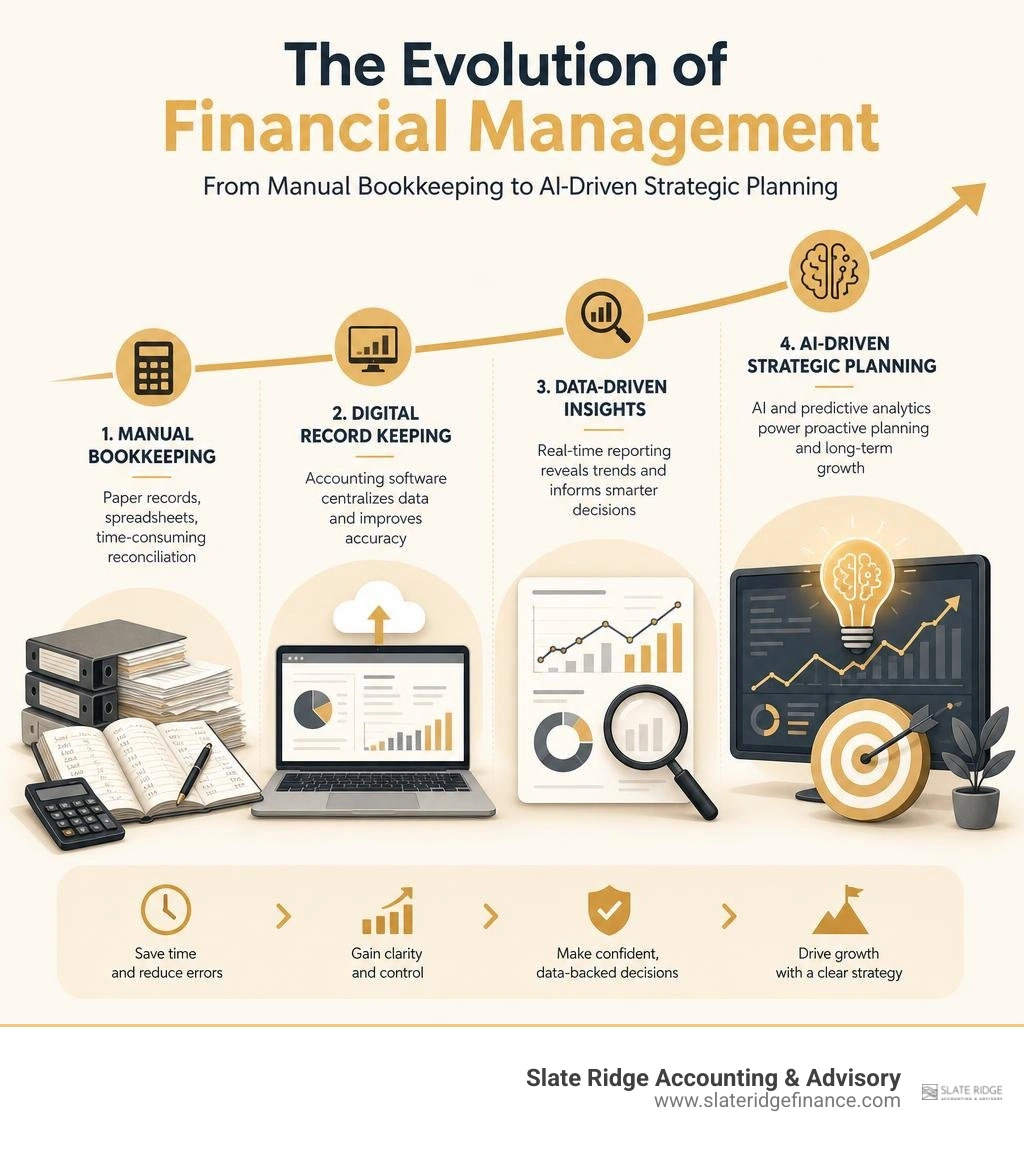
Basic modern financial management glossary:
What is Modern Financial Management?

At its simplest, modern financial management is the framework an organization and its leaders use to guide resource allocation, investment decisions, and operational efficiency. It encompasses everything from day-to-day cash flow monitoring to long-term investment decisions.
In the past, managing business finances was often treated as a back-office administrative task—little more than recording historical transactions and filing taxes. Today, it has shifted into a forward-looking strategic driver of competitive advantage.
The core purpose of this discipline is to ensure your business remains financially sustainable, achieves its strategic goals, maintains regulatory compliance, and maximizes value. Without a structured financial management plan, even a business with a fantastic product or service can quickly run out of cash.
The Core Purpose of Modern Financial Management
The ultimate goal of any business has traditionally been described as shareholder wealth maximization. However, the modern perspective has evolved. Today, leading experts advocate for a broader approach that balances profit with the needs of all stakeholders—including employees, customers, and the community.
In the textbook Financial Managing for a Sustainable World, the authors highlight how modern finance must integrate both traditional accounting data and non-accounting sustainability metrics to create long-term value. This shifts the focus from short-term greed to enduring, sustainable growth.
By adopting Modern Accounting Practices, businesses can move past simple compliance. Instead of just looking backward at what you spent last month, modern practices give you the tools to look forward, ensuring every dollar allocated serves a clear, strategic purpose.
Strategic vs. Tactical Financial Management
To understand how this works in daily operations, it helps to divide financial management into two distinct levels: strategic and tactical.
- Tactical Financial Management: This is the "boots-on-the-ground" execution. It involves managing daily transactions, paying bills on time, invoicing customers, processing payroll, and keeping the books balanced. It is essential for survival, but on its own, it won't grow your business.
- Strategic Financial Management: This is the high-level visioning. It involves financial planning and analysis (FP&A), identifying expansion opportunities, assessing risk, and determining how to fund major projects.
When you combine the two, tactical data feeds into your strategic models. For instance, a detailed Financial Performance Analysis allows you to spot trends in your daily transactions, giving you the clarity needed to make confident, long-term strategic adjustments.
The Three Pillars of Modern Financial Decisions
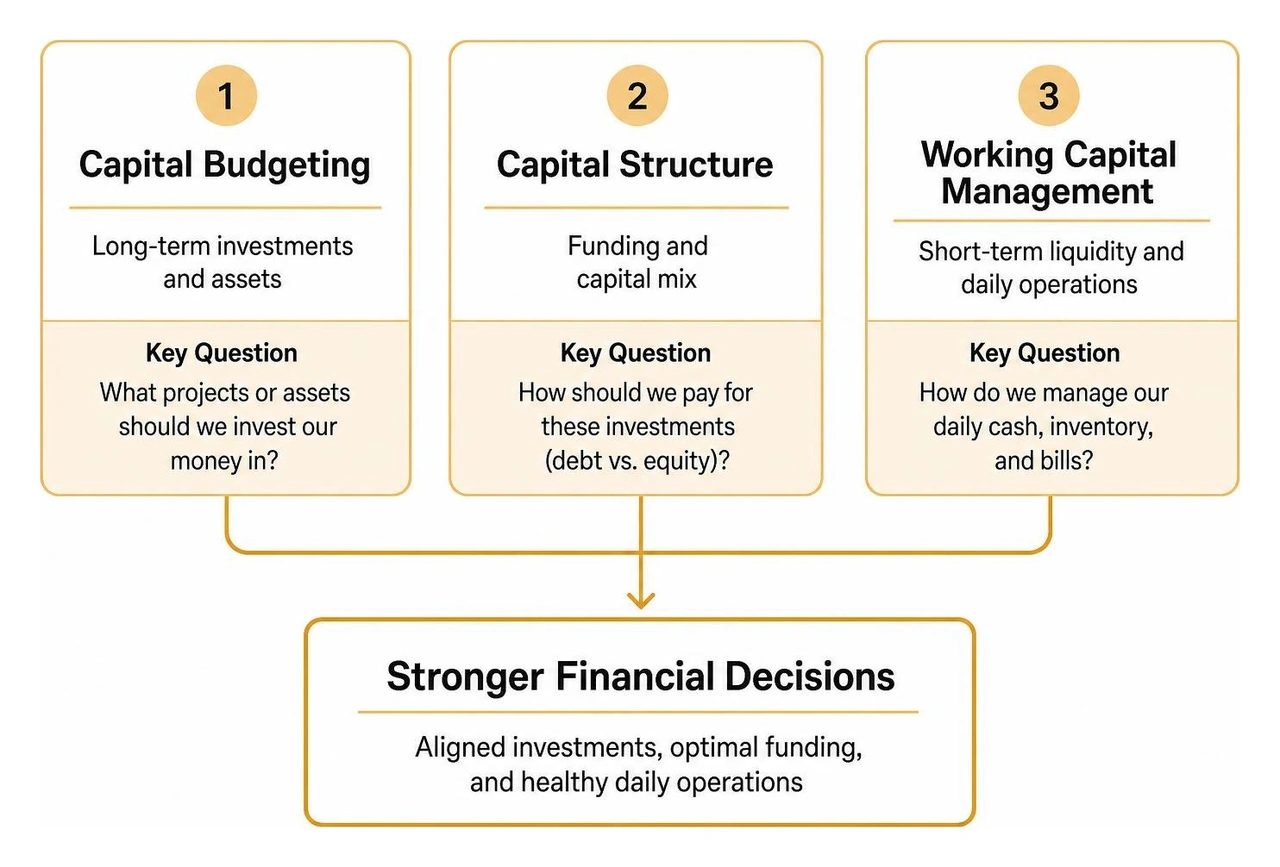
Every financial decision in a business falls into one of three primary categories. Understanding these pillars is crucial for maintaining balance in your operations.
| Decision Type | Core Focus | Key Question Answered |
|---|---|---|
| Capital Budgeting | Long-term investments and assets | "What projects or assets should we invest our money in?" |
| Capital Structure | Funding and capital mix | "How should we pay for these investments (debt vs. equity)?" |
| Working Capital Management | Short-term liquidity and daily operations | "How do we manage our daily cash, inventory, and bills?" |
Capital Budgeting and Long-Term Investments
Capital budgeting is the process of analyzing and prioritizing large-scale, long-term investments. Whether you are thinking about opening a new office in Charlotte, NC, purchasing heavy machinery, or developing a new software platform, capital budgeting helps you determine if the project is worth the risk.
To evaluate these opportunities, modern financial managers rely on key metrics such as Net Present Value (NPV) and Internal Rate of Return (IRR). These mathematical models help you understand the time value of money—the concept that a dollar today is worth more than a dollar tomorrow.
As outlined in Financial Management: Principles and Applications, Global Edition, structured project evaluation and risk analysis prevent businesses from sinking precious capital into unprofitable ventures.
Capital Structure and Funding Strategies
Once you identify a valuable project, you have to figure out how to pay for it. This is where capital structure comes in. It represents the specific mix of debt (such as bank loans or lines of credit) and equity (such as owner investment or venture capital) used to finance your operations and growth.
Balancing this mix is a delicate art. Too much debt can lead to high interest payments that strain your cash flow, while relying too heavily on equity can dilute your ownership and limit your return on investment.
The text AE Contemporary Financial Management emphasizes that optimizing your capital structure is a primary driver of value creation. The goal is to minimize your overall cost of capital while keeping your risk profile at a manageable level.
Working Capital Management and Liquidity
While capital budgeting and structure focus on the long-term horizon, working capital management is all about the present. It involves managing your current assets (cash, accounts receivable, and inventory) and current liabilities (accounts payable and short-term debt).
A key metric here is the Cash Conversion Cycle (CCC), which measures how long it takes to turn raw inventory investments back into cash in your bank account. If your CCC is too long, your cash gets trapped in unpaid invoices or unsold stock on warehouse shelves.
By leveraging Modern Bookkeeping Services, businesses can keep a real-time watch on their cash conversion metrics. This ensures you always have enough liquidity to cover immediate obligations without leaving excess cash sitting idle.
Key Components and Scope of Modern Financial Operations
Modern financial operations stretch far beyond simple bookkeeping. To build a resilient business, you must establish a comprehensive system that covers planning, budgeting, risk mitigation, and process optimization.
Financial Planning, Forecasting, and Budgeting
A budget shouldn't be a rigid document that you create in January and ignore for the rest of the year. Modern businesses utilize flexible budgeting, which adjusts automatically based on changes in revenue or market conditions.
Pairing your budget with dynamic cash flow forecasting allows you to play out different scenarios. For example, if you want to expand your services in Asheville, NC, or Boone, NC, scenario planning can show you exactly how that move will impact your bank balance six months down the road.
Implementing structured Financial Forecasting and Planning is especially critical for smaller operations. With a clear Financial Planning Small Business strategy, you can confidently navigate seasonal dips and make hiring decisions based on real numbers rather than gut feelings.
Risk Management and Establishing Procedures
Every business face risks, from sudden economic shifts to internal errors. Modern financial management mitigates these risks by establishing clear, written financial procedures and internal controls.
This includes defining who has the authority to sign off on specific expenses, setting up automated alerts for unusual transactions, and separating duties so that the person who approves an invoice isn't the same person who sends the payment.
Focusing on Financial Process Optimization not only protects your assets from fraud and simple human error, but it also streamlines your workflows, saving your team hours of manual administrative work each week.
How Technology and AI Drive Modern Financial Management
The days of manual data entry and massive, error-prone spreadsheets are coming to an end. Modern technology, including cloud-based ERP systems and artificial intelligence, has completely transformed how we manage business finances.
Integrating your core operations—accounting, payroll, inventory, and customer relationship management—into a single cloud system provides a unified, real-time view of your financial health.
When you utilize modern Cloud Accounting Services, you no longer have to wait until the end of the month to see your financial statements. You can access accurate, up-to-date data from anywhere, whether you are working from an office in Raleigh, NC, or checking in from Wilmington, NC.
Leveraging AI and FinOps for Cost Savings
Artificial intelligence is no longer a futuristic concept; it is actively saving businesses money today. Organizations that implement AI-powered FinOps models for their cloud-based investments report cost savings exceeding 20%.
These tools work by analyzing historical data to build highly accurate predictive models. Instead of spending hours manually running calculations, automated systems can instantly flag inefficiencies, predict cash flow bottlenecks, and even automate your bank reconciliations.
By freeing up your team from repetitive tasks, technology allows you to focus on high-level Business Performance Tracking. This shifts your finance department from a cost center into a strategic partner that actively helps identify new revenue streams.
Essential Skills and Challenges for Today's Financial Leaders
Because the role of finance has changed, the skills required to be a successful financial leader have evolved as well.
Today's financial managers cannot simply hide behind spreadsheets. They must possess strong collaborative leadership and communication skills. A modern financial leader must act as a bridge, translating complex financial data into clear, actionable insights for non-finance department heads.
However, modern leaders also face unique challenges:
- Balancing cash flow vs. growth: Knowing when to conserve cash and when to aggressively reinvest it for expansion.
- Data integration: Pulling together data from multiple software platforms to create a single, accurate source of truth.
- Regulatory compliance: Keeping up with constantly changing local, state, and federal tax laws—especially if you operate across multiple municipalities in North Carolina, such as Greensboro, Greenville, Hickory, or Morganton.
Frequently Asked Questions about Financial Management
What are the four Cs of financial management?
The four Cs represent a simple framework used to assess a company's financial position and creditworthiness:
- Cash Flow: The movement of money in and out of your business; the lifeblood of daily operations.
- Credit: Your business's ability to borrow money and its history of repaying debts.
- Customers: The financial health, payment habits, and overall profitability of your client base.
- Collateral: Assets that can be used to secure financing if your business needs to borrow capital.
What are the three Es of financial management?
The three Es focus on measuring how effectively a business uses its resources:
- Economy: Acquiring resources of the appropriate quality at the lowest reasonable cost (spending less).
- Efficiency: Maximizing the relationship between inputs and outputs—getting the most out of your resources (spending well).
- Effectiveness: Ensuring that your financial activities directly support and achieve your core business goals (spending on the right things).
How does financial management support organizational control?
Financial management provides the benchmarks and guardrails needed to keep a business on track. By establishing clear budgets and key performance indicators (KPIs), you can perform regular variance analysis to compare your actual spending against your plans. This performance tracking alerts you to overspending or underperforming product lines early, allowing you to make course corrections before they impact your bottom line.
Conclusion
Modern financial management is no longer a luxury reserved for massive corporations. By combining strategic planning, the three pillars of financial decision-making, and modern cloud technology, small businesses can build a resilient foundation for long-term growth.
Whether you are looking to optimize your working capital, streamline your daily bookkeeping, or build a predictive forecast to fund your next big project, you don't have to navigate this journey alone.
At Slate Ridge Accounting & Advisory, we provide cloud-based virtual bookkeeping, financial clean-up, and advisory services tailored specifically to your business's unique needs. Let us handle the complexities of modern finance so you can focus on what you do best—growing your business. Reach out to us today to learn how we can help you turn your financial data into your greatest competitive advantage.
Ready to get started?
Book a free consultation today and let’s explore how Slate Ridge can support your business with expert accounting that’s accurate, timely, and built around your goals.
You Might Also Like
A few more posts we think you’ll enjoy on topics that matter to business owners like you.