

DIY or Hire a Pro? What Every Small Business Owner Needs to Know About Accounting
Small biz accounting is one of the most important — and most overlooked — parts of running a successful company. Whether you're a solo founder or managing a growing team, how you handle your books directly affects your cash flow, your taxes, and your ability to make smart decisions.
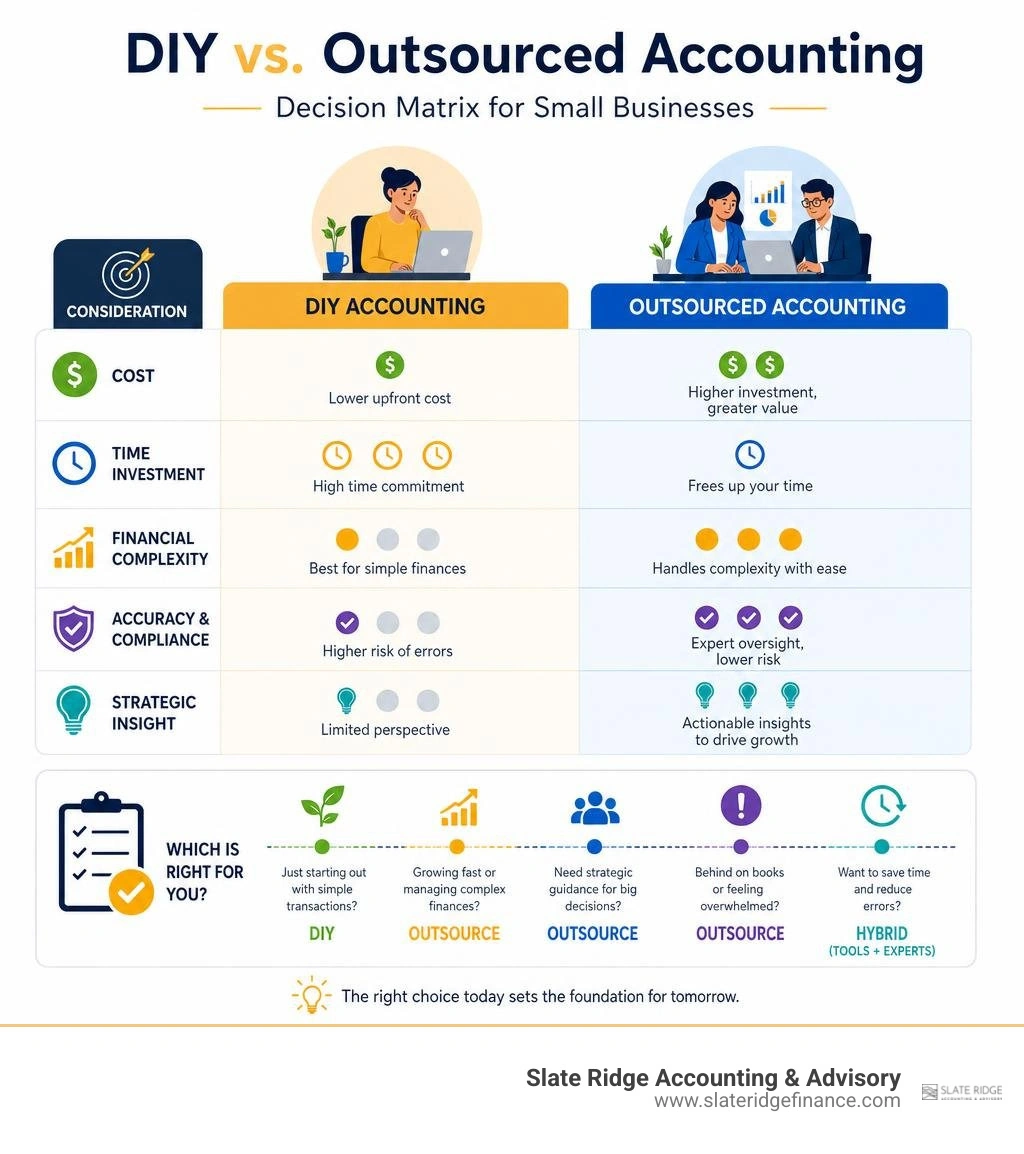
Here's a quick answer to the core question:
| Situation | Best Approach |
|---|---|
| Just starting out, very few transactions | DIY software (QuickBooks, Xero) |
| Growing fast, complex finances | SME accounting firm or hybrid model |
| Need strategic guidance (hiring, funding, exit) | Fractional CFO or full-service firm |
| Overwhelmed, behind on books | Professional bookkeeping service |
| Want to save time and reduce errors | AI-assisted tools + human oversight |
The US small business bookkeeping market is worth over $70 billion — and the average small business spends around $3,400 per year on bookkeeping alone. That's a significant investment. The real question is whether that money is being spent wisely.
The stakes are real. A business can be profitable on paper and still run out of cash. Missed deductions, messy records, and the wrong accounting method can quietly cost you thousands every year — without you even knowing it.
This guide is written by Caroline and Joe at Slate Ridge Accounting & Advisory, and we'll walk you through everything you need to make the right call for your business.
Understanding the Basics of Small Biz Accounting
At its core, small biz accounting is the process of tracking, recording, and analyzing your business’s financial transactions. It is the language of your business. Without it, you are essentially flying blind in a storm.
Many entrepreneurs confuse bookkeeping with accounting. Bookkeeping is the day-to-day recording of transactions — keeping track of invoices, receipts, and bank statements. Accounting takes those records and turns them into a strategic map. It involves financial analysis, tax planning, and growth forecasting. To build a solid foundation, we recommend checking out our comprehensive Accounting For Small Businesses Guide to understand how these parts fit together.
Why Small Biz Accounting is Essential for Growth
You didn't start a business to spend your weekends staring at spreadsheets. However, ignoring your numbers is the fastest way to stunt your growth. Proper financial planning is what separates a passion project from a scalable enterprise.
When your books are clean and organized:
- Lenders and Investors Gain Confidence: If you ever need to apply for a small business loan or pitch to investors, they won’t just look at your product; they will audit your financial history. They want to see clean, GAAP-compliant statements that tell a story of sustainability.
- You Can Spot Gaps Early: Are your marketing costs rising faster than your sales? Is a specific product line eating up all your margins? Good accounting highlights these issues before they become crises.
- Tax Season is a Breeze: Instead of scrambling in April, you have IRS-ready books year-round.
For practical steps on setting up your processes, review our Small Business Accounting Tips Guide.
Cash Basis vs. Accrual Accounting Methods
One of the first decisions you must make is choosing your accounting method. This choice affects how and when you recognize revenue and expenses.
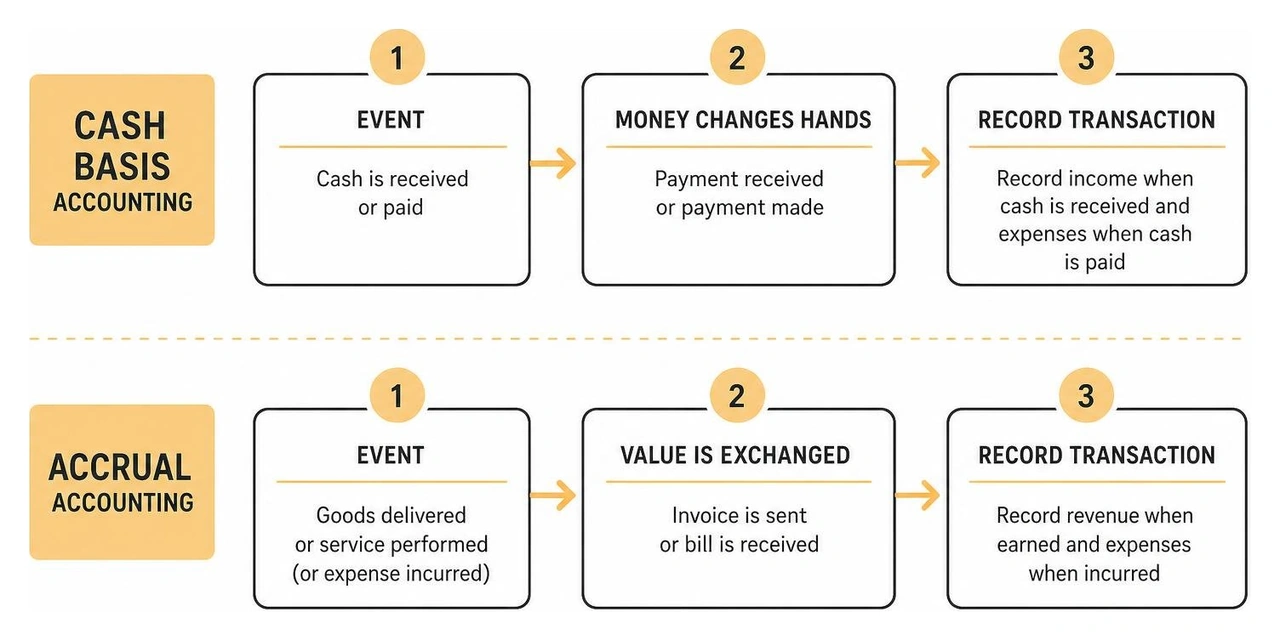
- Cash Basis Accounting: You record income when cash is received and expenses when cash is paid. It is simple, intuitive, and works well for very small businesses with no inventory.
- Accrual Accounting: You record revenue when it is earned (e.g., when you send an invoice or deliver a service) and expenses when they are incurred. This method is crucial for rapidly growing businesses because it gives you a much more accurate picture of your long-term profitability.
| Feature | Cash Basis | Accrual Accounting |
|---|---|---|
| When is revenue recorded? | When cash is received | When the sale is made / invoiced |
| When are expenses recorded? | When cash is paid out | When the service or product is received |
| Pros | Easy to manage; clear view of cash in bank | Accurate view of long-term profitability |
| Cons | Can hide upcoming bills or delayed revenue | More complex; doesn't show immediate cash flow |
Essential Financial Reports and KPIs to Track
Great accounting produces useful, actionable reports, not just numbers on a page. To keep your business healthy, you need to understand your reports and know How To Track Kpis that matter to your bottom line.
The Big Three Financial Reports
There are three essential financial statements that every business owner must review regularly:
- The Profit and Loss (P&L) Statement: Also known as the income statement, this shows your revenues, costs, and expenses over a specific period. It answers the fundamental question: Are we making a profit?
- The Balance Sheet: This provides a snapshot of your business’s financial health at a single point in time, showing what you own (assets), what you owe (liabilities), and your equity.
- The Cash Flow Statement: This tracks the actual physical movement of cash in and out of your business. A business can look highly profitable on a P&L but still go bankrupt if cash is locked up in unpaid invoices (accounts receivable) when bills are due.
Key Performance Indicators for Small Biz Accounting
To truly drive growth, you need to look beyond basic profitability. Here are the key performance indicators (KPIs) we help our clients track:
- Gross Profit Margin: This measures how much money is left over from sales after paying the direct costs of producing your goods or services.
- Customer Acquisition Cost (CAC): How much do you spend to acquire a single customer? If your CAC is higher than your customer lifetime value, your business model is unsustainable.
- Cash Runway & Burn Rate: Especially critical for startups, this tells you exactly how many months your business can survive if revenue stops today.
The Battle of the Back Office: DIY Software vs. SME Accounting Firms
As your business grows, you will eventually hit a wall where managing your own books becomes a bottleneck. Should you stick with DIY software, hire an in-house team, or partner with an outsourced firm?
The Pros and Cons of DIY Accounting Software
Cloud-based DIY tools like QuickBooks Online or Xero have revolutionized small business finances. More than 4 million subscribers globally use Xero to streamline their operations, and QuickBooks users report saving an average of 13 hours each month.
Pros:
- Affordability: Software subscriptions are highly cost-effective for startups.
- Automation: Automated bank feeds pull transactions directly into your ledger.
- Accessibility: You can run invoices and track expenses from your phone.
Cons:
- The "Garbage In, Garbage Out" Problem: Software is only as good as the data entered. If you categorize an owner's draw as a business expense, your reports will be wrong, and your tax return will be incorrect.
- No Strategic Context: Software can tell you what happened, but it cannot tell you why it happened or how to fix it.
- Time Consumption: As transaction volume grows, managing the software can easily consume 10 to 40 hours a month of a founder's valuable time.
The Value of Partnering with an SME Accounting Firm
Partnering with an SME accounting firm gives you the best of both worlds: advanced technology and human expertise. At Slate Ridge Accounting & Advisory, we act as your virtual finance team, taking the burden of bookkeeping off your shoulders while providing high-level financial forecasting.
When you work with a professional firm:
- You Get Expert Advice: You gain access to CPAs and advisory experts who can help you model cash flow scenarios before you make your next big hire.
- You Avoid Costly Errors: Our team ensures your books are GAAP-compliant and audit-ready.
- You Can Focus on Scaling: Instead of digging through spreadsheets, you can focus on leading your company.
To explore how outsourcing can transform your daily operations, check out our Accounting Outsourcing Complete Guide and our Best Accounting Services Small Biz Guide.
Maximizing Deductions and Navigating Complex Tax Landscapes
Tax planning is not a once-a-year event; it is a year-round strategy. Keeping your books clean ensures you never miss out on valuable tax write-offs.
Common Deductible Business Expenses
To maximize your tax savings, you must track every legitimate business expense. Some of the most common deductible expenses include:
- Office Expenses & Rent: Whether you rent a commercial space or use a dedicated home office.
- Software Subscriptions: The tools you use to run your business daily, from your CRM to your accounting systems.
- Travel and Vehicle Costs: Mileage and travel expenses incurred for business purposes.
To keep these expenses organized and ensure your bills are paid on time, it is vital to establish solid workflows. Learn more in our Accounts Payable Complete Guide Small Business.
Navigating State and Local Tax Nuances
Tax regulations vary wildly depending on where your business is physically located or where you do business. For our clients operating across North Carolina, understanding localized tax requirements is critical.
For instance, if your business operates in or near major NC metro areas, you must stay compliant with state-specific franchise taxes and local county property taxes. If you expand your business footprint nationally, you might also run into complex local tax structures like the NYC corporate tax or Virginia's BPOL (Business, Professional, and Occupational License) tax.
Working with local experts who understand these regional nuances is key to avoiding compliance surprises. By partnering with a specialized firm that has deep roots in North Carolina, you can navigate these complex state and local tax structures with confidence, ensuring your business remains fully compliant while optimizing your tax position.
Frequently Asked Questions about Small Business Accounting
How can AI and automation improve bookkeeping accuracy?
AI tools and automated systems are fantastic for handling high-volume, repetitive tasks. They can pull data directly from your bank accounts, extract information from scanned receipts, and automatically suggest categories for standard transactions.
However, AI is not foolproof. A software algorithm does not understand the unique context of your business and cannot take legal responsibility if an error is made on your tax return. The most accurate approach is a hybrid model: using AI to handle the volume and human experts to verify the accuracy and deliver strategic value.
What should I look for when choosing an accountant?
When evaluating accounting partners, look for the following:
- CPA Credentials: Ensure you are working with certified public accountants who understand current tax laws.
- Fixed-Fee Pricing: Traditional hourly billing can lead to surprise invoices. Look for a firm that offers transparent monthly packages.
- Modern, Cloud-Based Workflows: Your accountant should work in real-time in the cloud, not require you to drop off physical boxes of paper receipts.
For a deeper dive into this decision, read our guide on What Type Of Accountant Is Best For A Small Business.
How much does professional bookkeeping cost?
Bookkeeping costs vary depending on the size of your business, your transaction volume, and the complexity of your financial needs. Some firms charge hourly, while modern virtual firms typically offer flat monthly fees.
To help you budget effectively and choose the right level of service, we have compiled a detailed breakdown in our Bookkeeping Services Pricing Guide.
Conclusion
At the end of the day, your financial records should not just be a historical archive of what you spent. They should be a forward-looking tool that helps you grow.
At Slate Ridge Accounting & Advisory, we help small businesses across North Carolina — from Asheville to Wilmington, and everywhere in between — transition from financial confusion to complete clarity. We offer cloud-based virtual bookkeeping, comprehensive financial clean-ups, and proactive advisory services designed to help you track your KPIs and forecast your future growth.
Stop spending your valuable weekends buried under a mountain of receipts. Let us handle the numbers so you can focus on building your business.
Partner with Slate Ridge Accounting & Advisory today to take control of your financial future.
Ready to get started?
Book a free consultation today and let’s explore how Slate Ridge can support your business with expert accounting that’s accurate, timely, and built around your goals.
You Might Also Like
A few more posts we think you’ll enjoy on topics that matter to business owners like you.