
How to Start a Small Business Budget
Start with a monthly plan: Estimate your sales, list fixed costs like rent, and forecast costs that change with sales. Add one-time purchases and a cash reserve for surprises. Then compare your plan with what actually happened each month so you can adjust spending before a shortfall grows.
A budget helps you protect today’s cash while making room for future growth. We’re Caroline and Joe, and we’ll show you how to build one you can keep using.

Must-know budgeting for small business terms:
The Fundamentals of Budgeting for Small Business
Running a business without a clear budget is like driving through the Blue Ridge Mountains in thick fog without headlights—you might stay on the road for a while, but every sharp turn brings unnecessary stress. A well-designed budget provides financial resilience, ensures efficient resource allocation, and acts as your primary tool for risk mitigation.
Rather than viewing a budget as a restrictive financial diet, think of it as an operational roadmap. It clarifies how much capital you can afford to reinvest, helps you build strategic cash reserves, and ensures day-to-day expense tracking aligns with your high-level business goals. When combined with a comprehensive financial planning guide for small business, budgeting turns abstract goals into actionable, month-by-month financial milestones.
Core Benefits of Proactive Financial Management
Proactive financial management protects your bottom line through several distinct operational mechanisms:
- Predictable Cost Control: Tracking spending before invoices arrive prevents unmonitored software subscriptions, unnecessary overhead, and vendor creep from eroding your profit margins.
- Strategic Debt Management: When you understand your cash inflows and outflows, you avoid taking on emergency, high-interest loans to cover routine operational expenses.
- Informed Decision-Making: A live budget answers critical questions immediately—such as whether you can afford to hire a new team member, invest in marketing, or lease new office space.
- Clear Profit Targets: Budgeting helps you set realistic gross and net profit margins based on real-world cost structures rather than wishful thinking.
- Structured Investment Planning: Having visibility into your cash surplus lets you confidently allocate capital toward equipment, technology, and team expansion.
Master Budget vs. Operating Budget
Small businesses frequently confuse their overarching financial architecture with day-to-day spending targets. Understanding the difference between a master budget and an operating budget is critical for keeping your records organized.
An operating budget focuses on the routine revenue and expenses required to run your business over a specific time frame (typically monthly, quarterly, or annually). It details expected sales, cost of goods sold (COGS), payroll, marketing, and general administrative overhead.
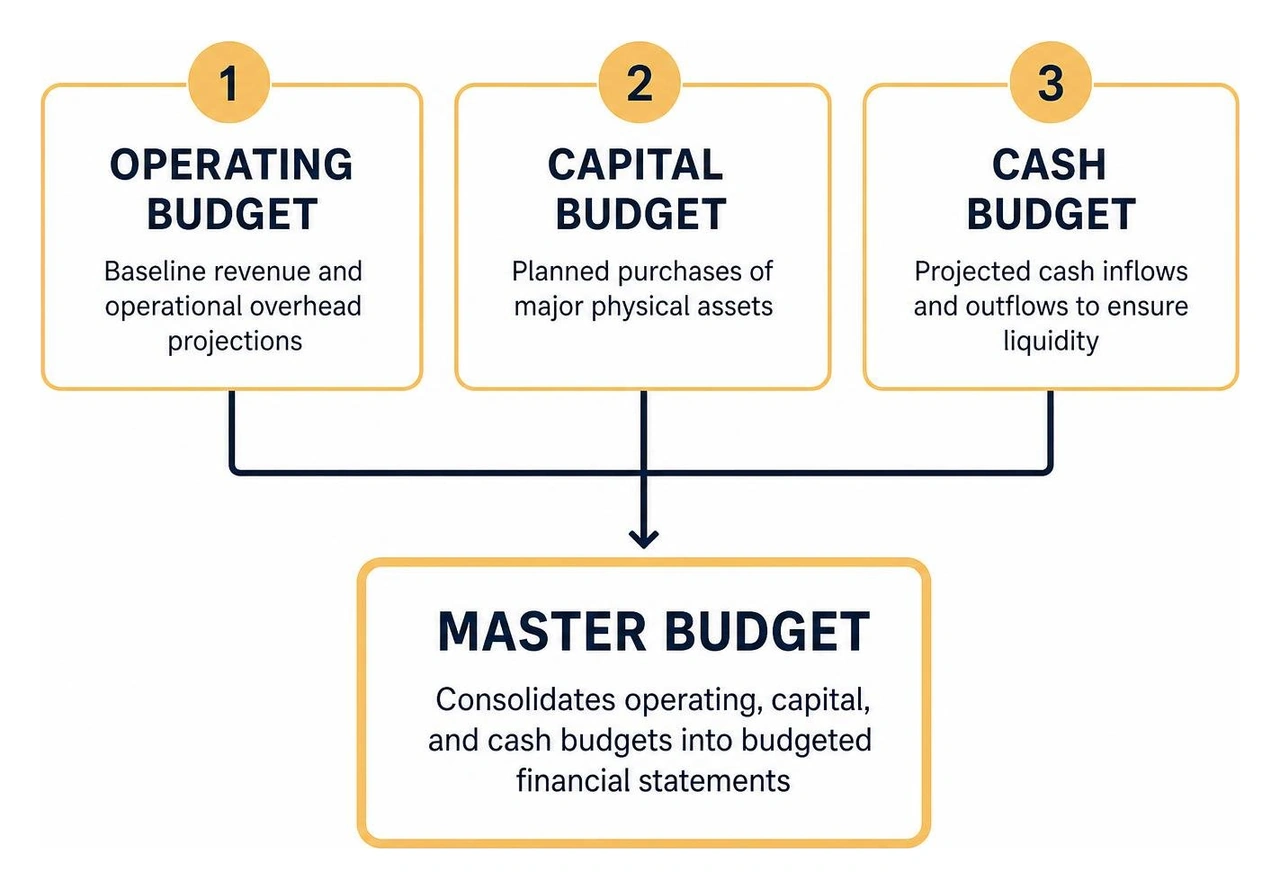
A master budget, on the other hand, is the comprehensive umbrella that consolidates all smaller, specialized budgets across your company. It incorporates:
- The Operating Budget: Your baseline revenue and operational overhead projections.
- The Capital Expenditures (CapEx) Budget: Planned purchases of major physical assets, such as machinery, commercial vehicles, or facility renovations.
- The Cash Budget: A projected cash flow forecast tracking actual cash inflows and outflows to ensure ongoing liquidity.
- Budgeted Financial Statements: Pro-forma versions of your income statement, balance sheet, and cash flow statement.
Step-by-Step Guide to Creating a Small Business Budget

Building a dependable budget does not require a finance degree or expensive software suites. Following a structured, four-step workflow establishes baseline metrics using historical data and realistic market projections.
Step 1: Project Revenue and Income Streams
Start by identifying all your anticipated cash inflows. If you have been in business for over a year, review historical data from your accounting software over the past twelve months to establish baseline sales volume trends.
When calculating your projected gross revenue, be sure to account for:
- Core Product or Service Sales: Your primary operational revenue lines.
- Client Retainers and Recurring Contracts: Predictable subscription or contract income.
- Seasonal Fluctuations: Account for slower quarters and peak revenue cycles rather than simply dividing annual sales by twelve.
- Non-Operating Income: Secondary cash inflows such as interest earned on business savings accounts, equipment sales, or short-term investments.
If you are a newer business without historical sales records, research industry benchmarks and use conservative sales estimates. Projecting three distinct scenarios—conservative, moderate, and aggressive—gives you clear operating thresholds if revenue falls short.
Step 2: Differentiate Fixed, Variable, and One-Time Expenses
Organizing your expenses into distinct categories clarifies exactly where your cash goes and which costs you can reduce if revenue slows down.
- Fixed Costs: Consistent monthly obligations that stay the same regardless of your sales volume. These include office rent, baseline salaries, commercial insurance policies, website hosting, accounting retainers, and equipment lease payments.
- Variable Expenses: Costs that rise or fall based on production and sales volume. Examples include raw materials, packaging, inventory purchases, direct shipping fees, sales commissions, and merchant processing charges. Identifying these costs helps you apply targeted actionable cost reduction strategies without disrupting core operations.
- One-Time Outlays: Irregular capital expenditures such as emergency legal filings, annual software renewals, computer hardware upgrades, or initial office buildouts. That state statement filing fees can exceed $300, and workplace accommodations generally cost around $500 when they have a cost at all (though roughly half cost nothing and quickly pay for themselves in reduced turnover and higher productivity).
Step 3: Establish a Contingency Fund and Cash Buffer
Every business encounters unexpected expenses, from sudden server failures to HVAC breakdowns. Setting aside an emergency reserve protects your daily operations and maintains healthy working capital.
According to proven SCORE recommendations for managing cash flow reserves, small businesses should aim to keep an emergency cash buffer equal to 5% to 10% of gross revenue, or approximately three to six months of baseline fixed operational overhead.
Building this reserve gives your business the risk tolerance needed to handle delayed client receivables, unexpected supply chain disruptions, or sudden regulatory compliance updates without cutting vital team members.
Step 4: Track Performance with Financial Statements
A budget is a live operational guide rather than a static document you file away. To keep it effective, compare your projected numbers against your actual monthly bookkeeping records using your primary financial statements.
Your Profit and Loss (P&L) Statement shows whether your operations are generating a net profit or running at a loss during the period. Your Balance Sheet tracks cumulative assets, liabilities, and owner's equity, giving you a clear view of your company's overall solvency.
Conducting a monthly variance analysis allows you to see the exact dollar and percentage differences between your budgeted targets and actual results. For deeper guidance on structuring these reports, explore our guide on small business financial reporting, as well as the practical FDIC guide on budgeting and financial statements.
Evaluating Core Business Budgeting Models
Different businesses require different budgeting methodologies depending on their industry, operational complexity, and maturity stage. Selecting the right financial modeling approach ensures your budget matches your internal management bandwidth.
| Budgeting Model | Best Suited For | Core Advantage | Main Drawback |
|---|---|---|---|
| Zero-Based Budgeting (ZBB) | Startups, turnarounds, and high-scrutiny periods | Eliminates unnecessary expenses and enforces spending justification | Time-intensive and demanding to maintain |
| Incremental Budgeting | Mature businesses with predictable operations | Simple to calculate based on historical figures | Can perpetuate unnecessary legacy spending |
| Activity-Based Budgeting (ABB) | Manufacturing, logistics, and high-volume operations | Directly ties resource spending to production output targets | Requires detailed tracking of granular operational activities |
| Value-Proposition Budgeting | Customer-centric service firms and tech companies | Ensures every dollar supports tangible customer or stakeholder value | Subjective scoring can cause internal disagreements |
Choosing the Right Model for Budgeting for Small Business
When selecting an approach, consider your team's size and the predictability of your market:
- Incremental Budgeting: Takes the prior period's actual numbers and adjusts them up or down by a set percentage (e.g., adding 3% for inflation or projected sales growth). While fast, it risks carrying over outdated expenses.
- Activity-Based Budgeting: Works backward from your operational goals. If you plan to manufacture 500 custom units, ABB calculates the exact labor hours, machine time, and materials required to set your spending limits.
- Value-Proposition Budgeting: Reviews line items by asking: Does this expense create clear value for our customers, team, or bottom line? If an expense cannot demonstrate a direct return, it gets cut.
Implementing Zero-Based Budgeting for Tighter Control
For businesses looking to cut overhead or restructure costs, Zero-Based Budgeting (ZBB) provides unmatched financial discipline. Under this model, every department starts each planning period with a baseline budget of zero dollars.
Instead of assuming last year's spending is automatically approved, managers must justify every single expense—from recurring software seats to travel budgets. This systematic review eliminates legacy waste, redirects capital toward high-ROI initiatives, and ensures every dollar spent supports strategic business growth.
Resource Allocation and Long-Term Scaling Strategies

Scaling a business requires balancing short-term operational obligations with long-term capital deployment. By applying disciplined resource frameworks alongside dynamic business financial forecasting techniques, you can expand without overextending your cash reserves.
Applying the 70-20-10 Rule to Budgeting for Small Business
The 70-20-10 Rule provides an intuitive framework for allocating your net income to support both daily execution and sustainable future expansion:
- 70% for Core Operations: Dedicated to maintaining essential business functions, including payroll, rent, inventory replenishment, software, taxes, and customer fulfillment.
- 20% for Growth Opportunities: Allocated toward medium-term expansion projects, such as hiring specialists, testing new advertising channels, upgrading operational tools, or expanding product lines.
- 10% for Long-Term Innovation and Reserves: Directed into strategic capital reserves, proprietary research and development, major capital purchases, or debt reduction to protect the company's future.
Navigating Economic Uncertainty with Rolling Forecasts
Static annual budgets often become outdated during market shifts, supply chain crunches, or sudden inflation. To maintain agility, replace rigid annual plans with a rolling 90-day forecast.
A rolling forecast looks three months ahead and updates at the end of every month. This approach allows you to:
- Conduct realistic scenario planning (modelling best-case, expected, and worst-case cash positions).
- Make dynamic adjustments to variable spending before minor cash dips become major deficits.
- Perform ongoing in-depth financial performance analysis to spot shifts in customer payment behaviors or inventory turnover.
- Enter supplier negotiations early to secure volume discounts or extend vendor payment terms when supply chains tighten.
Frequently Asked Questions About Small Business Budgeting
How often should a small business review its budget?
Small businesses should conduct a formal budget review at the close of every month. Comparing actual income and expenses against budgeted targets helps you spot negative variances early. In addition, conduct a deeper quarterly reforecasting session to adjust projections based on shifting seasonal trends, market changes, or updated operational goals.
What is the difference between cash and accrual budgeting?
Cash budgeting tracks revenue and expenses strictly when cash enters or exits your bank account, offering clear, immediate visibility into your daily liquidity. Accrual budgeting records income when earned (such as when an invoice is sent) and expenses when incurred, regardless of when cash changes hands. While cash budgeting is simpler for tracking bank balances, accrual budgeting provides a truer picture of long-term operational profitability.
How much should a small business keep in a contingency fund?
A healthy benchmark is maintaining three to six months of fixed operating expenses in an easily accessible, liquid business savings account. Alternatively, businesses with highly predictable, recurring cash flows can maintain a dedicated reserve equal to 5% to 10% of their annual gross revenue to comfortably cover emergency repairs, tax adjustments, or seasonal lulls.
Conclusion
A well-structured budget provides the financial clarity you need to navigate economic changes, control overhead, and scale sustainably. Consistently monitoring your income streams, separating fixed from variable costs, and conducting monthly variance reviews turns your financial data into your strongest operational asset.
If managing financial spreadsheets and variance tracking is taking you away from serving your clients and growing your business, our team at Slate Ridge Accounting & Advisory is here to help. We provide modern, cloud-based bookkeeping, fractional advisory, and expert virtual accounting services tailored to small businesses throughout North Carolina—including Asheville, Boone, Charlotte, Greensboro, Greenville, Hickory, Morganton, Raleigh, and Wilmington. Reach out to us today to streamline your books and protect your bottom line.
Ready to get started?
Book a free consultation today and let’s explore how Slate Ridge can support your business with expert accounting that’s accurate, timely, and built around your goals.
You Might Also Like
A few more posts we think you’ll enjoy on topics that matter to business owners like you.