Why Every Business Leader Needs to Understand Corporate Cash Flow Forecasting
Corporate cash flow forecasting is the process of estimating how much cash will move in and out of your business over a defined future period — so you always know whether you'll have enough money to keep the lights on, pay your team, and fund growth.
Here's a quick overview:
| Question | Answer |
|---|---|
| What is it? | A projection of future cash inflows and outflows over a set time period |
| Why does it matter? | 82% of businesses fail due to cash flow problems |
| Who needs it? | Any business that wants to survive and grow |
| How often to update? | Weekly for short-term; monthly for medium and long-term |
| Key outputs | Opening balance, net cash movement, closing balance |
Many business owners track revenue and assume they're financially healthy. But a company can have strong sales and still run out of cash. That gap between what you earn on paper and what you actually have in the bank is exactly what cash flow forecasting is designed to close.
The numbers are sobering. Almost 90% of treasurers at large companies rate their forecasting accuracy as unsatisfactory. And yet, accurate forecasting is one of the single most important things a business can do to stay solvent and grow strategically.
This guide was put together by Caroline and Joe at Slate Ridge Accounting & Advisory to give you a clear, practical roadmap — whether you're building your first forecast or trying to sharpen the one you already have.
Why Corporate Cash Flow Forecasting is Critical for Business Survival
It’s hard to reach your business goals when you’re reacting to unexpected cash flow shifts rather than preparing for what’s ahead.
According to frequently cited industry research, a staggering 82% of businesses fail because of cash flow problems. It is rarely a lack of paper profitability that kills an enterprise; it is the sudden, catastrophic realization that there is no cash left in the bank to meet immediate payroll or vendor demands. Most organizations simply do not have the financial reserves to survive even a short-term cash flow crisis.
This is why corporate cash flow forecasting is not just a dry administrative task. It is a foundational strategic practice that transforms how you run your business. When you build a reliable forecasting process, you unlock several key benefits:
- Optimizing Liquidity: Instead of letting idle cash sit in low-interest accounts, or worse, finding yourself short during a peak purchasing cycle, forecasting helps you optimize your working capital. You can put surplus cash to work or secure lines of credit well before a shortage hits.
- Enhancing Stakeholder Credibility: Lenders, investors, and board members want to see fiscal discipline. Presenting a clear cash projection shows that you are in control of your numbers, which directly builds trust and improves your access to capital.
- Preventing the Hazards of Inaccurate Forecasting: Flawed or non-existent forecasts lead directly to cash shortages, overborrowing at high interest rates, poor investment timing, and reputational damage with suppliers who get paid late.
For a deeper dive into how this fits into your broader strategic roadmap, take a look at our guide on business financial forecasting.
Key Components and Horizons of Cash Flow Projections
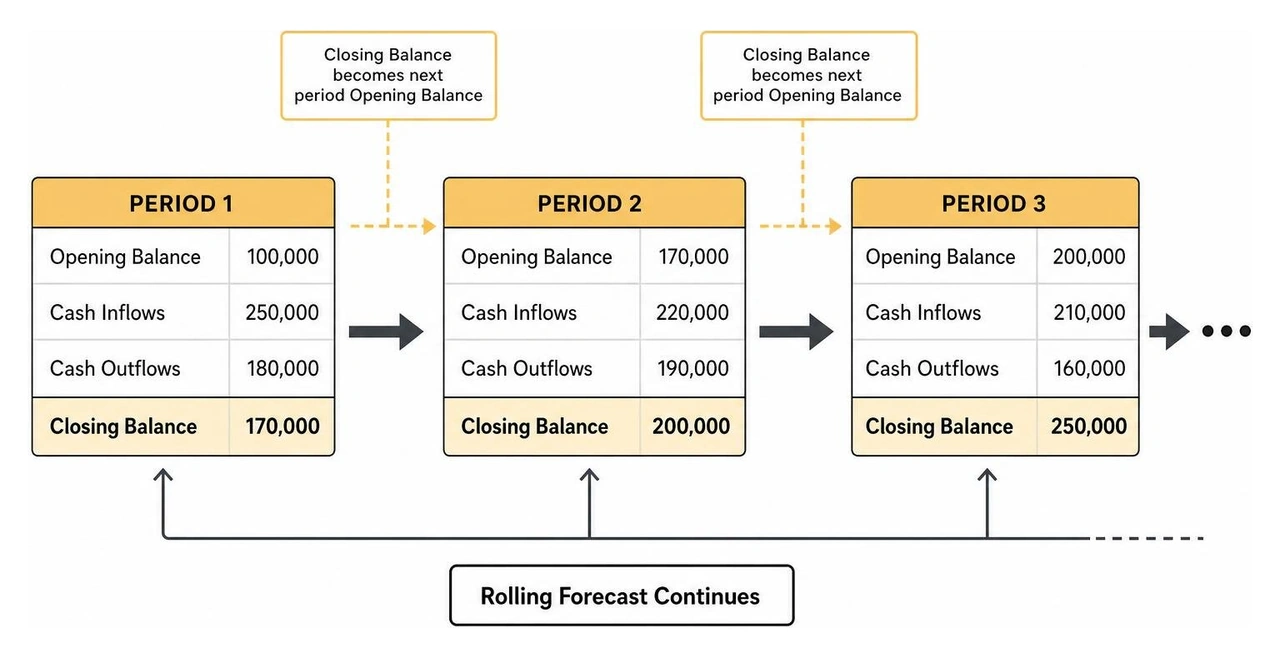
Every reliable cash flow forecast is built on four core components. Think of these as the mathematical building blocks of your treasury management:
- Opening Balance: The actual cash you have on hand across all operating accounts, savings, and cash pools at the very beginning of the forecasting period. Always start from your true cash position, not an estimate.
- Cash Inflows: All projected incoming cash. This includes customer invoice payments, tax refunds, asset sales, and financing draws.
- Cash Outflows: All projected cash leaving the business. This covers operating expenses, payroll, inventory purchases, debt service, capital expenditures (CAPEX), and tax payments.
- Closing Balance: The simple formula:
Opening Balance + Inflows - Outflows = Closing Balance. This figure becomes the opening balance for your next period.
To visualize how these components roll forward continuously, we use a rolling forecast model:
Short-Term, Medium-Term, and Long-Term Horizons
Not all cash forecasts serve the same purpose. Depending on what decisions you need to make, you will utilize different time horizons:
- Short-Term Horizons (Tactical, Rolling ~10 Days to 4 Weeks): This is your day-to-day operational cash tracker. It relies heavily on direct transactional data—like outstanding invoices and immediate bills—to ensure you can cover payroll and immediate supplier payments next week.
- Medium-Term Horizons (Operational, ~3 to 6 Months / 12 to 26 Weeks): The 13-week cash flow forecast is the gold standard of corporate treasury. It bridges the gap created by accrual accounting, helping you align invoice due dates with cash availability and manage seasonal working capital dips.
- Long-Term Horizons (Strategic, 12 Months to 5 Years): Used primarily for multi-year strategic planning, capital allocation, and testing acquisition scenarios. While less granular, these projections help you see the long-range liquidity impact of major investments.
For organizations managing complex operations across ERP platforms, you can review this Technical guide on ERP cash forecasting integration to understand how system modules feed directly into these horizons.
Direct vs. Indirect Forecasting Methods
When designing your forecasting process, you must choose between two primary methodologies: the Direct Method and the Indirect Method.
- The Direct Method is a ground-up approach. It looks directly at your bank accounts and lists actual projected cash receipts (collections from customers) and cash disbursements (payments to vendors, payroll, taxes). It is highly accurate for short-to-medium horizons but becomes incredibly tedious to project beyond 90 days.
- The Indirect Method starts with your projected Net Income from the P&L and adjusts it for non-cash transactions (like depreciation and amortization) and working capital changes (like accounts receivable and accounts payable balances from the balance sheet). It is the preferred choice for long-term strategic forecasting because it is easier to build from standard financial statements.
| Feature / Metric | Direct Forecasting Method | Indirect Forecasting Method |
|---|---|---|
| Primary Data Source | Bank transactions, AR/AP ledgers, actual cash receipts/payments | Net Income (P&L), Balance Sheet changes, non-cash adjustments |
| Ideal Time Horizon | Short-term (1 to 13 weeks) | Medium-to-long term (1 to 5 years) |
| Primary Use Case | Tactical liquidity management, payroll planning, daily cash positioning | Long-range strategic planning, capital structure modeling, board reporting |
| Level of Detail | Extremely granular (individual cash lines) | High-level (working capital trends) |
| Implementation Effort | High (requires continuous transaction-level data) | Moderate (derived from existing financial models) |
Direct vs. Indirect Corporate Cash Flow Forecasting
In the corporate world, choosing the right method is all about matching the tool to the problem. If you are a high-growth startup managing a tight runway, or a business experiencing seasonal cash swings, you need the tactical precision of the direct method. It tells you exactly when cash will hit the bank so you do not default on vendor payments.
Conversely, if you are presenting a three-year growth plan to investors, the indirect method is much more practical. It keeps your P&L, Balance Sheet, and Cash Flow Statement in perfect, integrated lockstep.
To see a practical breakdown of how these concepts play out in real-world corporate finance, watch this helpful Corporate Finance Explained Video.
Common Challenges and Pitfalls in Cash Flow Modeling
Even the most sophisticated finance teams run into roadblocks when modeling cash. Some of the most common pitfalls include:
- Spreadsheet Errors: Relying on manual, un-governed Excel sheets is a recipe for disaster. One broken macro or outdated formula can throw off your projected closing balance by hundreds of thousands of dollars.
- Communication Silos: Inaccuracies rarely stem from bad math; they usually stem from a lack of internal communication. If your sales team closes a massive deal but fails to tell finance that the customer negotiated 60-day payment terms instead of 15, your near-term forecast will be wrong.
- The "Net 30" Reality Check: (To quote Rick Ross, "Net 30 is a lie.") Contractual payment terms are frequently ignored. If your contract says Net 30, but historical data shows your customer consistently pays in 55 to 70 days, modeling your inflows strictly on Net 30 terms will leave you cash poor on a working capital basis.
- Timing Gaps: Accrual accounting records revenue when a deal is signed or an invoice is sent. But you cannot pay rent with an invoice. Failing to model the exact timing of cash receipts versus revenue recognition is a leading cause of sudden liquidity crises.
To mitigate these risks, modern financial leaders rely heavily on visual scenario analysis to map out potential cash variances before they happen:

Strategic Best Practices for Financial Leaders
To build a resilient forecasting engine in 2026, corporate finance leaders should adopt several core best practices:
- Run Scenario Analysis: Do not rely on a single "most likely" projection. Always model a baseline, a best-case (e.g., rapid sales growth requiring upfront inventory), and a worst-case scenario (e.g., a major customer delaying payment by 60 days or a sudden supply chain disruption).
- Perform Variance Analysis: Establish a feedback loop. Every single month (or week), compare your forecasted figures against your actual cash outcomes. If your variance is consistently higher than your target (e.g., 5%), dig into the data to find out where your assumptions went wrong.
- Embrace Automation: Manual data entry is slow and prone to human error. Modern treasury platforms and cloud integrations can pull live banking feeds and ERP data directly into your forecast, giving you real-time visibility.
- Maintain Strategic Cash Buffers: Keep at least one to three months of operating expenses in dedicated, yield-generating business savings accounts to weather unexpected market shifts.
If you are looking to elevate your corporate strategy, you can discover our financial forecasting and planning services designed to put these exact practices to work for your business.
Best Practices to Improve Corporate Cash Flow Forecasting Accuracy
- Use Rolling Forecasts: Instead of static annual forecasts that become obsolete by February, use rolling models that continuously extend your forward-looking horizon (e.g., always projecting 12 months out).
- Analyze Historical Customer Payment Patterns: Do not trust invoice due dates blindly. Look at your historical debtor days to model cash inflows based on when customers actually pay.
- Involve Department Leaders: Bring sales, procurement, and operations into the forecasting conversation. They have the ground-level insights on upcoming deals, inventory needs, and vendor contract changes.
- Separate Fixed and Variable Outflows: Clearly identify non-negotiable fixed costs (rent, payroll) and variable expenses (marketing, travel) so you know exactly where you can cut back if a cash crunch looms.
Frequently Asked Questions about Cash Flow Projections
How does cash flow forecasting differ from budgeting?
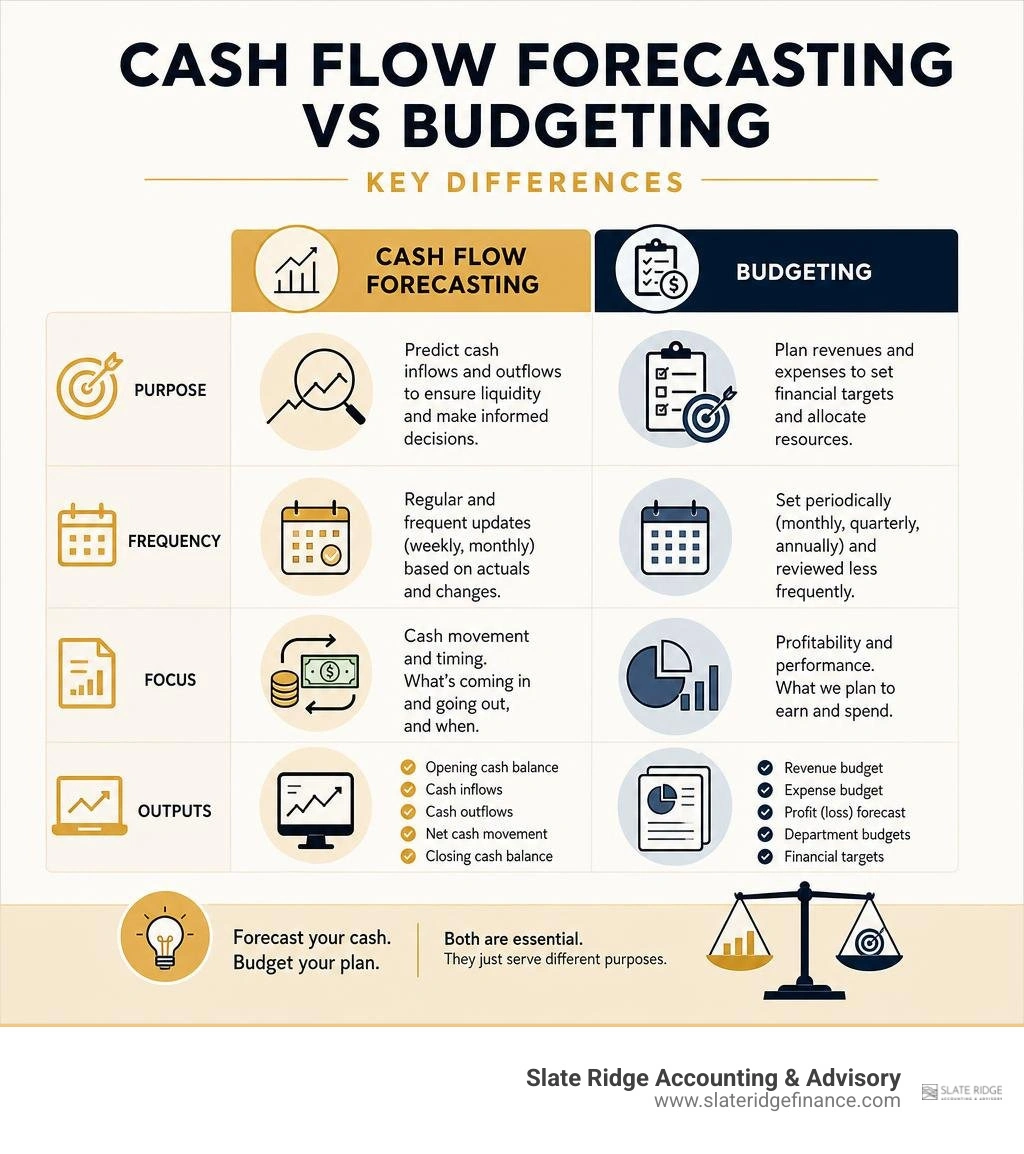
A budget is a static financial plan created once a year. It sets your spending targets and revenue goals, acting as a strategic benchmark.
A cash flow forecast, on the other hand, is a dynamic, frequently updated management tool. While a budget tells you what you want to spend over the year, a cash flow forecast tells you if you actually have the cash in the bank to pay for those expenses on any given Tuesday.
How often should a cash flow forecast be updated?
For most stable businesses, a monthly update of your 12-month rolling forecast is sufficient. However, if your business is experiencing rapid growth, navigating a turnaround, dealing with high market volatility, or operating with tight cash margins, you should update your tactical 13-week forecast on a weekly basis.
What tools are best for corporate cash forecasting?
While a simple spreadsheet is a fine starting point for early-stage companies, scaling enterprises require dedicated software to eliminate manual errors and handle complex, multi-entity transactions.
- For Enterprise & Midsize Treasury: Specialized platforms like Cash Flow Forecasting Software | Farseer help integrate P&L, balance sheets, and operational drivers.
- For Predictive & AI-Driven Insights: Tools like the Predictive Cash Forecasting Overview allow teams to run advanced statistical and trend-based modeling.
- For Multi-Entity & Real-Time Cash Positioning: Platforms like Cash & Liquidity | Nilus and Cash Forecasting Product Card automate bank connectivity and intercompany netting.
- For Hands-On Modeling: If you prefer spreadsheets but want to leverage AI, check out this guide on How to Build a Rolling 13 Week Cash Flow Forecast Using Claude + Excel .
Conclusion
At the end of the day, corporate cash flow forecasting isn't about predicting the future with 100% mathematical perfection. It’s about being directionally correct so you can make confident, proactive decisions. It gives you the clarity to invest in a new location, hire key talent, or negotiate better terms with your suppliers without worrying if your next check will bounce.
At Slate Ridge Accounting & Advisory, we help businesses across North Carolina—from the mountain towns of Asheville and Boone to the bustling metro hubs of Charlotte, Raleigh, Greensboro, and Wilmington—take complete control of their numbers.
Whether you need virtual bookkeeping to clean up your historical records, a customized KPI dashboard setup, or fractional CFO advisory to design a rolling 13-week cash flow model, we provide modern, personalized, and cloud-based solutions tailored to your industry.
Stop guessing where your cash will be next month. Partner with Slate Ridge Accounting & Advisory today, and let's build a financial foundation that supports your long-term growth.
Ready to get started?
Book a free consultation today and let’s explore how Slate Ridge can support your business with expert accounting that’s accurate, timely, and built around your goals.
You Might Also Like
A few more posts we think you’ll enjoy on topics that matter to business owners like you.