
Why Outsourced AP AR Can Simplify Finance Operations
Outsourced AP AR means using an external finance team to handle selected accounts payable and accounts receivable work, while your business keeps control of approvals, policies, and key decisions. It can be a strong fit when invoices, collections, vendor questions, and month-end tasks are taking time away from running the business.
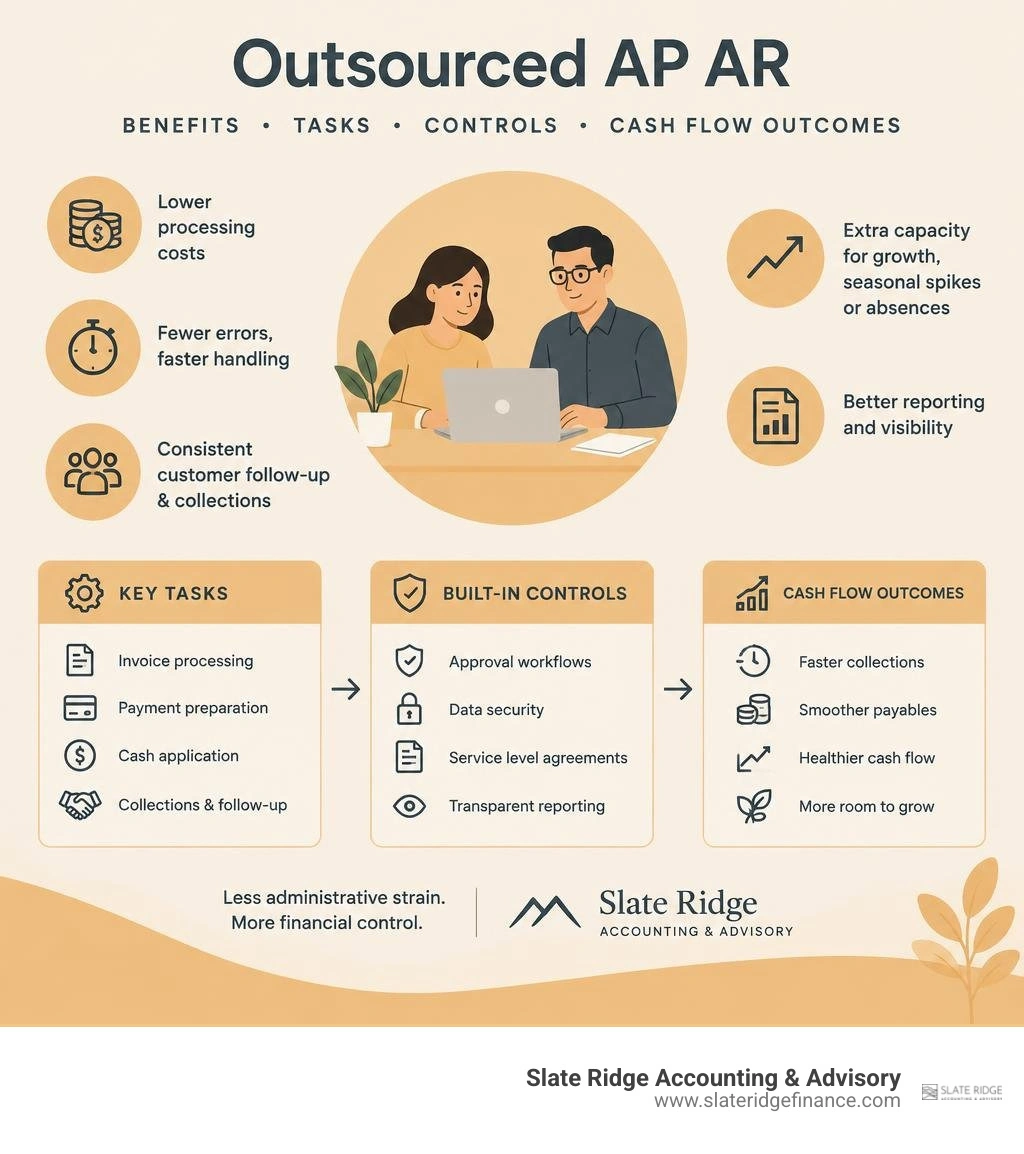
For many small and mid-sized businesses, the biggest benefits are:
- Lower processing costs than fully manual in-house work
- Fewer data-entry errors and faster invoice handling
- More consistent customer follow-up and cash collection
- Extra capacity during growth, seasonal spikes, or staff absences
- Better reporting on payables, receivables, and cash flow
The right model is not always full outsourcing. You might outsource invoice entry, payment preparation, cash application, or collections while retaining approval authority and customer relationships internally. The key is to choose a provider with clear service levels, strong security controls, and reporting that gives you visibility rather than creating a black box.
We are Caroline and Joe, and this guide will help you assess whether outsourced AP and AR can reduce administrative strain while improving financial control.
Understanding the Scope of Modern Accounts Payable and Receivable Outsourcing
Managing transaction processing in a growing company often starts as a minor administrative chore. Over time, it turns into an overwhelming web of paper bills, email attachments, unapplied customer deposits, and vendor reminders. Nearly half of businesses spend five or more days every month just managing invoice processing. When routine administrative tasks monopolize your accounting staff, strategic growth takes a back seat.
Deploying a modern model for outsourced ap ar allows growing organizations to restructure these operational bottlenecks. Rather than asking an internal bookkeeper or office manager to manually key in every bill, a specialized external team handles multi-channel billing, invoice ingestion, and reconciliations.
This approach draws directly from the shared service models that enterprise organizations have relied on for decades. In fact, over 80% of Fortune 500 businesses utilize shared service structures to standardize transactional workflows. Today, cloud technology brings these same operational efficiencies to small and mid-sized enterprises across North Carolina—from Charlotte and Raleigh to Greensboro, Wilmington, and Asheville.
When evaluating this transition, reviewing a foundational accounting outsourcing guide helps clarify how transactional workflows integrate into broader financial reporting. Maintaining clear boundaries ensures your leadership team preserves policy enforcement while shedding daily administrative legwork, putting into practice proven best practices for balancing payables and receivables.
End-to-End Accounts Payable Workflows
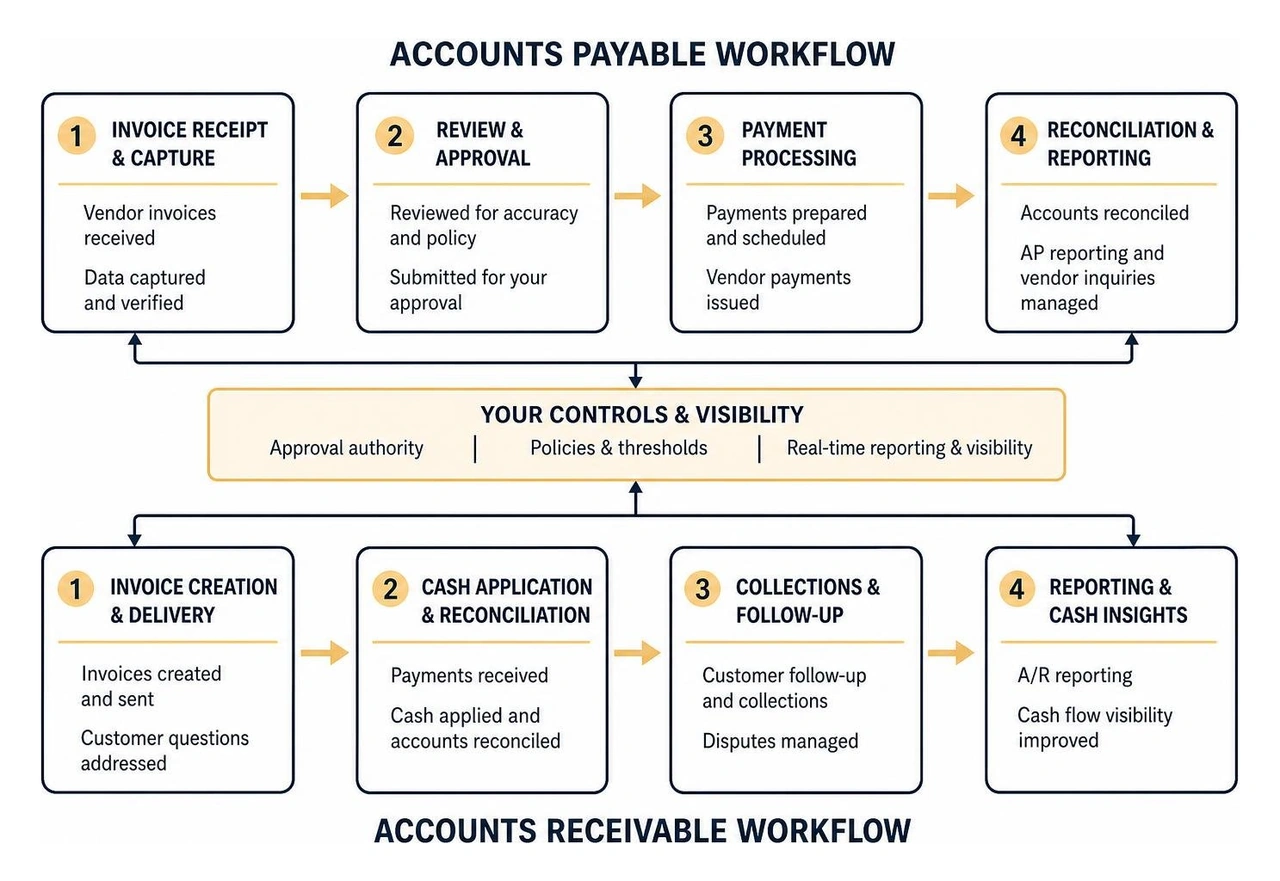
Accounts payable is far more than paying bills on the first and fifteenth of the month. A comprehensive outsourced AP setup handles every touchpoint of the liability lifecycle:
- Invoice Capture & Ingestion: Invoices arrive via dedicated email inboxes, vendor portals, or physical mail. Optical Character Recognition (OCR) and intelligent document processing extract line-item details, vendor tax IDs, and payment terms automatically.
- Three-Way Matching: The team matches line items against approved purchase orders and receiving documents to prevent duplicate billing or overpayment.
- Approval Routing: Invoices are matched with predefined authorization rules and sent digitally to department managers for sign-off.
- Vendor Inquiries: The external team manages routine vendor communications regarding payment status, statement reconciliations, and billing discrepancies.
- Payment Execution: The service prepares payment runs (via ACH, check, or virtual card), leaving final release authorization strictly in your hands.
Mastering these stages is essential for managing accounts payable effectively without introducing unnecessary friction into supplier relationships.
Comprehensive Accounts Receivable Functions
On the other side of the ledger, accounts receivable governs your incoming cash flow. Stalled invoicing or passive collections can choke operational liquidity even when sales figures look great on paper.
Outsourcing AR covers every step required to turn delivered goods and services into cash:
- Sales Invoicing: Generating and delivering accurate, itemized customer invoices across multiple customer billing portals.
- Cash Application: Reconciling incoming ACH deposits, credit card payments, and wire transfers against open receivables in your ledger.
- Aging Analysis: Tracking customer balances across standard 30, 60, and 90+ day aging buckets.
- Collections Management: Implementing structured, professional reminder workflows to follow up on overdue accounts without damaging client rapport.
- Dispute Resolution: Identifying disputed charges, missing documentation, or billing questions early to secure timely payment.
Implementing comprehensive accounts receivable outsourcing ensures receivables do not age into uncollectible bad debt.
Key Strategic Benefits of an Outsourced AP AR Model
The primary driver for outsourcing payables and receivables is operational scalability. As transaction volumes expand, an in-house accounting department often hits a breaking point. Hiring additional administrative staff introduces fixed overhead, recruitment delays, and training demands.

Outsourcing transforms variable operational workloads into structured, predictable processes. Manual invoice handling is famously error-prone; studies show that roughly 39% of manually processed invoices contain errors, ranging from misplaced decimal points to duplicate entries. Delegating these tasks to focused specialists dramatically reduces error rates while keeping your books audit-ready year-round.
Direct Cost Reduction and Predictable Pricing Structures
The economics of AP and AR processing heavily favor specialized teams. Manual in-house invoice handling generally costs between $10 and $30 per invoice when accounting for staff time, document routing, error correction, and manual data entry. In contrast, specialized accounts payable outsourcing services can reduce processing costs to $2–$6 per invoice.
For a mid-sized business processing 500 invoices per month, that efficiency translates to annual savings between $48,000 and $108,000.
Pricing models generally fall into three predictable formats:
- Per-Invoice Pricing: You pay a fixed rate per transaction processed (typically $2–$6), which works well for seasonal transaction volumes.
- Monthly Flat Fee: Predictable monthly retainers (generally ranging from $500 to $3,000 per month depending on scope) that cover standard daily processing and reconciliations.
- Volume-Based Tiers: Sliding scale pricing where per-unit costs decrease as your transaction volumes grow.
Eliminating internal overhead—such as software seat licenses, payroll taxes, recruiting fees, and equipment costs—creates direct bottom-line savings.
Working Capital Optimization and Accelerated Cash Flow
Cash flow timing dictates business resilience. When your AR team follows up on invoices promptly and applies payments cleanly, Days Sales Outstanding (DSO) drops. Case studies frequently show businesses lowering their DSO from over 35 days down to 15 to 20 days under dedicated AR management.
On the payable side, optimizing Days Payable Outstanding (DPO) allows your company to hold onto cash longer without incurring late fees. Furthermore, structured processing ensures your business captures time-sensitive early payment discounts (such as 2/10 net 30 terms), which can generate thousands of dollars in annual savings.
Across global finance benchmarks, roughly 85% of companies are engaging or plan to engage managed service providers to achieve holistic cash forecasting across payables and receivables.
How Outsourced AP AR Compares to Automation Software Alone
Many organizations wonder: Why not just purchase standalone AP/AR software?
Software alone is rarely a silver bullet. Tools can ingest data and route approvals, but they cannot handle edge cases on their own. When an invoice fails OCR recognition, when a vendor changes their banking information, or when a customer disputes a short-shipped line item, standalone software halts. Your internal team is left managing the exceptions.
| Dimension | In-House Manual Processing | Standalone Automation Software | Managed AP/AR Outsourcing |
|---|---|---|---|
| Primary Cost Driver | High internal payroll & benefits | Software subscription & internal labor | Predictable monthly/per-unit service fee |
| Error Handling | Manual human review (slow) | Halts workflows; alerts internal staff | Managed by external specialists |
| Scalability | Requires adding full-time staff | Software scales, but internal review grows | Fully elastic transaction capacity |
| Tech Management | None | Internal IT/Finance setup & maintenance | Managed entirely by service provider |
| Approval Control | Internal | Internal | Internal (Strict oversight retained) |
Outsourcing combines AP automation tools and technology integration with human-in-the-loop validation. The provider manages the software, monitors data synchronization with your ERP, and resolves daily exceptions before they reach your desk.
Enterprise-Grade Security and Compliance Standards
Handing off financial transaction workflows requires strict security controls. When dealing with banking details, customer lists, and vendor payment files, casual workflows are unacceptable. Professional providers build their services around rigid compliance frameworks to mitigate fraud risk and safeguard sensitive data.
Security Certifications to Require
When evaluating any external financial services provider, verify that their technical infrastructure and administrative protocols carry industry-standard certifications:
- SOC 1 & SOC 2 Type II: Confirms that the provider maintains independently audited controls surrounding data security, system availability, processing integrity, and financial reporting safeguards.
- ISO 27001: Demonstrates adherence to global ISO 27001 standards for establishing, implementing, and continually maintaining an Information Security Management System (ISMS).
- Encrypted Transmission & Storage: All financial data in transit and at rest must use enterprise-grade encryption (e.g., TLS 1.3 and AES-256).
- Role-Based Access Controls (RBAC): External processors should only access the specific accounting modules necessary to complete their tasks, with no unmonitored administrative rights.
Maintaining Governance and Financial Control
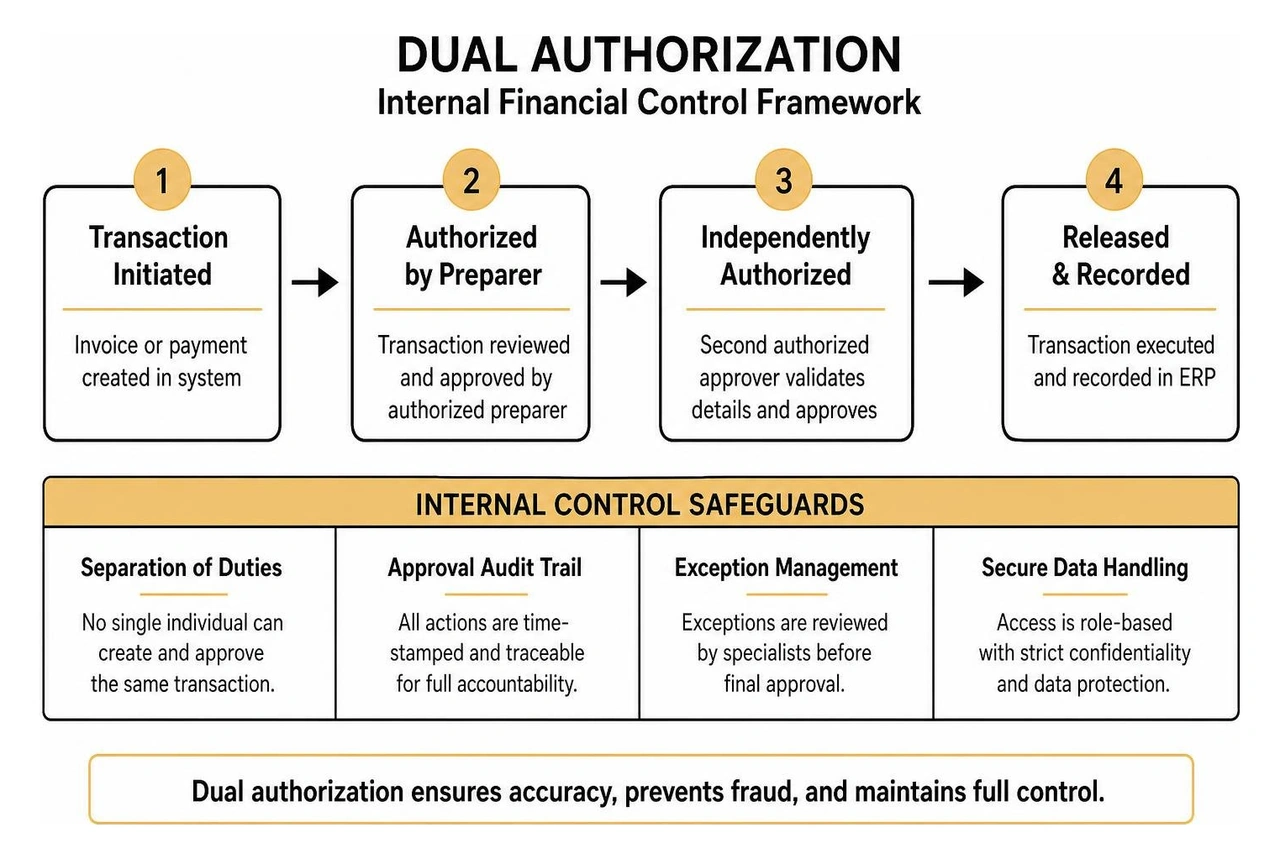
Outsourcing AP and AR does not mean relinquishing financial control. On the contrary, it often strengthens governance by introducing a clear separation of duties that small in-house teams struggle to maintain.
To maintain tight governance:
- Enforce Dual Authorization: The external provider prepares payment batches, but the final release of funds requires dual authorization from internal leadership.
- Protect the Vendor Master File: Changes to vendor payment details, tax identification numbers, or bank accounts must require verified internal approval to prevent fraud.
- Conduct Regular Reconciliations: Perform routine accounts payable reconciliations and bank reconciliations to ensure the sub-ledgers align precisely with the general ledger.
- Maintain Full Audit Trails: Modern cloud systems log every timestamp, user interaction, invoice modification, and approval for audit readiness.
Evaluating Operational Models: In-House, Software, and Dedicated Outsourcing
Every business operates within specific resource constraints. Determining whether to retain tasks in-house, invest in standalone software, or engage an external team depends on transaction complexity, internal capacity, and budget.
For companies exploring flexibility, remote accounting solutions provide access to specialized talent without geographic restrictions, whether operating in Raleigh, Charlotte, or elsewhere across North Carolina.
Dedicated Remote Clerks vs. Fully Managed BPO Services
When exploring external staffing, businesses generally choose between two primary operational frameworks: hiring dedicated remote clerks or partnering with a fully managed Business Process Outsourcing (BPO) team.
A direct remote clerk—often sourced through specialized staffing platforms—provides an individual contractor or employee dedicated to your business. While hiring a US-based clerk can cost between $70,000 and $100,000 annually when factoring in taxes and benefits, an offshore professional often represents a 50% to 70% cost reduction. However, your internal finance managers remain responsible for direct daily training, task management, software provisioning, and performance tracking.
A fully managed service provider operates under strict Service Level Agreements (SLAs). The provider supplies the technology, trains the team, builds redundancy to handle staff turnover or absences, and guarantees performance outcomes (such as invoice turnaround times and reconciliation accuracy).
Steps to Transition Smoothly to Outsourced AP AR Operations
Migrating from an ad-hoc in-house process to an outsourced structure should follow a deliberate, phased methodology to prevent disruption.
- Conduct a Current-State Assessment: Document invoice volume, current software tools, exception rates, and processing bottlenecks. Identifying these elements is key to financial process optimization and workflow redesign.
- Map Workflows and Define Authorization Limits: Outline clear steps for invoice receipt, approval hierarchies, dispute handling, and payment execution.
- Launch a Controlled Pilot Phase: Transition a subset of vendors or a single billing channel to the external team for 30 to 60 days to refine communication and approval flows.
- Execute Full Migration & Ongoing Review: Expand the scope across all vendor and customer accounts, monitoring key performance indicators (KPIs) through weekly or monthly dashboard reviews.
Frequently Asked Questions About AP and AR Outsourcing
When is the right time for a growing business to outsource AP and AR?
A company should evaluate outsourcing when transaction volume causes delays in the monthly financial close, invoice entry errors increase, or key personnel spend excessive time on billing disputes instead of core business operations. It is also an ideal solution when facing sudden hiring constraints or rapid seasonal scaling.
How does an outsourced team handle invoice discrepancies and vendor disputes?
Discrepancies are managed using predefined escalation rules. When an invoice fails three-way matching or a customer disputes an item, the outsourced team gathers supporting documentation (purchase orders, bills of lading, contracts) and routes the issue to your designated internal manager for resolution, keeping all parties informed.
What systems and ERPs integrate with outsourced AP/AR services?
Modern outsourcing teams work directly inside your existing cloud accounting ecosystem. Common platforms include QuickBooks Online, NetSuite, Sage Intacct, Bill.com, and other cloud-based ERP systems, ensuring real-time data synchronization without requiring a disruptive platform migration.
Conclusion
Sustaining long-term business growth requires operational efficiency across your entire back office. When leadership and core accounting staff are bogged down by repetitive data entry, collections follow-ups, and vendor inquiries, strategic initiatives stall.
Transitioning transaction processing to an external team provides scalable capacity, lowers overhead costs, accelerates cash collections, and sharpens financial reporting. Whether you need transactional support or are planning on building an outsourced finance department to handle comprehensive bookkeeping and advisory services, modernized workflows offer clear visibility and control.
At Slate Ridge Accounting & Advisory, we deliver modern, personalized, and cloud-based financial solutions designed for growing small businesses throughout North Carolina—including Charlotte, Raleigh, Greensboro, Wilmington, Asheville, and surrounding communities. To eliminate back-office bottlenecks, discover scalable finance solutions at Slate Ridge Accounting & Advisory and keep your team focused on strategic growth.
Ready to get started?
Book a free consultation today and let’s explore how Slate Ridge can support your business with expert accounting that’s accurate, timely, and built around your goals.
You Might Also Like
A few more posts we think you’ll enjoy on topics that matter to business owners like you.