

Why Accounting for Small Businesses Can Make or Break Your Company

Accounting for small businesses is the process of recording, organizing, and analyzing your financial transactions so you can make smart decisions, stay compliant, and keep your business alive.
Here's a quick overview of what it involves:
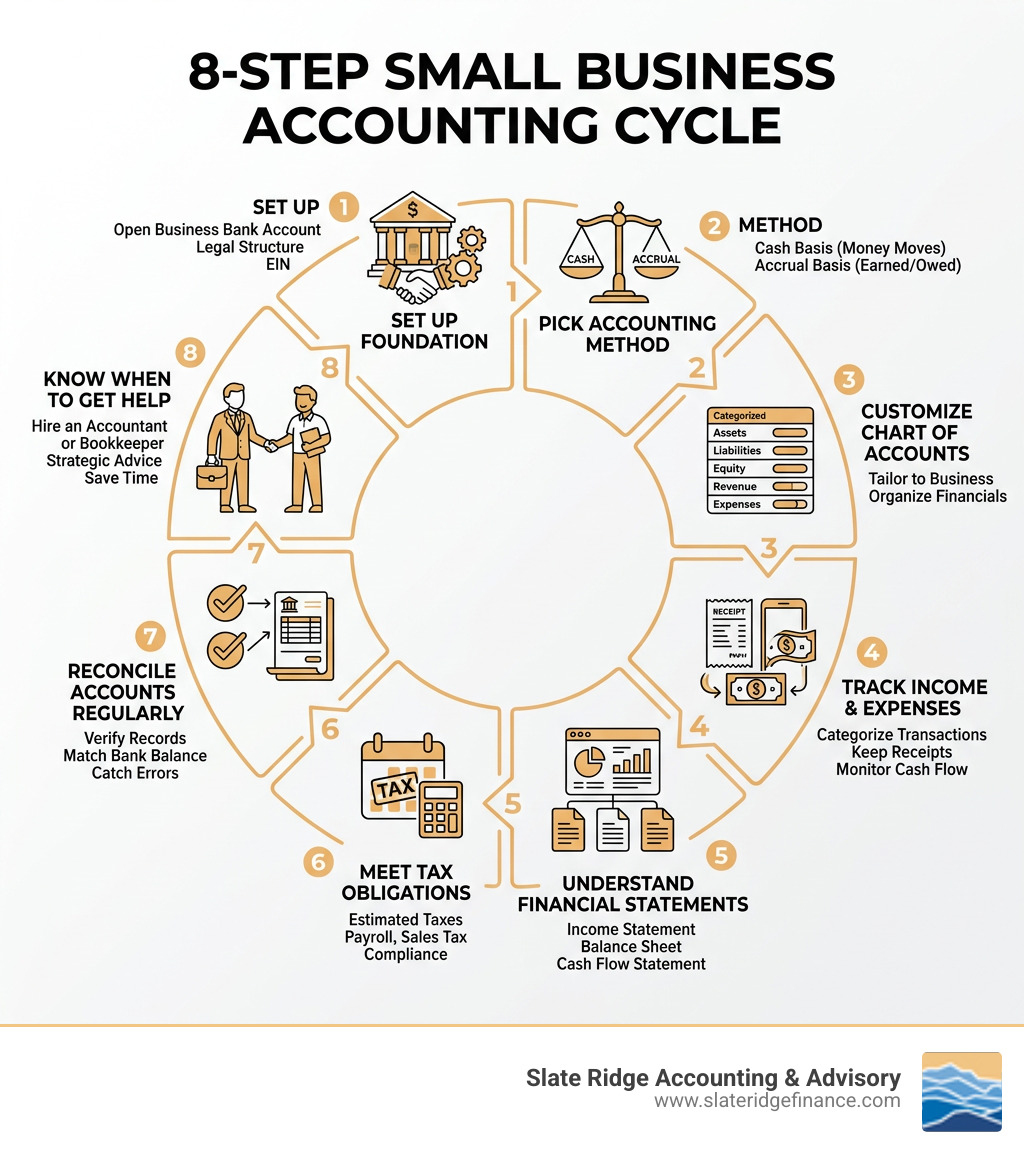
- Set up your financial foundation - open a business bank account, choose a legal structure, get an EIN
- Pick an accounting method - cash basis (record when money moves) or accrual basis (record when earned or owed)
- Track income and expenses - categorize every transaction, keep receipts, monitor cash flow
- Understand your financial statements - income statement, balance sheet, and cash flow statement
- Meet your tax obligations - estimated taxes, self-employment tax, payroll tax, sales tax
- Reconcile accounts regularly - at least monthly, to catch errors and stay accurate
- Use the right tools - accounting software automates most of the heavy lifting
- Know when to get help - a professional can save you far more than they cost
Running a small business is exciting. Managing its finances? That's where a lot of owners hit a wall.
Between tracking expenses, chasing invoices, preparing for tax season, and trying to understand what your numbers actually mean - it's easy to feel buried. And the stakes are high. Poor financial management is one of the leading causes of small business failure, and more businesses collapse from cash flow problems than from a lack of profit.
The good news: you don't need to be an accountant to get this right. You just need a clear system and the right knowledge.
This guide walks you through everything - from setting up your books for the first time to understanding financial statements and avoiding the mistakes that trip up most small business owners.
Accounting for small businesses further reading:
- accounts for small business
- accounts payable tips for small business
- tips for managing small business accounts receivable and payable
The Foundation: Setting Up Your Financial Infrastructure
Before you send your first invoice or buy your first piece of equipment, you need a solid foundation. Think of this as the "plumbing" of your business. If it's installed incorrectly, you're going to have a messy leak down the road.
Choose Your Legal Structure
Your legal structure dictates how you are taxed and your level of personal liability.
- Sole Proprietorship: The simplest form. You and the business are the same entity for tax purposes.
- LLC (Limited Liability Company): Very popular for small businesses in North Carolina. It provides personal asset protection. For tax purposes, a single-member LLC is often a "disregarded entity," meaning you report income on your personal Schedule C.
- Partnership: For businesses with two or more owners.
- Corporation: More complex, with stricter record-keeping requirements.
Get an EIN
An Employer Identification Number (EIN) is like a Social Security number for your business. The U.S. Small Business Administration recommends getting one even if you don't have employees yet. You'll need it to open a business bank account and file taxes.
Open a Dedicated Business Bank Account

If there is one rule we cannot stress enough, it is this: Never mix business and personal finances.
Mixing funds (often called "commingling") is a nightmare for several reasons. It makes it nearly impossible to track your true profitability, it creates a massive headache during tax season, and it can even jeopardize the "corporate veil" that protects your personal assets in an LLC.
Once your account is open, consider a business credit card to start building a business credit score. This will be vital if you ever need to apply for small business funding. For more on building these systems, check out our Accounting Systems Small Business Guide.
Mastering the Basics of Accounting for Small Businesses
At its core, accounting for small businesses relies on the "Accounting Equation":Assets = Liabilities + Equity
Everything your business owns (Assets) was paid for either by borrowing money (Liabilities) or by using your own money and retained earnings (Equity).
Most modern systems use double-entry bookkeeping. This doesn't mean you enter things twice for fun; it means every transaction affects at least two accounts. For example, if you buy a $500 laptop with cash, your "Equipment" account goes up by $500, and your "Cash" account goes down by $500. The equation stays balanced.
Choosing the Right Method for accounting for small businesses
One of the first big decisions you'll make is choosing between cash and accrual accounting.
| Feature | Cash Basis Accounting | Accrual Basis Accounting |
|---|---|---|
| When is revenue recorded? | When the cash hits your bank. | When the invoice is sent/earned. |
| When are expenses recorded? | When the money leaves your bank. | When the bill is received/incurred. |
| Complexity | Simple; easy to see cash on hand. | More complex; requires more tracking. |
| Accuracy | Can be misleading (doesn't show future bills). | Provides a long-term financial "truth." |
According to the IRS, businesses with over $25 million in annual revenue must use the accrual method. However, most very small businesses start with the cash method because it’s easier to manage day-to-day. As you grow, you might find that the accrual method gives you a much better picture of your actual profitability. You can find more nuance on this in our Accounting Best Practices Small Business Guide or by reviewing HMRC guidance on accounting methods if you have international considerations.
Creating a Functional Chart of Accounts
Your Chart of Accounts (COA) is the organizational map for every penny that moves through your business. It categorizes your transactions into five main buckets:
- Assets: Cash, inventory, equipment, accounts receivable.
- Liabilities: Loans, credit card balances, accounts payable.
- Equity: Owner’s investment, retained earnings.
- Revenue: Sales, service fees, interest income.
- Expenses: Rent, utilities, payroll, advertising.
A well-structured COA allows you to see exactly where your money is going. Instead of just "Expenses," you might have sub-accounts for "Software Subscriptions" and "Office Supplies." This level of detail is what helps us at Slate Ridge Accounting & Advisory help you track KPIs and forecast growth.
Navigating Financial Statements and Expense Tracking
If your bookkeeping is the "data entry," your financial statements are the "story." There are three primary reports you need to review regularly. You can dive deeper into these with our Small Business Financial Reporting Complete Guide.
- Income Statement (Profit & Loss): This shows your revenue minus your expenses over a specific period (like a month or a year). It tells you if you’re actually making money.
- Balance Sheet: This is a snapshot of your business at a single point in time. It shows what you own, what you owe, and what’s left over (equity).
- Cash Flow Statement: This tracks the actual movement of cash in and out. Remember: Profit is not the same as cash. You can be "profitable" on paper but have zero dollars in the bank because your customers haven't paid their invoices yet.
Managing your Accounts Receivable (money owed to you) and Accounts Payable (money you owe) is the secret to staying afloat. For practical help here, see our Tips for Managing Small Business Accounts Receivable and Payable.
Tracking Deductible Expenses Effectively
Every dollar you spend on your business is a potential tax deduction, but only if you track it correctly. The IRS requires you to keep records for at least three years, though we recommend seven years to be safe.
Common deductible expenses include:
- Home Office: If you use a portion of your home exclusively for business.
- Travel & Meals: Generally, 50% of business meals are deductible.
- Mileage: Keep a log of every business-related trip. For 2025, the standard mileage rate is 70 cents per mile.
- Software & Subscriptions: Your accounting software, CRM, and industry tools.
Pro-tip: Use an app to scan receipts as soon as you get them. Digital records are much harder to lose than a shoebox full of fading thermal paper.
Tax Obligations and Global Compliance Requirements
Taxes are the most stressful part of accounting for small businesses. In the U.S., we have a "pay-as-you-go" system. This means if you expect to owe more than $1,000 in taxes, you generally need to make estimated tax payments quarterly.
Key taxes to watch for:
- Self-Employment Tax: This covers Social Security and Medicare. The rate is 15.3%.
- Payroll Tax: If you have employees, you must withhold and pay these.
- Sales Tax: If you sell physical goods (and some services), you likely need to collect and remit sales tax to the state of North Carolina.
For a comprehensive look at federal rules, always refer to IRS Publication 334. Staying updated on Modern Accounting Practices ensures you don't miss new credits or deductions.
Understanding the Kleinunternehmerregelung in Germany
If your small business operates in Germany or has German subsidiaries, you should know about the Kleinunternehmerregelung (Small Business Regulation).
- The Limit: If your turnover was under €22,000 last year and is expected to be under €50,000 this year (note: thresholds updated periodically, previously €25,000/€100,000), you can apply for VAT exemption under §19 UStG.
- The Benefit: You don't have to charge VAT on your invoices, which can make you more competitive for B2C customers.
- The Catch: You cannot deduct "input tax" (VAT you paid on business purchases). If you have high startup costs, this might actually cost you money.
Avoiding Common Pitfalls in Accounting for Small Businesses
Even the smartest entrepreneurs make mistakes. Here are the big ones to avoid:
- Mixing Finances: We mentioned it before, but it bears repeating. Keep those accounts separate!
- Neglecting Reconciliation: Bank reconciliation is the process of matching your internal books to your bank statement. You should do this monthly to catch bank errors, fraudulent charges, or forgotten subscriptions.
- Misclassifying Workers: Are they employees or independent contractors? Getting this wrong can lead to massive back-tax penalties.
- Ignoring Cash Flow: Don't just look at your "Profit" number. Look at your bank balance and upcoming bills.
Many of these issues stem from outdated beliefs. Check out our guide on 3 Bookkeeping Myths That Could Be Costing You Money to see if you're falling for any of them.
Essential Software for accounting for small businesses
Gone are the days of ledger paper and pencils. Today, cloud accounting software is the gold standard. It allows for:
- Bank Synchronization: Transactions flow into your books automatically.
- Automation: Set up "rules" so your rent is automatically categorized every month.
- Real-Time Reporting: See your profit and loss from your phone while sitting in a coffee shop in Asheville or Charlotte.
- Security: Your data is backed up in the cloud, protected from hardware failure.
Choosing the right platform is critical. Our Best Cloud Accounting Small Business Guide can help you decide between the major players like QuickBooks Online, Zoho Books, or FreshBooks.
When to Hire a Professional Partner
You started a business to do what you love—not to spend your weekends wrestling with spreadsheets. It might be time to hire a professional if:
- You are spending more than 5 hours a month on bookkeeping.
- You are consistently late with tax filings.
- Your business is growing rapidly and your finances are getting complex.
- You need a "clean-up" because your books are a mess.
Whether you need a Bookkeeping Service for Small Business or more advanced advisory services, a partner can help you see the "big picture" that data entry alone misses.
Frequently Asked Questions about Small Business Accounting
What is the difference between bookkeeping and accounting?
Bookkeeping is the daily process of recording transactions—it’s about accuracy and organization. Accounting is the higher-level process of analyzing that data, preparing financial statements, and providing strategic tax and growth advice. Think of the bookkeeper as the person building the house and the accountant as the architect.
How often should I reconcile my business bank accounts?
At a minimum, you should reconcile monthly when your bank statement is issued. However, with modern cloud software, many businesses do a "mini-reconciliation" weekly to stay on top of their cash flow.
What records must I keep for tax and audit purposes?
You should keep almost everything: gross receipts, credit card statements, invoices, canceled checks, and any documents supporting your business expenses (like mileage logs or meal receipts). While the IRS "officially" requires three years for most items, keeping digital copies for seven years is the safest industry standard.
Conclusion
Mastering accounting for small businesses isn't about becoming a math genius; it's about consistency and using the right tools. By setting up a separate bank account, choosing the right accounting method, and staying on top of your monthly reconciliations, you take the "fear" out of your finances.
At Slate Ridge Accounting & Advisory, we specialize in taking this weight off your shoulders. As a cloud-based firm serving businesses across North Carolina—from Wilmington to Hickory—we offer Virtual Accounting and bookkeeping services that go beyond just "doing the books."
We provide modern, personalized, and industry-tailored financial solutions. We don't just tell you what happened last month; we help you track KPIs and forecast growth so you can build the business you've always envisioned.
Ready to get your finances in order? Let's talk.
Ready to get started?
Book a free consultation today and let’s explore how Slate Ridge can support your business with expert accounting that’s accurate, timely, and built around your goals.
You Might Also Like
A few more posts we think you’ll enjoy on topics that matter to business owners like you.