

Why Small Business Direct Deposit Payroll Matters
Small business direct deposit payroll is the electronic transfer of wages from your business bank account directly into your employees' accounts using the ACH network. Here's what you need to know:
Quick Setup Overview:
- Choose your solution - Use your business bank's ACH portal or cloud payroll software
- Complete employer setup - Provide your business details and verify your bank account
- Gather employee information - Collect signed authorization forms with routing and account numbers
- Run a test payment - Verify the process works before your first official payroll
- Process payroll - Submit payments 1-3 business days before payday
Typical Timeline: Initial setup takes 1-2 weeks. After that, payments process in 1-3 business days.
Cutting paper checks costs more time and money. The median cost of a paper check is $1.01 to $2.00, while ACH payments are just $0.26 to $0.50. This doesn't include the hours spent printing, signing, and distributing checks.
Direct deposit solves these issues. Employees get paid on time, you save money on supplies, and you gain better cash flow control by scheduling exact payment dates.
Nearly 80% of small businesses are adopting digital payroll solutions. This shift makes businesses run smoother and keeps teams happy.
This guide covers everything you need to set up direct deposit for your small business, including choosing a solution, handling common issues, compliance, and cost savings.
For comprehensive support with your payroll setup and ongoing management, explore our Payroll Administration Services.
Small business direct deposit payroll vocab to learn:
- accounting and payroll services for small business
- small business online payroll services
- cost of payroll services for small business
The "What" and "Why" of Direct Deposit Payroll
Direct deposit payroll promises a smooth, secure, and stress-free payday. It's an electronic transfer of funds via the Automated Clearing House (ACH) network. Instead of physical checks, you send payment instructions, and money moves from your business account to your employees' accounts.
The process uses a standardized NACHA file format, but modern payroll software handles this automatically. The benefits for both employers and employees create a win-win, streamlining a critical business function.
For employers, the advantages are clear:
- Cost Savings: Say goodbye to the expenses of check stock, printer ink, envelopes, and postage.
- Time Savings: Eliminates manual check preparation, signing, and distribution, saving administrative time.
- Improved Security: Reduces the risk of lost or stolen paper checks.
- Improved Cash Flow: Allows precise payment scheduling for better cash flow control.
- Reduced Errors: Automation minimizes human error in calculations and disbursements.
For employees, direct deposit means:
- Convenience: Funds are deposited automatically, even when employees are on vacation.
- Faster Access to Funds: Money is available early on payday.
- Security: No need to worry about losing a check or having it stolen.
- Flexibility: Allows splitting pay between multiple accounts.
In short, direct deposit is a strategic move to optimize operations and keep your team happy.
For a deeper dive into how direct deposit impacts your bottom line, take a look at our Small Business Payroll Cost Guide.
| Feature | Direct Deposit | Paper Checks |
|---|---|---|
| Cost | Low (median ACH $0.26 - $0.50 per transaction) | High (median $1.01 - $2.00 per check) |
| Speed | Fast (funds available 1-3 business days) | Slower (mailing time, bank hours, deposit time) |
| Security | High (electronic, less fraud risk) | Lower (risk of loss, theft, forgery) |
| Convenience | High (automatic, no bank visit needed) | Lower (requires physical handling and deposit) |
| Eco-Friendly | Yes (paperless) | No (paper, ink, envelopes) |
How Direct Deposit Works
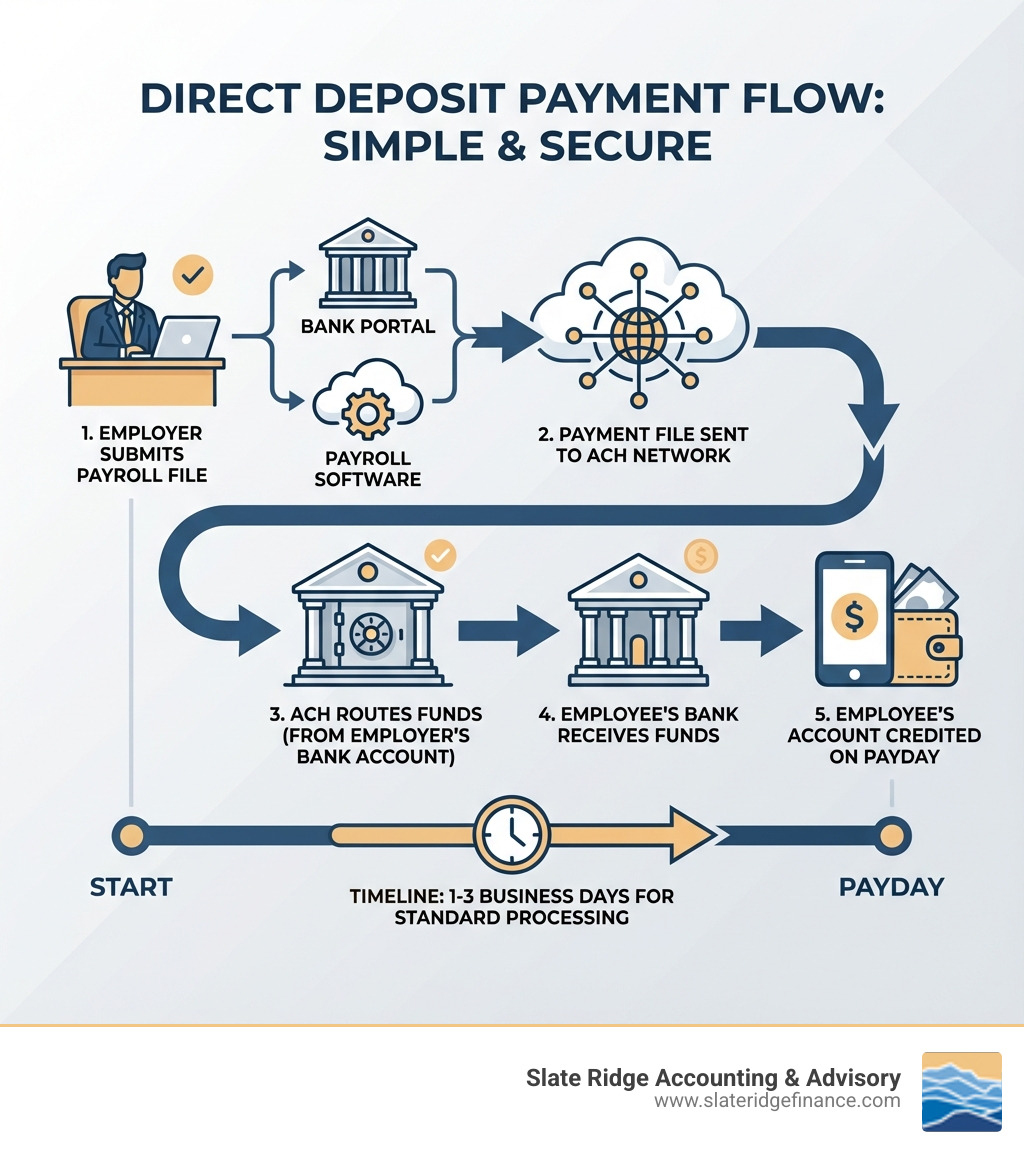
The magic behind direct deposit happens through the ACH network. Here’s a simplified breakdown:
- Employer Submits Payroll File: You or your payroll provider collect payroll data, format it into a secure NACHA file, and submit it to your business bank.
- ACH Network Processes the Transaction: Your bank sends the file to the ACH network, which sorts the payments and debits the total payroll amount from your account.
- Funds are Routed to Employee Banks: The ACH network instructs employee banks on how much to credit to each account.
- Employee Accounts are Credited on Payday: Employee banks receive the instructions and credit the accounts. Funds are available on payday.
This process takes one to three business days and is highly efficient, reliable, and accurate.
The Financial Benefits of Switching
The financial advantages of small business direct deposit payroll are compelling. Switching from paper checks is smart financial management.
A significant benefit is reduced costs. The median ACH payment costs $0.26 to $0.50, compared to $1.01 to $2.00 for a paper check. These savings add up quickly over a year. You eliminate expenses for:
- Printing check stock and envelopes.
- Purchasing ink cartridges.
- Postage fees if you mail checks.
- The administrative time spent preparing and distributing checks.
Direct deposit also offers improved cash flow predictability. Unlike paper checks that can be cashed at any time, direct deposit debits your account on a precise schedule. This allows for more accurate financial management, preventing cash shortages and enabling better financial planning.
By embracing direct deposit, you're not just making payroll easier; you're actively implementing Cost Reduction Strategies that contribute directly to your business's profitability.
A Step-by-Step Guide to Setting Up Small Business Direct Deposit Payroll
Setting up small business direct deposit payroll is a straightforward process that improves efficiency. This guide will walk you through it.
Step 1: Choose Your Direct Deposit Solution
First, choose how you'll manage direct deposit. We can help businesses in Asheville, Raleigh, Charlotte, and across North Carolina find the best fit from these primary options:
- Your Business Bank: Many banks offer ACH services directly to business customers. This can be a straightforward option, but some bank portals might require more manual input.
- Cloud Payroll Management Software: This is a popular choice for small businesses. These platforms automate payroll, direct deposit, tax calculations, and compliance. Our expertise in Cloud Payroll Management can help you steer these options.
- Outsourced Payroll Management Services from Slate Ridge Accounting & Advisory: We offer comprehensive Payroll Management Services that include direct deposit setup and processing. We handle all the complexities so you can focus on your business.
Consider cost, ease of use, automation, and support level when choosing. We offer expert advice custom to your business.
Step 2: Complete Employer Setup and Verification
After choosing a solution, you'll set up your business as the employer by providing essential information and verifying your bank account.
Here's what you'll typically need:
- Business Legal Name and Address
- Federal Employer Identification Number (FEIN): Obtain this from the IRS website if you don't have one.
- Principal Officer Information: Full name, home address, date of birth, and Social Security Number (SSN) to verify identity.
- Connecting and Verifying Your Business Bank Account: Provide your bank's routing and account numbers. Many systems use instant bank verification via online banking credentials. Alternatively, a micro-deposit process (a small test deposit you must confirm) verifies the account is valid for ACH transactions.
This setup process is critical for the security and compliance of your payroll.
Step 3: Gather and Enter Employee Information
To set up direct deposit for employees, you need their banking details and authorization.
Here’s what you'll need to collect:
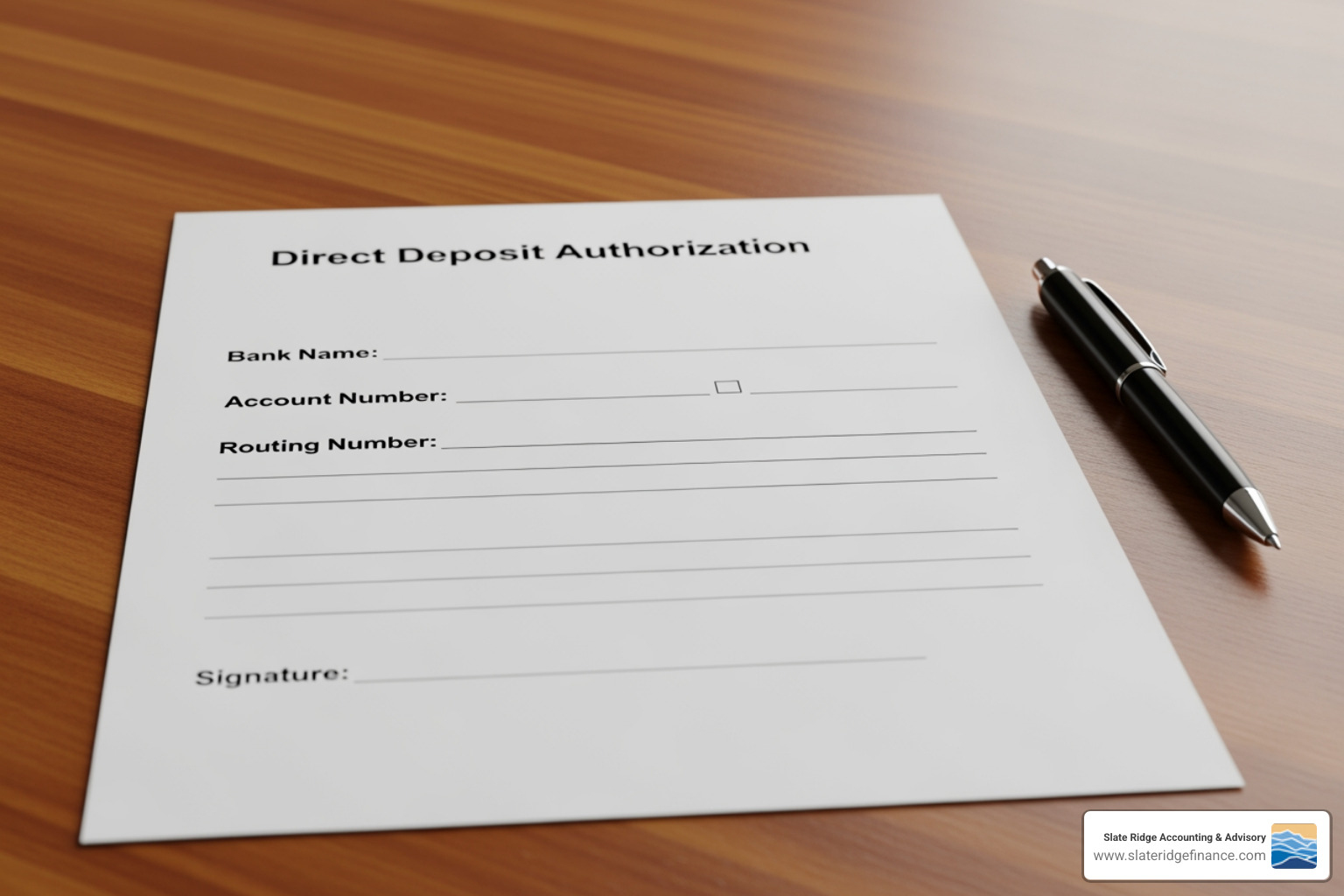
- Signed Direct Deposit Authorization Forms: You must have written consent from each employee. The form should include their name, bank name, account type, routing and account numbers, and a signature authorizing deposits and any necessary corrections.
- Voided Check or Bank Letter: To ensure accuracy and prevent errors, ask employees for a voided check or a bank letter with their routing and account numbers.
- Entering Data into Your Payroll System: Enter the authorized, verified information into your payroll system. Many systems allow employees to split their pay between accounts, a great perk to offer.
Handle this sensitive information securely, with access limited to authorized personnel. A clear process is vital for new businesses. Find out more about how we support Payroll Services for Startups.
Step 4: Understand Processing Timelines and Run a Test
Understanding direct deposit timing is key to ensuring employees are paid on time.
- Initial Setup Time: First-time setup can take one to two weeks, depending on how quickly you gather information and complete bank verification.
- Standard Processing Time: Standard payments process one to three business days before payday. This lead time allows the ACH network to move funds. For a Friday payday, you might need to submit payroll by Tuesday or Wednesday.
- Prenote or Micro-Deposit Verification: Before the first live payroll, systems may use a "prenote" (a zero-dollar test transaction) or micro-deposits to verify account details. These steps are vital to prevent errors and take 1-3 banking days.
- Running a Test Payroll: Always run a test payroll before your first official run. This helps catch errors in banking details or calculations and confirms the system works. It's much easier to fix issues during a test run.
Planning for these timelines ensures your employees in Greensboro, Hickory, Morganton, and beyond receive their pay accurately and on time.
Troubleshooting Common Direct Deposit Delays and Errors
Even with careful planning, errors can happen. Most direct deposit delays or errors for small business direct deposit payroll are easily resolvable if you know what to look for.
Resolving Incorrect Banking Information
This is the most common cause of a failed direct deposit. A typo in an account or routing number can cause the transaction to be rejected or sent to the wrong account.
- Verifying Data: If an employee doesn't receive their pay, first double-check the banking information on file against their authorization form or voided check.
- Communicating with Employees: If you find a discrepancy, communicate promptly and obtain the correct information.
- Re-issuing Payment: Once corrected, re-issue the payment. You may need to write a manual check to pay the employee on time, then update the direct deposit for future cycles. Quick action and clear communication minimize disruption.
Planning for Bank Holidays and Processing Cutoffs
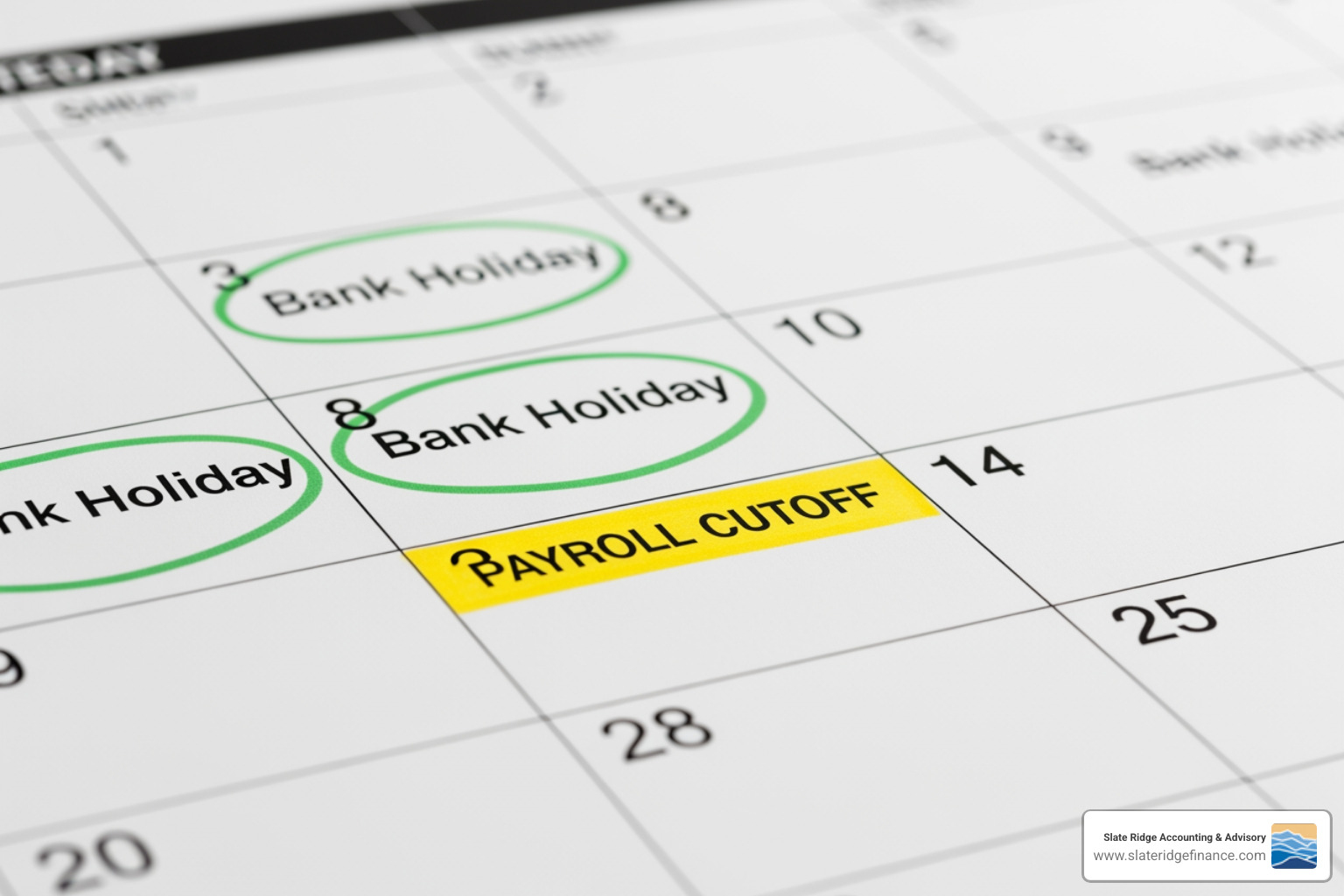
The ACH network only operates on business days. Weekends and federal bank holidays are non-processing days, and ignoring them can cause payroll delays.
- ACH Network Operating Hours: The ACH network doesn't process transactions on Saturdays, Sundays, or federal holidays.
- Adjusting Payroll Submission Dates: If payday is on a weekend or holiday, submit payroll earlier. For example, for a holiday on Monday, pay is typically deposited the preceding Friday. Your provider may send alerts, but it's wise to watch the calendar.
- Understanding Your Provider's Daily Cutoff Time: Each provider has a daily cutoff time for submitting payroll. Submitting after this time will delay processing until the next business day. Be aware of these deadlines.
Proactive planning around holidays will keep your employees in Wilmington, Hendersonville, and Greenville paid on time.
Handling Insufficient Funds and Payment Reversals
Insufficient funds for payroll is a stressful but preventable scenario. Understanding how to resolve it is crucial.
- Ensuring the Payroll Account is Funded: Always verify your payroll account has sufficient funds before submitting payroll. Services often debit your account 1-2 days before payday, so the money must be available. Good cash flow management prevents this issue.
- NACHA Rules for Reversing Incorrect Payments: If you overpay or pay the wrong person, the ACH network allows reversals under strict NACHA rules. Reversals are generally for incorrect amounts, recipients, or duplicate payments.
- Time Limits for Reversals: Crucially, you have only five business days from the settlement date to initiate a reversal. After that, recovering funds is difficult and may require legal action. Acting quickly is paramount, as fees can apply for errors.
We can help you set up robust financial processes and offer Expert Financial Advice to ensure your payroll account is always ready for payday.
Security and Compliance: The Rules of Direct Deposit
Beyond convenience and cost savings, small business direct deposit payroll demands careful attention to security and compliance. Handling employee banking information means you're entrusted with highly sensitive data, and adhering to regulations is non-negotiable for businesses in North Carolina.
How to Securely Handle Employee Banking Information
Protecting your employees' financial data is paramount. A breach can lead to severe consequences, including financial penalties, reputational damage, and loss of employee trust.
Here are best practices we recommend:
- Data Encryption: Any digital storage or transmission of banking information should be encrypted. Most reputable payroll software providers will handle this automatically, but it's a key question to ask.
- Limiting Access: Only individuals directly involved in payroll processing should have access to employee banking details. Implement strong password policies and multi-factor authentication (MFA) for all payroll systems.
- Securely Storing Physical and Digital Authorization Forms: If you collect paper authorization forms, store them in a locked cabinet. Digital forms should be stored on secure, password-protected servers with limited access. Do not keep sensitive information on easily accessible computers or unsecured cloud drives.
- Following Privacy Laws: Be aware of general privacy principles regarding Personally Identifiable Information (PII). While there isn't one overarching federal law specifically for payroll data privacy, state laws and industry best practices emphasize data protection.
At Slate Ridge Accounting & Advisory, we prioritize these security measures as part of our Accounting Best Practices Small Business Guide to safeguard your business and your employees.
Can Employers Mandate Direct Deposit?
This is a common question, and the answer varies by state. While direct deposit is highly beneficial, employers generally cannot unilaterally force employees to accept it.
- Varying State Laws: Across the U.S., states have different rules regarding mandatory direct deposit. Some states permit employers to require it, while others mandate that employers offer an alternative option.
- Requirement to Offer Alternatives: Many states, including North Carolina, typically require employers to provide an alternative method of payment if an employee declines direct deposit. This alternative is usually a paper check or, in some cases, a pay card.
- Importance of a Clear, Written Payroll Policy: To avoid misunderstandings and ensure compliance, it’s crucial to have a clear, written payroll policy that outlines your payment methods and any opt-out procedures. This policy should be communicated to all employees upon hiring and whenever changes occur.
Always ensure your practices align with both federal and North Carolina state labor laws.
Federal and State Compliance Requirements
Payroll compliance is a complex but critical area for any small business. Direct deposit simplifies the payment process but doesn't eliminate your underlying compliance obligations.
- Properly Storing Payroll Records: You are required to maintain accurate and detailed payroll records for a specific period (typically three to seven years, depending on the type of record and regulation). This includes timesheets, wage calculations, tax deductions, and direct deposit authorizations.
- Filing Tax Forms: You must continue to file federal tax forms, such as Form 941 (Employer's Quarterly Federal Tax Return), which reports withheld income taxes, Social Security, and Medicare taxes. Other forms like Form 940 (FUTA), 943 (agricultural employees), or 944 (small employers) may also apply depending on your business.
- Registering with State Tax Agencies: In North Carolina, you must register with the North Carolina Department of Revenue for state income tax withholding and unemployment insurance. You'll file state-specific payroll tax forms and remit payments as required.
- Employer Identification Number (EIN): As mentioned, your FEIN is essential for federal tax purposes.
Navigating these requirements can be challenging, but ensuring compliance protects your business from penalties and audits. We can help you stay on top of all these obligations, allowing you to focus on your business's growth.
Frequently Asked Questions about Direct Deposit Payroll
We hear a lot of questions about small business direct deposit payroll, and rightly so! It’s a big step for many businesses. Here are some of the most common inquiries we receive:
How much does direct deposit cost a small business?
The cost of direct deposit for a small business can vary. However, it's almost always more cost-effective than paper checks.
- Provider Dependent: Costs depend on your chosen provider. If you use your business bank's ACH service, they might charge a per-transaction fee (e.g., $0.25 to $0.50 per transaction) or a monthly service fee.
- Payroll Software/Service: Many payroll software subscriptions, particularly those focused on Small Business Online Payroll Services, include direct deposit as part of their basic package at no extra charge. This often provides the best value, as you get payroll calculation, tax filing, and direct deposit all in one.
- Significant Savings: Regardless of the specific fee structure, the savings from eliminating check stock, envelopes, postage, and the administrative time associated with paper checks far outweigh the costs of direct deposit. The median price for an ACH payment is significantly lower than that of a paper check.
Can I pay independent contractors via direct deposit?
Yes, absolutely! Paying independent contractors via direct deposit is just as common and beneficial as paying employees this way. The process is very similar, offering the same efficiency and security benefits.
- Form W-9: For contractors, you'll need them to complete a Form W-9 (Request for Taxpayer Identification Number and Certification) to gather their tax ID information.
- Separate Process: While the payment mechanism is similar, it's crucial to distinguish between W-2 employee payroll and payments to 1099 independent contractors for tax and compliance purposes. Most payroll systems or services will have a distinct process for contractor payments.
- Streamlined Management: We can help you set up and manage direct deposit for your contractors as part of our broader Payroll Administration Services, ensuring all payments are handled correctly and efficiently.
What happens if a payday falls on a bank holiday?
This is a scenario every small business owner should plan for! Since the ACH network does not process transactions on weekends or federal banking holidays, your payroll schedule needs to adjust.
- Payments Processed Early: If a payday falls on a bank holiday (or a weekend), direct deposit payments are almost always processed on the preceding business day. This means your employees will receive their funds early. For example, if payday is Friday, but Friday is a holiday, employees will likely see their pay hit their accounts on Thursday.
- Plan Ahead: This makes proactive payroll planning essential. Always review the federal holiday calendar and adjust your payroll submission dates accordingly. Your payroll provider will typically remind you of these changes, but it's good practice to be aware yourself. This ensures your employees in Boone, Charlotte, and across North Carolina are never left waiting for their wages.
Conclusion: Streamline Your Payroll and Empower Your Team
Embracing small business direct deposit payroll is more than just an administrative update; it's a strategic improvement that benefits your entire organization. We've seen how it offers significant cost savings by eliminating paper-based expenses and precious time savings by automating manual tasks. More importantly, it boosts employee satisfaction, ensuring your team receives their hard-earned wages accurately and reliably. Happy employees are productive employees, after all!
Modernizing your payroll is a key step in developing robust Business Growth Strategies. It frees up valuable time and resources that can be redirected towards core business activities and innovation. At Slate Ridge Accounting & Advisory, we understand the unique challenges and opportunities small businesses face. Our expertise allows us to seamlessly integrate payroll with your overall Bookkeeping Service for Small Business, providing you with a holistic view of your financial health.
Ready to transform your payroll from a chore into a streamlined asset? To see how expert financial guidance can transform your operations, explore our Virtual Accounting services. We're here to help your North Carolina business thrive.
Ready to get started?
Book a free consultation today and let’s explore how Slate Ridge can support your business with expert accounting that’s accurate, timely, and built around your goals.
You Might Also Like
A few more posts we think you’ll enjoy on topics that matter to business owners like you.