

Is an Outsourced Finance Department Right for Your Business?

An outsourced finance department is a third-party team — often CPA-led — that handles some or all of your financial operations, from bookkeeping and payroll to tax compliance and CFO-level strategy, without the overhead of hiring in-house staff.
Here's what you need to know at a glance:
- What it is: A fully managed finance function delivered by an external provider using cloud-based tools and expert staff
- Who it's for: Small to mid-sized businesses overwhelmed by financial complexity or outgrowing basic tools like QuickBooks
- What it costs: Typically 25–50% less than building an equivalent in-house team
- What you get: Bookkeeping, AP/AR, payroll, tax filing, financial reporting, and optional fractional CFO advisory
- How fast it deploys: Most providers can have your finance function running in roughly 90 days
Running a business is hard enough without also playing accountant, HR manager, and financial strategist all at once.
For many small and mid-sized business owners, the finance function starts as a manageable task — maybe a part-time bookkeeper or a QuickBooks subscription. But as the business grows, the cracks start to show. Reports are late. Errors pile up. Your CFO is buried in routine invoicing instead of helping you grow.
That's exactly where an outsourced finance department steps in.
Rather than patching the problem with another hire — or worse, letting it fester — more businesses are turning to outsourced finance teams that bring the full depth of an internal department without the full cost or management burden.
The results can be significant. Businesses that make the switch have reported dropping late fees by 70% in the first quarter alone, and some scaling companies have achieved EBITDA growth of nearly 96% with the help of outsourced CFO services.
This guide will help you evaluate whether outsourcing your finance department makes sense for your business — and what to look for if it does.
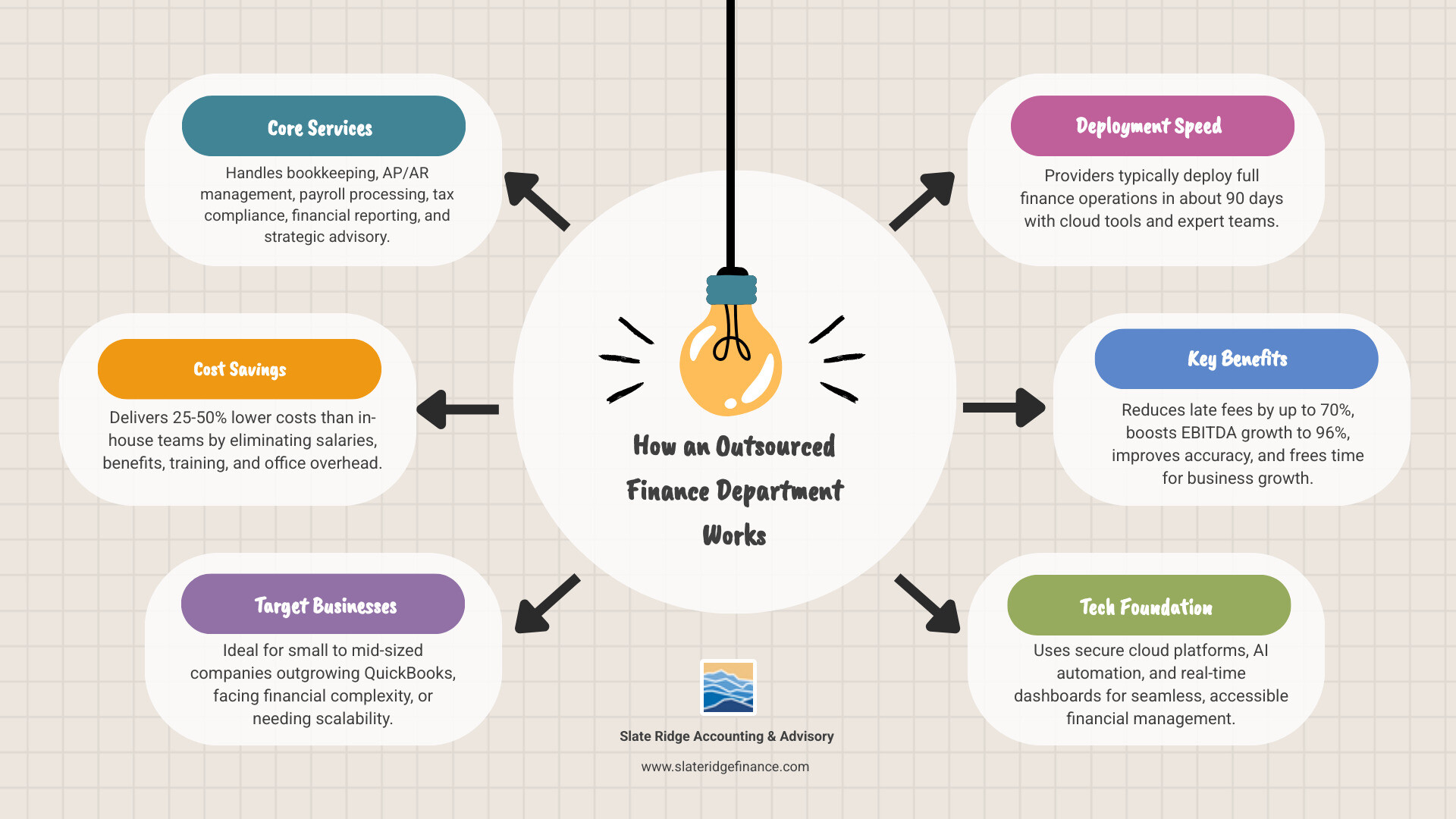
Outsourced finance department basics:
Understanding the Modern Outsourced Finance Department
When we talk about a modern outsourced finance department, we aren't just talking about a person who balances your checkbook once a month. We are talking about a comprehensive, virtual accounting engine that powers your entire business.
In the traditional model, you’d hire a bookkeeper, then an office manager to handle payroll, and eventually a controller or CFO. This creates "internal silos" and significant overhead. If your bookkeeper leaves, your financial history often walks out the door with them. This staffing turnover is a major bottleneck for middle-market and small businesses alike, leading to slow monthly closes and missed opportunities.
The modern approach utilizes remote accounting solutions to provide a "Finance as a Service" (FaaS) model. This aligns people, processes, and technology into a single, seamless workflow. By moving to the cloud, your financial data is no longer trapped in a desktop computer in a back office in Raleigh or Charlotte; it is accessible, real-time, and managed by a team that stays on top of global financial standards and North American tax regulations.
Scaling Beyond Bookkeeping with an Outsourced Finance Department
Many business owners start their journey looking for monthly bookkeeping packages, but they soon realize they need much more. An integrated outsourced finance department provides an end-to-end suite of services that scales as you do:
- Transactional Excellence: This includes accounts receivable outsourcing to ensure you get paid faster and AP automation services to eliminate the "paper chase" of vendor bills.
- Compliance and Payroll: Handling outsource payroll for small business means more than just cutting checks; it involves managing tax withholdings, benefits, and local North Carolina compliance.
- Strategic Advisory: Beyond the day-to-day, you gain access to fractional CFO advisory. This level of service helps with fundraising, cash flow forecasting, and preparing statutory accounts for stakeholders or lenders.
Why a CPA-Led Outsourced Finance Department Outperforms Basic Bookkeepers
There is a massive difference between a data-entry bookkeeper and a CPA-led team. While a bookkeeper records what happened, a CPA-led outsourced finance department analyzes what will happen.
Working with a CPA provides:
- Deep Regulatory Knowledge: CPAs undergo rigorous education and must stay current with GAAP standards) and evolving business laws.
- Audit Representation: If you are ever audited, having a CPA on your side is invaluable for representation and support.
- Future-Focused Strategy: Instead of just looking at historical data, a CPA-led team provides strategic tax planning and financial analysis to help you keep more of what you earn.
- One-Stop Shop: You get everything from basic reconciliations to high-level boardroom-ready strategies in one package.
The Strategic Benefits of Outsourcing Your Finance Function
The most compelling reason to consider an outsourced finance department is strategic, but the math is what usually seals the deal. Research shows that businesses often save between 25% and 50% compared to the cost of full in-house staffing. When you factor in salaries, benefits, office space, and software licenses, the "hidden costs" of an internal team add up quickly.
Beyond the bottom line, the speed-to-scale is a "slam dunk." While it might take six months to recruit and train a full-time controller, an outsourced team can often deploy in roughly 90 days. This allows you to have a high-functioning finance department by next quarter.
| Expense Category | In-House Team (Avg) | Outsourced Dept (Avg) |
|---|---|---|
| Annual Salary/Fees | $120,000+ (Full Team) | $45,000 - $75,000 |
| Benefits & Taxes | 20-30% of Salary | $0 |
| Software & Tech | $5,000 - $15,000 | Included in many packages |
| Training & Overhead | $10,000+ | $0 |
| Total Estimated Cost | $160,000+ | $45,000 - $75,000 |

Furthermore, the impact on EBITDA can be transformative. Scaling businesses using outsourced CFO services have seen EBITDA growth as high as 96%. Whether you are trying to secure a $30M debt facility or raise private equity, having clean, professional financials is the key to unlocking capital.
Signs Your Business Has Outgrown QuickBooks and In-House Management
QuickBooks is a fantastic tool for startups, but it has "hard limits." If you find your team spending more time in Excel than in your accounting software, you’ve hit a growth barrier.
How do you know it's time to look at monthly accounting packages or more robust small business bookkeeping packages? Look for these red flags:
- Spreadsheet Reliance: If you are using manual spreadsheets to track "real" numbers because QuickBooks can't handle your complex billing or inventory, errors are inevitable.
- Data and User Limits: Enterprise QuickBooks users often hit roadblocks with user counts and data volumes that cap growth.
- Reporting Gaps: If you can't get a real-time dashboard of your KPIs (Key Performance Indicators) or if preparing for an audit takes weeks of manual labor, your system is broken.
- Fundraising Challenges: Investors expect "boardroom-ready" reports. If your current setup can't produce multi-source data insights, you may struggle to secure the funding you need to scale.
Choosing the Right Provider and Ensuring a Smooth Transition
Choosing an outsourced finance department is about more than just price; it's about fit. You need a partner that understands your industry and uses a modern cloud accounting services stack.
When vetting a provider, ask about their:
- Security Protocols: Do they have SOC 2 compliance? Do they use data encryption and role-based access?
- Technology Stack: Do they leverage AI and hyper-automation to reduce manual errors?
- Implementation Process: A phased implementation is best. It should include data migration, validation checkpoints, and clear communication with your internal stakeholders.
A successful bookkeeping service for small business should feel like an extension of your team, not a distant vendor. This transition usually involves a "Rapid Assessment" phase to identify process improvements before the full hand-off.
Common Myths Regarding an Outsourced Finance Department
Despite the clear benefits, several myths persist that keep business owners from making the leap:
Myth 1: "I’ll Lose Control Over My Numbers"Actually, the opposite is true. With cloud-based platforms, you have 24/7 real-time visibility. You no longer have to wait for a bookkeeper to email you a PDF; you can see your cash flow on your phone at any time.
Myth 2: "Security Risks Are Higher"Professional outsourced firms use enterprise-grade security that far exceeds what most small businesses have in-house. This includes encrypted channels, multi-factor authentication, and secure cloud backups.
Myth 3: "It’s Only for Large Companies"Outsourcing is actually a "great equalizer" for small businesses. It gives a $2M company in Hickory or Wilmington access to the same high-level talent and technology as a $50M corporation.
Frequently Asked Questions
How much does an outsourced finance department cost compared to hiring?
Most businesses save between 25% and 50% compared to a full-time in-house team. While a virtual bookkeeper's cost varies by complexity, you avoid the heavy burden of payroll taxes, benefits, and office overhead.
How long does it take to transition to an outsourced model?
A typical deployment takes roughly 90 days. This includes a phased transition where workflows are documented, data is migrated to the cloud, and systems are automated for maximum efficiency.
Is my financial data secure with a virtual provider?
Yes. Reputable providers use secure, encrypted cloud platforms and follow strict compliance standards like SOC 2 or ISO/IEC 27001. Role-based access ensures that only authorized personnel can view sensitive information.
Conclusion
At Slate Ridge Accounting & Advisory, we believe that your finance department should be an engine for growth, not a source of stress. Whether you are based in Asheville, Raleigh, or anywhere across North Carolina, we provide the modern, personalized, and industry-tailored solutions you need to thrive.
By moving to an outsourced finance department, you gain more than just accurate books — you gain the clarity to track KPIs, the foresight to forecast growth, and the freedom to focus on what you do best. From financial clean-up to high-level advisory, we are here to help you bridge the gap between where your business is and where you want it to be.
Ready to stop juggling and start growing? Master your business finances today and see the difference that expert, cloud-based support can make for your bottom line.
Ready to get started?
Book a free consultation today and let’s explore how Slate Ridge can support your business with expert accounting that’s accurate, timely, and built around your goals.
You Might Also Like
A few more posts we think you’ll enjoy on topics that matter to business owners like you.