
What It Means to Reconcile Accounts Payable (And Why It Matters)
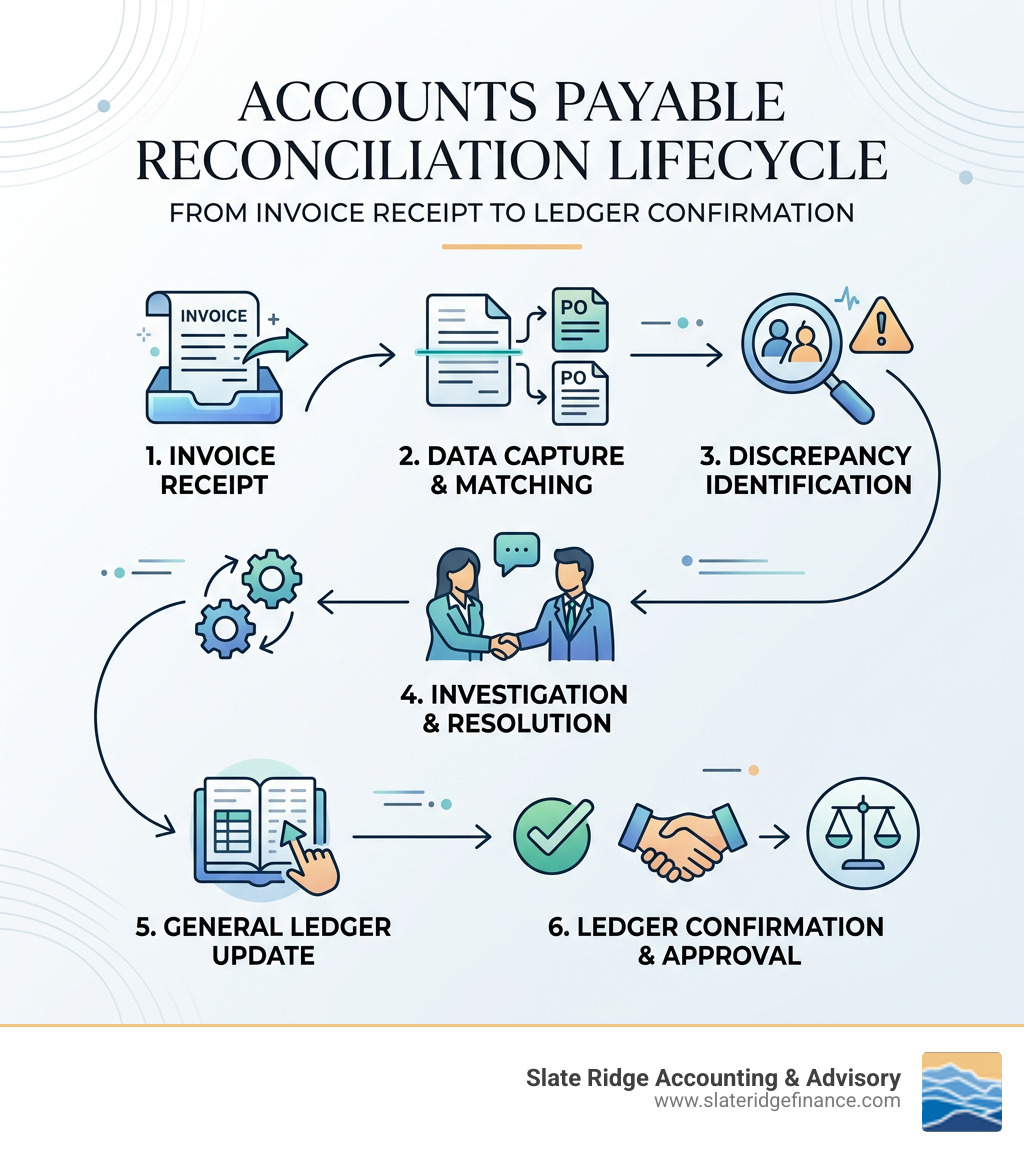
To reconcile accounts payable means to verify that what your business records show you owe matches what your vendors say you owe. Here's the quick version:
How to reconcile accounts payable:
- Check your starting balance against the previous period's ending balance
- Gather vendor statements, invoices, purchase orders, and payment records
- Match each invoice to its purchase order and payment
- Identify and investigate any differences
- Update your ledger and document the resolution
- Get a final sign-off and file everything for your records
For most small business owners, month-end is already stressful. Then comes the pile of vendor invoices, mismatched statements, and the creeping worry: are we actually paying what we owe — nothing more, nothing less?
That worry is valid. A missed invoice leads to late fees. A duplicate payment drains cash you needed elsewhere. And if your books are wrong, every financial decision you make is built on shaky ground.
The good news? Reconciling your accounts payable doesn't have to be a nightmare. With the right process, it becomes a routine check that keeps your finances clean, your vendors happy, and your stress levels manageable.
Reconcile accounts payable terms to remember:
- AP automation services
- Tips for Managing Small Business Accounts Receivable and Payable
- Small Business Financial Reporting: Complete Guide
Why You Must Reconcile Accounts Payable Regularly
At Slate Ridge Accounting & Advisory, we often see small businesses in North Carolina—from Raleigh to Asheville—struggle with "phantom" liabilities. These are balances on the books that don't actually exist, or worse, debts to vendors that aren't recorded at all.
When you reconcile accounts payable regularly, you are performing preventive maintenance on your business's heart: its cash flow. According to How to Reconcile Accounts Payable in 8 Steps, this process ensures your financial statements reflect actual obligations.
Financial Accuracy and Vendor Trust
Your vendors are your partners. If you consistently underpay or miss invoices, that trust erodes. Conversely, overpaying is a direct hit to your bottom line. Regular reconciliation helps you catch these errors before they impact operations. It’s about maintaining "financial integrity"—the assurance that your numbers are honest.
Fraud Prevention and Audit Compliance
Internal fraud is a quiet killer of small businesses. The Association of Certified Fraud Examiners (ACFE) notes that organizations can lose up to 5% of revenue to fraud annually, much of it through weak AP controls. By matching invoices to actual goods received, you create a barrier against unauthorized charges. This also keeps you "audit-ready," which is vital if you're seeking a loan or looking to sell your business in the future.
Duplicate Payments and Credit Score Protection
Did you know that in a manual environment, it’s remarkably easy to pay the same invoice twice? Maybe the vendor sent a reminder that looked like a new bill, or two different employees approved the same charge. Reconciling catches these duplicates. Furthermore, ensuring every bill is paid on time protects your business credit score, which is essential for securing favorable terms with suppliers.

The Strategic Value of Clean Books
Clean books aren't just for the tax man; they are for you, the owner. When your payables are reconciled, your Small Business Financial Reporting: Complete Guide actually means something. You can look at your dashboard and know exactly how much "dry powder" you have for new investments or hiring. It shifts your role from reactive fire-fighting to proactive strategic planning.
The Step-by-Step Process to Reconcile Accounts Payable
Think of reconciliation like a pre-flight checklist for a pilot. It might feel repetitive, but it’s what keeps the plane in the air. To reconcile accounts payable effectively, you need to bridge the gap between your General Ledger (the "big picture") and your AP Subledger (the "details").
Before you dive in, ensure you have these essential documents ready:
- Vendor Statements: The "external" truth provided by your suppliers.
- AP Aging Report: A list of what you owe, broken down by how long it’s been outstanding.
- Purchase Orders (POs): What you intended to buy.
- Receiving Reports/Packing Slips: Proof that you actually got the goods.
- Bank and Credit Card Statements: Proof that money actually left your account.
For a deeper dive into how these fit into your overall bookkeeping, check out our Monthly Bookkeeping Packages: Ultimate Guide.
Step 1: Verify Starting Balances and Gather Documentation
The most common mistake is starting a reconciliation without checking the "Step 0." You must ensure that your beginning balance for the current period matches the ending balance of the previous period. If these don't match, you're chasing ghosts from last month.
Once the starting balance is validated, gather your invoices. We recommend using a digital filing structure. In our Modern Accounting Practices, we advocate for "touchless" flows where invoices are emailed directly to a dedicated inbox, reducing the risk of a paper bill getting lost under a coffee mug.
Step 2: Perform Three-Way Matching to Reconcile Accounts Payable
This is the gold standard of AP control. Three-way matching involves comparing:
- The Vendor Invoice: What they are charging you.
- The Purchase Order: What you agreed to pay.
- The Receiving Report: What was delivered to your warehouse or office.
If the invoice says 100 widgets at $5 each, but the receiving report says only 90 arrived, you have a discrepancy. If the PO said $4 each, but the invoice says $5, you have a price variance. This step prevents you from paying for items you never received or for price hikes you didn't authorize. For more on setting up these systems, see our Accounting Systems Small Business Guide.
Step 3: Resolve Variances and Update the Ledger
When you find a mismatch, don't just "force" the numbers to work. Investigate.
- Timing Differences: Did you send the check on the 30th, but the vendor didn't log it until the 2nd?
- Credit Memos: Did you return a damaged item but forget to record the credit?
- Journal Entries: Sometimes manual adjustments are made to the GL that don't flow to the subledger. These need to be documented and explained.
Once resolved, update your records. This might involve reaching out to a vendor to request a corrected invoice or logging a Financial Process Optimization entry to clear a stale balance.
Common Challenges and Causes of Discrepancies
Why is this so hard? Usually, it's because of human error. Research shows that the average cost to process an invoice manually is about $15, but that drops to $3.50 with automation. Why? Because manual entry is riddled with mistakes.
| Manual Reconciliation Errors | Automated Accuracy |
|---|---|
| Transposed numbers ($1,234 vs $1,243) | AI-driven OCR capture (99%+ accuracy) |
| Lost paper invoices | Centralized digital inbox |
| Duplicate payments | Automated duplicate detection |
| Slow approval cycles | Digital workflows with reminders |
A frequent issue is that 62% of businesses manually keyed in invoice data from paper documents as recently as 2012. While we've come a long way, many small businesses in North Carolina still rely on manual data entry, which is the primary cause of reconciliation headaches.
Identifying Fraud and Unauthorized Charges
We can't stress "segregation of duties" enough. The person who approves the invoice should not be the same person who cuts the check. If one person handles the entire cycle, it’s easy for "ghost vendors" to slip through the cracks. Regularly reviewing your vendor list for unusual activity is a cornerstone of our Accounting Best Practices Small Business Guide.
Best Practices to Efficiently Reconcile Accounts Payable
To make the process smoother, we recommend a few "pro tips" we use with our clients at Slate Ridge:
- Standardize Your Workflow: Create a checklist. Whether you are in Charlotte or Wilmington, having a repeatable process ensures nothing is missed.
- Reconcile Frequently: Don't wait until the end of the year. If you have high transaction volume, reconcile weekly. For most, monthly is the sweet spot.
- Open Communication: If you see a discrepancy, call the vendor immediately. It’s much easier to fix a mistake from three days ago than one from three months ago.
- Digital Audit Trails: Use software that logs who approved what and when. This makes future audits a breeze.
Transitioning to Automated Reconciliation Systems
If you’re still using spreadsheets, it’s time to look at Online Accounting Software for Small Business. Modern tools use AI to "read" invoices and automatically match them to POs.
Teams using platforms like BILL or Ramp report spending 50% less time on their AP process. That’s hours of your life back every month—time you could spend growing your business or finally taking a weekend off in the Blue Ridge Mountains.
Frequently Asked Questions about AP Reconciliation
How often should a small business reconcile accounts payable?
We recommend a monthly close for most small businesses. However, if you are a high-volume business—like a busy restaurant in Raleigh or a retail shop in Hickory—you might benefit from weekly cycles. The goal is to catch errors while the transactions are still fresh in your mind. Our Modern Bookkeeping Services can help you determine the right cadence for your specific needs.
What is the difference between vendor reconciliation and general AP reconciliation?
General AP reconciliation ensures your General Ledger matches your AP Subledger (internal vs. internal). Vendor reconciliation is a subset where you compare your internal records for a specific supplier against the statement they sent you (internal vs. external). Both are necessary for 100% accuracy.
How does AP reconciliation impact cash flow management?
It’s all about the demand for real-time data. If you don't reconcile, your cash flow forecast is a guess. By knowing exactly when payments are due and ensuring you aren't overpaying, you can manage your working capital more effectively. You’ll know if you can afford that new piece of equipment or if you need to tighten the belt for a lean month.
Conclusion
At Slate Ridge Accounting & Advisory, we believe that your books should be a tool for growth, not a source of stress. Whether you need a full Bookkeeping Service for Small Business or a one-time financial clean-up, our team is here to help you reconcile accounts payable and gain total clarity over your finances.
We serve businesses across North Carolina—from the tech hubs of Raleigh to the coastal offices of Wilmington. By combining modern cloud technology with personalized advisory, we help you track the KPIs that actually matter.
Don't let mismatched invoices keep you up at night. Let's get your payables reconciled so you can focus on what you do best: running your business. Contact us today to learn how we can streamline your financial processes.
Ready to get started?
Book a free consultation today and let’s explore how Slate Ridge can support your business with expert accounting that’s accurate, timely, and built around your goals.
You Might Also Like
A few more posts we think you’ll enjoy on topics that matter to business owners like you.