

Find an Asheville, NC Virtual Accountant Who Fits Your Business
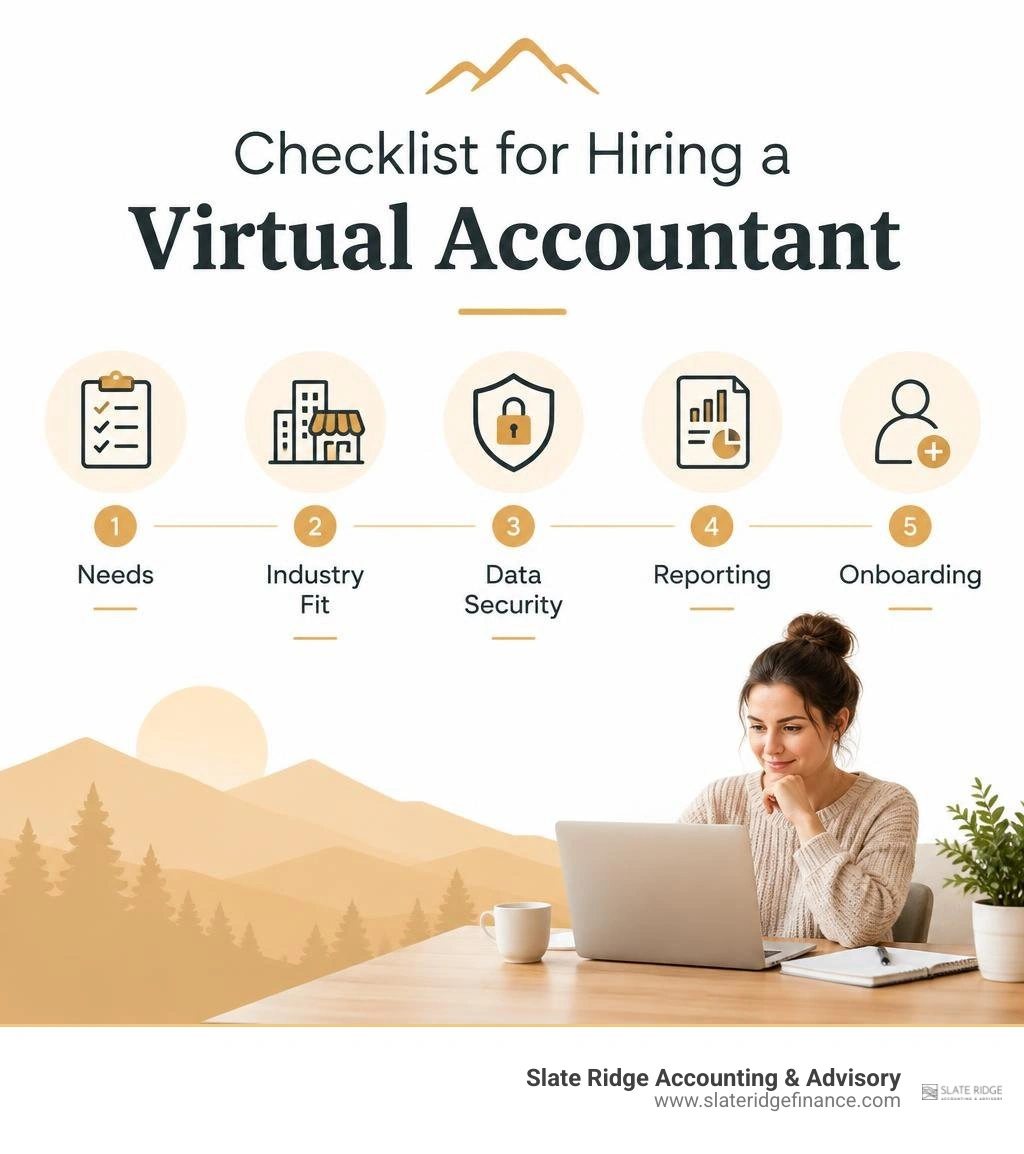
To hire an Asheville, NC virtual accountant, start with your primary operational priority: keeping the books current, fixing disorganized historical records, or gaining clearer monthly reports to direct your growth. Then evaluate how each candidate handles your industry's specific accounting workflows, secures proprietary financial data, and communicates regular performance updates. A reliable accounting partner will clearly outline what deliverables you will receive each month, establish structured review cycles, and define a transparent onboarding plan.
Slate Ridge Accounting & Advisory provides cloud-based bookkeeping, catch-up financial clean-up, and strategic advisory tailored to growing small businesses. We’re Caroline and Joe, and we’re here to help you understand exactly what to look for before choosing your virtual accounting partner.
Why Modern Small Businesses Need an Asheville NC Virtual Accountant
Running an independent business in Western North Carolina means balancing operational craft with administrative overhead. Whether you are operating a boutique creative agency in downtown Asheville, managing a specialized construction crew along the Blue Ridge, running an independent hospitality concept, or scaling a tech startup, outdated bookkeeping methods create severe administrative drag.
Traditional accounting models often rely on dropped-off physical receipts, periodic desktop file backups, and rear-view reporting that tells you what happened three months ago rather than what is happening today. Hiring an Asheville NC virtual accountant bridges this gap by merging location-independent cloud technology with localized, high-touch financial expertise.
| Feature | Traditional In-Person Accounting | Virtual Cloud Accounting |
|---|---|---|
| Data Accessibility | Local desktop files, physical paper drop-offs | 24/7 real-time access via secure cloud platforms |
| Reporting Cadence | Annual or quarterly historical reviews | Monthly close, live KPI dashboards, continuous visibility |
| Overhead Cost | High hourly rates billing for physical overhead | Predictable, flat-rate monthly service models |
| Communication | Scheduled office visits, phone tag | Direct digital channels, asynchronous video, shared screens |
| Tech Integration | Manual ledger entries, paper checks | Automated bank feeds, cloud receipts, app integrations |
A virtual financial workflow removes the physical constraints of traditional firms while ensuring your business stays compliant and agile. For organizations growing within our local business ecosystem in Western NC, modern accounting infrastructure offers complete visibility into operating cash flow. You can also explore trusted state networks like the Find a Professional Accountant or Bookkeeper - Relay directory to understand the broader shift toward digital-first banking and bookkeeping integration.
Virtual Accounting vs. Traditional In-Person CPA Services
The core difference between traditional brick-and-mortar firms and modern virtual practices lies in how data moves through your business. Traditional CPA engagements often center primarily around tax compliance—looking at historical numbers once a year to calculate liability and file annual returns.
In contrast, virtual accounting focuses on forward-looking operational finance and day-to-day clarity. We automate repetitive tasks such as invoice capture, transaction categorization, and bank reconciliations through encrypted cloud systems like QuickBooks Online and Xero. This automation eliminates lost paper trails, prevents tax-time surprises, and gives business owners immediate access to their balance sheets, income statements, and cash positions whenever critical decisions must be made.
Comprehensive Cloud Accounting and Advisory Services
Modern small businesses require more than basic ledger entry; they need clear, timely data to support strategic decisions. Our approach integrates day-to-day transaction management with strategic financial planning, ensuring your operations remain lean, organized, and cash-flow positive throughout the business lifecycle.
By leveraging remote accounting solutions alongside structured virtual financial planning, businesses can transition seamlessly from reactive record-keeping to proactive cash management and long-term stability.
Core Services Offered by an Asheville NC Virtual Accountant
A well-structured virtual engagement covers every layer of your company's back-office financial operations:
- Full-Charge Bookkeeping: Our full-charge bookkeeping service for small business covers daily categorization, accounts payable (A/P) approvals, accounts receivable (A/R) tracking, and structured month-end reconciliations.
- Financial Clean-Up & Catch-Up: Resolving backlog ledgers, unreconciled accounts, duplicate entries, and mismatched past filings to establish a reliable baseline.
- Payroll Management: Coordinating automated direct deposits, tracking state and federal payroll liabilities, and recording precise gross-to-net journal entries.
- Cash Flow Monitoring: Overseeing short-term working capital needs and building rolling forecasts to avoid liquidity shortfalls during seasonal dips.
Strategic Advisory and FinOps Optimization
Beyond standard reconciliation, virtual firms deliver operational financial management (FinOps). Through online financial advisory, we build customized Key Performance Indicator (KPI) dashboards using tools like Power Query and modern business intelligence integrations.
This framework allows us to evaluate your gross margins, monitor your Days Sales Outstanding (DSO), and manage your Days Payable Outstanding (DPO). When tax season arrives, we coordinate directly with your CPA firm through structured virtual tax preparation support, delivering clean trial balances, supporting schedules, and finalized workpapers so your tax preparer can file without friction.
Tailored Financial Solutions for Western North Carolina Industries
Different industries carry distinct accounting rules, revenue recognition standards, and compliance demands. A generic chart of accounts rarely serves specialized operations effectively.
How an Asheville NC Virtual Accountant Drives Growth in Key Industries
We implement custom bookkeeping solutions structured around the specific operating realities and reporting demands of regional sectors:
- Construction & Trades: Tracking profitability by project requires precise job-costing. We separate direct costs of goods sold (COGS)—materials, trade labor, subcontractor expenses, and equipment rentals—from general administrative overhead, allowing general contractors and specialty trades to bid accurately and protect project margins.
- SaaS & Technology Startups: Software companies require strict adherence to GAAP standards such as ASC 606 for subscription revenue recognition and deferred income. We track key software metrics, including Monthly Recurring Revenue (MRR), Customer Acquisition Cost (CAC), Lifetime Value (LTV), and Average Revenue Per User (ARPU).
- Franchisees & Multi-Unit Retail: Multi-unit operators face complex franchise fee reporting, advertising fund contributions, and distinct location-by-location unit economics. We structure comparative reporting to highlight performance variations between storefronts and identify margin leaks.
- Professional Services: Agencies, design studios, legal practices, and consultancies rely on project-level profitability, retainer management, and billable utilization. We streamline invoicing workflows and expense reimbursements to keep operational margins transparent.
Seamless Onboarding and Financial Clean-Up Process
Transitioning to a virtual accounting team follows a clear, structured sequence designed to eliminate operational downtime and ensure complete data integrity:
- Historical Ledger Audit: We review your historical accounts, identifying unreconciled balances, duplicate entries, misclassified expenses, and broken bank feeds.
- Chart of Accounts Restructuring: We align your accounts with industry-specific reporting needs, tax classifications, and GAAP requirements.
- Software & Feed Integration: We connect your business bank accounts, credit cards, payment gateways, and point-of-sale systems directly into QuickBooks Online or Xero.
- Standardized Monthly Cadence: We establish a recurring close schedule, delivering management reports and financial statements on time every single month.
How to Choose the Right Virtual Accounting Firm
Selecting an accounting partner requires evaluating technical capability, communication style, and transparent pricing models.
- Look for Verified Industry Experience: Choose a firm familiar with your revenue models, state filing rules, sales tax compliance, and industry-specific software tools.
- Demand Transparent Pricing: Avoid unpredictable hourly retainers that penalize efficiency. Review a clear small business accounting costs guide and prioritize fixed-fee monthly packages with defined deliverables.
- Verify Modern Technology Standards: Consult resources like a best cloud accounting small business guide to ensure your prospective firm uses modern, encrypted cloud tools and supports multi-factor authentication across all client portals.
- Assess Delivery Track Records: Ask about the firm's monthly close timeline, their response times for routine inquiries, and their process for coordinating with tax CPAs.
Frequently Asked Questions About Hiring a Virtual Accountant
How does a virtual accountant coordinate with my tax CPA?
Your virtual accounting team manages the general ledger throughout the year, keeping day-to-day records clean, balanced, and compliant. At year-end, we assemble a complete tax package containing the final trial balance, balance sheet substantiations, depreciation schedules, and adjusted general ledgers. We interface directly with your tax CPA to answer technical inquiries and record adjusting journal entries, eliminating last-minute tax season scrambles and expensive CPA clean-up rates.
What technology stack is required for remote bookkeeping?
Modern virtual bookkeeping requires only standard, user-friendly cloud software. Most small and mid-sized businesses operate effectively on QuickBooks Online or Xero paired with automated bank feeds, electronic document management tools, and integrated payroll platforms like Gusto. All access is handled through secure, encrypted client portals, meaning you never have to install local server software or exchange unencrypted spreadsheets over email.
How quickly can a virtual accounting team clean up overdue books?
The timeline for catching up backlogged bookkeeping depends on total transaction volume, the number of unorganized periods, and the complexity of bank connections. Simple cleanups involving a single back year typically take two to three weeks, while multi-year or complex cleanups requiring historical bank statement sourcing, inventory reconciliations, and revenue realignment may take four to six weeks.
Conclusion
Modernizing your business's financial infrastructure does not require an in-house accounting department or traditional paper-heavy workflows. Partnering with a dedicated virtual team provides the perfect balance of cloud automation, industry-specific insight, and reliable financial reporting that empowers sustainable growth.
Slate Ridge Accounting & Advisory combines over 20 years of collective finance experience with modern cloud systems to deliver 100% on-time financial statements. If you are ready to gain full visibility into your cash flow, eliminate messy books, and make confident business decisions, partner with an expert virtual accounting firm today.
Ready to get started?
Book a free consultation today and let’s explore how Slate Ridge can support your business with expert accounting that’s accurate, timely, and built around your goals.
You Might Also Like
A few more posts we think you’ll enjoy on topics that matter to business owners like you.