

Why Finding the Right Local Bookkeeping Services Can Make or Break Your NC Business
Local bookkeeping services give North Carolina small business owners something national firms often can't: someone who knows your community, understands your state's tax landscape, and picks up the phone when you call.
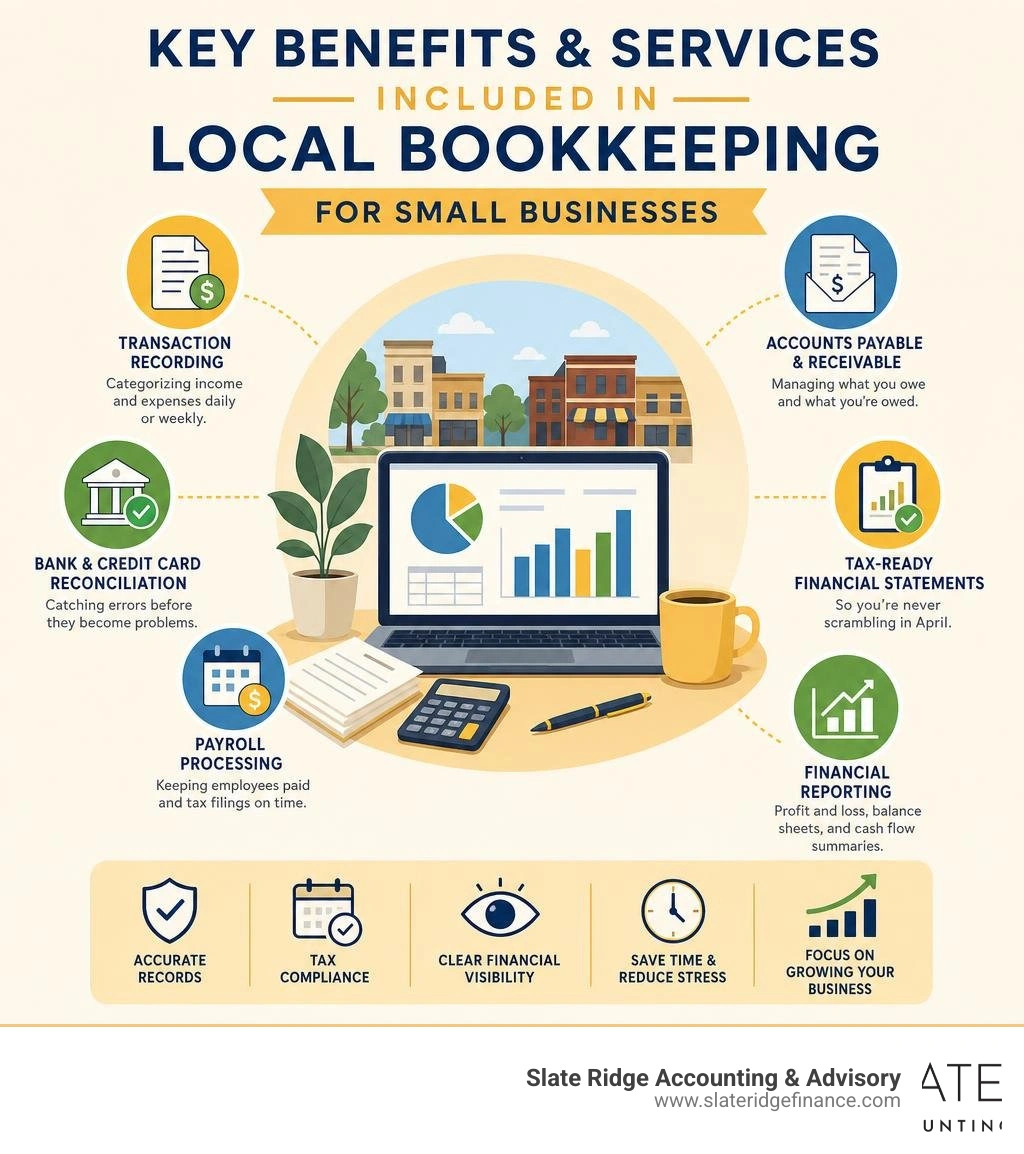
Here's a quick look at what local bookkeeping services typically include:
- Transaction recording - categorizing income and expenses daily or weekly
- Bank and credit card reconciliation - catching errors before they become problems
- Payroll processing - keeping employees paid and tax filings on time
- Accounts payable and receivable - managing what you owe and what you're owed
- Tax-ready financial statements - so you're never scrambling in April
- Financial reporting - profit and loss, balance sheets, and cash flow summaries
Running a business is hard enough without spending your off-hours sorting through receipts and invoices. Most small business owners didn't start their company to become bookkeepers. Yet that's exactly what happens when the books pile up.
Whether you're based in Hickory, Greensboro, or Wilmington, the right local bookkeeper keeps your records clean, your taxes compliant, and your financial picture clear — so you can focus on growing your business instead of drowning in spreadsheets.
This guide covers everything North Carolina business owners need to know about finding, hiring, and working with local bookkeeping professionals in 2026.
Local bookkeeping services basics:
Why North Carolina Businesses Choose Local Bookkeeping Services
When you run a business in North Carolina, you are part of a unique economic landscape. A furniture manufacturer in Hickory faces entirely different financial realities than a tech startup in Raleigh or a tourism-dependent boutique in Wilmington. That is why choosing a cookie-cutter, automated national platform often falls short.
By looking for a trusted bookkeeper near me or exploring professional bookkeepers near me, you gain a partner who understands the local market dynamics. We believe that financial support should feel personal and collaborative rather than transactional. When your financial records are maintained by someone who understands the local economic climate, you get more than just data entry; you get context.
The Strategic Value of Local Bookkeeping Services in NC
Working with a local financial professional provides structural advantages that remote-only call centers cannot replicate.
- State and Regional Compliance: North Carolina has specific sales tax rules, county-level property taxes, and state withholding requirements. A local expert helps you stay aligned with guidance from the North Carolina Department of Revenue so you do not run afoul of state requirements.
- On-Site Audit Assistance: If your business is ever selected for an audit, having a local professional who can sit down with you or even coordinate directly with local auditors provides immense peace of mind.
- Community Networking: Local bookkeepers are deeply embedded in the NC business community. They can connect you with trusted local attorneys, insurance agents, and commercial bankers.
- Virtual Expertise with a Local Touch: Modern firms like Slate Ridge Accounting & Advisory combine the ease of cloud-based technology with deep regional expertise. You get the convenience of a virtual workflow without sacrificing the personal touch of a partner who knows North Carolina business.
Bookkeeper vs. Accountant: When Do You Need Both?
Many business owners use the terms "bookkeeper" and "accountant" interchangeably, but they serve distinct, complementary roles. Think of your bookkeeper as the architect who builds a clean, sturdy foundation, while the accountant is the structural engineer who analyzes the design to plan your future.
- The Bookkeeper: Focuses on the daily and monthly recording of transactions. They categorize expenses, reconcile bank statements, manage accounts payable and receivable, and keep your financial systems organized.
- The Accountant: Focuses on higher-level financial analysis, tax planning, and strategic advisory. They take the clean data provided by your bookkeeper to file corporate tax returns and optimize your tax liabilities.
Do you need both? Often, yes. Having a bookkeeper manage your day-to-day records ensures your books are always accurate. When tax season arrives, your CPA or accountant can step in and immediately begin strategic planning without wasting costly billable hours cleaning up messy spreadsheets.
Core Offerings of North Carolina Bookkeeping Firms
What exactly does professional bookkeeping look like on a weekly basis? It is much more than just keeping receipts in a shoebox. A comprehensive Bookkeeping Service for Small Business provides a suite of administrative and analytical tools designed to keep your business running smoothly.

- Accounts Payable (AP): Managing and paying vendor invoices on time so you maintain great relationships and avoid late fees.
- Accounts Receivable (AR): Sending invoices to your clients promptly and tracking outstanding payments to ensure money keeps flowing into your business.
- Bank & Credit Card Reconciliation: Matching your internal books against your actual bank statements to identify discrepancies, bank errors, or unauthorized transactions early.
- Payroll Processing: Calculating employee hours, managing withholdings, and ensuring state and federal payroll tax liabilities are tracked accurately.
How Local Bookkeeping Services Streamline Tax Preparation and Compliance
One of the biggest pain points for North Carolina business owners is tax season. If you spend every March scrambling to find documents, you are losing valuable time and likely missing out on deductions.
By maintaining clean, tax-ready financial records throughout the year, local bookkeepers ensure you are prepared to file on time. In fact, small businesses utilizing professional bookkeeping services achieve a 98% on-time filing rate.
When your bookkeeping is handled properly, your financial statements are fully reconciled and categorized according to IRS guidelines. We leverage more than 17 years of experience in professional tax preparation and bookkeeping to make sure you maximize your deductions and remain fully compliant.
For businesses in specific North Carolina regions, collaborating with local tax specialists can streamline this process further. Whether you are working with a CPA in Greensboro, a tax preparer in Greenville, or an accounting firm in Hickory, having clean books ensures your tax professional can work efficiently and focus on saving you money.
Industry-Specific Solutions for NC Small Businesses
Bookkeeping is not one-size-fits-all. Different industries require different tracking methods to measure profitability accurately.
- Construction and Contracting: Requires precise job costing to track labor, materials, and subcontractor expenses for individual projects. This ensures you know exactly which projects are profitable and which are draining your cash.
- E-Commerce and Retail: Focuses heavily on inventory management, sales tax tracking across multiple states, and reconciling online payment processors (like Stripe, Shopify, or PayPal).
- Real Estate: Demands tracking income and expenses across multiple properties or entities, requiring clear, separate ledgers to simplify year-end reporting.
What to Expect During Onboarding and Ongoing Support
If you have never worked with a professional bookkeeping firm before, the transition might seem daunting. However, a structured onboarding process is designed to make the experience stress-free and seamless.
Our typical onboarding workflow is designed to move you from financial chaos to total clarity:
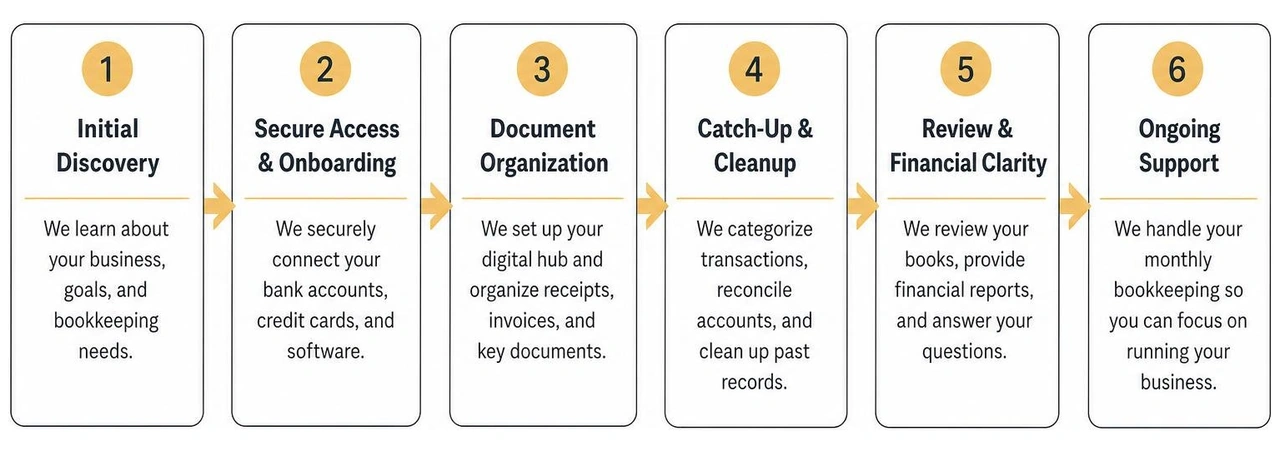
During the first few weeks, we focus on:
- System Access: Securely connecting your bank accounts, credit cards, and point-of-sale systems to our cloud software.
- Document Organization: Creating a digital hub where you can easily upload receipts and invoices.
- Catch-Up Bookkeeping & QuickBooks Cleanup: Sorting through past months of uncategorized transactions to bring your books completely up to date. You can learn more about how physical and virtual setups compare in our Bookkeeping Offices Complete Guide 2026.
Leveraging Modern Cloud Technology and ProAdvisor Expertise
Gone are the days of dropping physical ledger books off at a local office. Today, we use secure, cloud-based tools like QuickBooks Online and Xero to manage your finances in real time.
By working with certified ProAdvisors, you ensure that your software is configured correctly from day one. Across the state, from Western NC and the High Country to major metro areas like Charlotte and Raleigh, local businesses rely on certified experts to keep their systems optimized and their digital ledgers streamlined.
These cloud platforms allow us to deliver real-time financial monitoring. You can access your balance sheet, profit and loss statement, and cash flow reports on your phone or desktop whenever you need to make a quick business decision.
Improving Cash Flow and Financial Decision-Making
We believe that tracking your books does not help you if you do not understand the data. That is why we do not just record history; we help you write your business's next chapter.
By utilizing customized KPI (Key Performance Indicator) dashboards, we help you monitor crucial metrics like your gross profit margin, accounts receivable turnover, and customer acquisition cost. With accurate, real-time data, you can build reliable cash flow forecasts, allowing you to answer important questions like:
- Can we afford to hire two more employees next month?
- Which of our services or products is growing faster than its associated expenses?
- How much cash do we need to set aside for our quarterly tax payments?
Understanding Bookkeeping Costs and Pricing Structures
When it comes to bookkeeping, pricing should never be a mystery. Historically, traditional bookkeepers billed by the hour, which often led to surprise invoices at the end of the month. Today, most modern firms utilize transparent, flat-rate monthly pricing based on your transaction volume and business complexity.
| Pricing Model | Pros | Cons | Best For |
|---|---|---|---|
| Flat-Rate Monthly | Highly predictable; easier to budget; encourages open communication without "on-the-clock" anxiety. | Fees may adjust if your business transaction volume scales significantly. | Growing small businesses, startups, and established retail/e-commerce brands. |
| Hourly Billing | You only pay for the exact minutes worked. | Unpredictable monthly costs; can become expensive if clean-up or audit support is needed. | Very small micro-businesses with highly seasonal or fluctuating transaction volumes. |
To give you a general idea of industry standards in 2026, professional bookkeeping support typically starts around $149 USD per month for basic small business needs. For freelancers, solopreneurs, or new business owners who want to manage their own books but need professional guidance to set things up, 1:1 accounting coaching is often available starting at a $229 USD one-time fee.
Transparent flat-rate options demonstrate how predictable pricing helps small businesses budget effectively without worrying about surprise hourly bills.
Key Questions to Ask When Choosing a Bookkeeper
To ensure you find the perfect partner for your North Carolina business, we recommend asking these questions during your initial discovery calls:
- Are you a certified QuickBooks ProAdvisor or Xero Certified Advisor? (Ensures technical competency with modern cloud tools).
- Do you have experience working with businesses in my specific industry? (Crucial for niche industries like construction, hospitality, or e-commerce).
- How often will my books be updated, and how frequently will we communicate? (Establishes clear expectations for ongoing support).
- Do you offer advisory services, or do you only handle basic data entry? (Important if you want help tracking KPIs and forecasting growth).
If you are looking for localized support in the Triad, exploring Bookkeeping Services Greensboro NC can help you connect with qualified professionals who understand the regional market.
Frequently Asked Questions About NC Bookkeeping
How often should my business books be updated?
For most active small businesses, we recommend updating your books weekly. Weekly updates ensure that your cash flow monitoring is accurate, and it prevents a massive backlog of uncategorized transactions from building up at the end of the month. For businesses with very low transaction volumes, monthly updates may be sufficient, but weekly tracking provides the best financial visibility.
Can a bookkeeper help clean up years of messy financial records?
Absolutely. Many business owners come to us feeling overwhelmed because they are months or even years behind on their recordkeeping. Professional catch-up bookkeeping and cleanup services are designed to address this exact problem without judgment. We use our years of experience to systematically reconcile past accounts, correct historical errors, and get your business fully tax-ready.
What is the average monthly savings from outsourcing bookkeeping?
While savings vary depending on the size of your business, outsourcing your financial back-office can save growing companies an average of $12,450 monthly in recovered time, reduced overhead, minimized tax penalties, and optimized operational efficiency. Instead of spending 10 to 20 hours a week managing spreadsheets, founders can reallocate their time to high-value, revenue-generating activities.
Conclusion
At Slate Ridge Accounting & Advisory, we are passionate about helping North Carolina businesses find clarity, peace, and growth. As a cloud-based firm, we combine the convenience of modern virtual bookkeeping with a deeply personalized, industry-tailored approach.

We don't just record your historical numbers; we help you look forward. By tracking key performance indicators and building custom growth forecasts, we empower you to make confident, data-driven decisions that move your business forward.
Ready to get your weekends back and turn your financial chaos into clear, confident numbers? Let's build a stronger financial future for your business together.
Schedule a consultation with Slate Ridge Accounting & Advisory today.
Ready to get started?
Book a free consultation today and let’s explore how Slate Ridge can support your business with expert accounting that’s accurate, timely, and built around your goals.
You Might Also Like
A few more posts we think you’ll enjoy on topics that matter to business owners like you.