
What Does a Bookkeeper Actually Cost? Here's the Short Answer

How much does a bookkeeper cost is one of the first questions every small business owner asks — and the honest answer is: it depends, but there are clear ranges you can plan around.
Here's a quick breakdown:
| Service Type | Typical Cost |
|---|---|
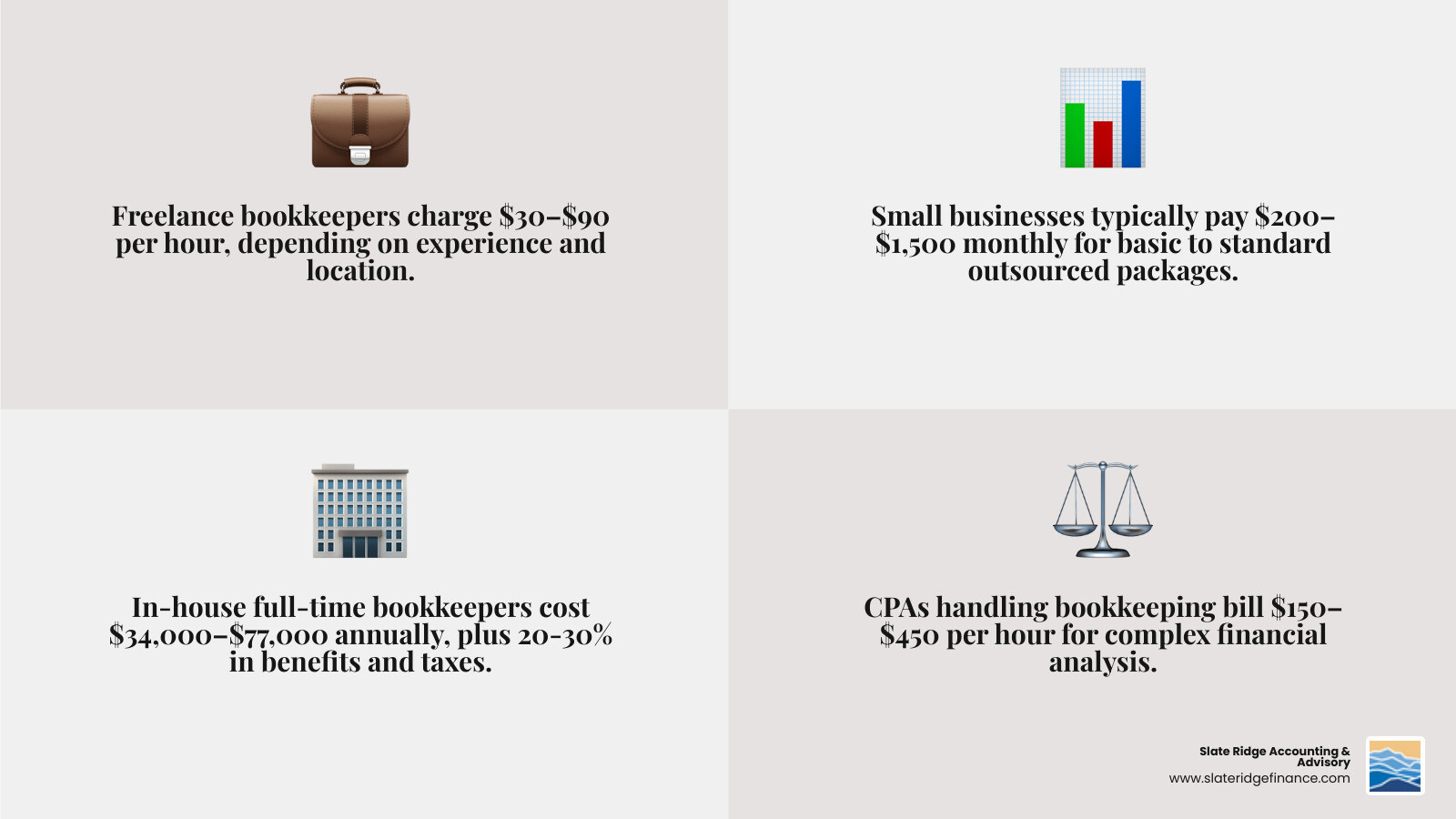
| Freelance bookkeeper (hourly) | $30–$90/hour |
| Basic monthly package | $200–$500/month |
| Standard monthly package | $500–$1,500/month |
| Premium/complex monthly package | $1,500–$2,500+/month |
| In-house full-time bookkeeper | $34,000–$77,000/year + benefits |
| CPA doing bookkeeping | $150–$450/hour |
Most small businesses land somewhere between $300 and $1,500 per month for outsourced bookkeeping. That range shifts based on your transaction volume, number of accounts, and the services included.
If you've been putting off this decision — doing it yourself, guessing at numbers, or handing everything to a CPA at a premium rate — you're not alone. Many business owners simply don't know what professional bookkeeping should cost, which makes it hard to budget for or even know if they're overpaying.
This guide breaks it all down clearly: hourly vs. monthly pricing, in-house vs. outsourced, and what you actually get at each price point.
Important how much does a bookkeeper cost terms:
- bookkeeping packages for small business
- monthly bookkeeping packages
- bookkeeping service for small business
Understanding the Average Cost of a Bookkeeper
When you start looking into professional help, you’ll quickly find that there isn't a single "sticker price" for financial clarity. The market is split into several different delivery models, each with its own pricing logic. Understanding these differences is the first step toward building a realistic budget.
For many of our clients in North Carolina, the choice often comes down to hiring a local freelancer or partnering with a specialized firm. Freelancers often provide the lowest entry point, but firms offer a level of redundancy and specialized expertise that a single person might lack.
How much does a bookkeeper cost per hour?
If you prefer to pay only for the exact minutes spent on your files, hourly billing might seem attractive. In the United States, freelance bookkeeper rates typically fall between $30 and $90 per hour.
- Entry-level/Junior Bookkeepers: Often charge $30–$50 per hour. These individuals handle basic data entry and bank reconciliations but may lack the experience to handle complex issues like inventory or multi-state sales tax.
- Experienced/Certified Bookkeepers: Usually range from $60–$100+ per hour. These professionals often hold certifications from organizations like the American Institute of Professional Bookkeepers (AIPB) and work much faster than a novice.
- CPA Firms: If you ask your tax accountant to handle your monthly bookkeeping, expect to pay a premium. CPA hourly rates for bookkeeping often sit between $150 and $450 per hour. While they are highly qualified, using a CPA for basic transaction coding is often like hiring a heart surgeon to put on a Band-Aid—it’s effective, but unnecessarily expensive.
According to national wage data for bookkeeping clerks, the median hourly wage for an employee is around $22, but an independent contractor must cover their own taxes, software, and overhead, which is why their billable rates are higher. To learn more about how these rates translate to the digital world, check out our guide on Virtual Bookkeeper Cost.
How much does a bookkeeper cost for small businesses?
Most modern businesses are moving away from hourly billing in favor of flat-fee monthly packages. This model offers price predictability—you know exactly what will leave your bank account on the first of the month.
- Starter/Basic Packages ($200–$500/month): These are ideal for solopreneurs or very small service businesses with low transaction volumes (under 50 transactions per month) and perhaps 1-2 bank accounts.
- Standard Packages ($500–$1,200/month): This is the "sweet spot" for most growing small businesses. It usually includes monthly reconciliations for multiple accounts, accounts payable/receivable support, and basic financial statements.
- Growing/Complex Businesses ($1,200–$2,500+/month): If you have a larger team, complex inventory, or need advanced reporting like KPI tracking and forecasting, your costs will scale accordingly.
For a deeper dive into what fits your specific stage of growth, see our breakdown of the Best Small Business Bookkeeping Packages.
Key Factors That Determine How Much a Bookkeeper Costs
If you’ve received three different quotes for bookkeeping, you might be wondering why they vary so much. It isn't just about the bookkeeper's experience; it’s about the "weight" of your business's financial engine.
- Transaction Volume: This is the biggest price driver. A business with 20 transactions a month takes much less time than a restaurant with 500 daily entries and complex point-of-sale integrations.
- Number of Accounts: Every bank account, credit card, and loan represents another statement that needs to be reconciled. More accounts mean more potential for errors and more time spent hunting down missing data.
- Industry Complexity: A professional services firm (like a law office or marketing agency) is generally simpler to manage than a construction company requiring job costing or a retail store managing physical inventory.
- Reporting Needs: Do you just need a Profit & Loss statement for your tax drafter at the end of the year? Or do you need weekly cash flow updates and custom KPI dashboards to help you scale?
For business owners in the Triad, our Bookkeeping Services Greensboro NC page details how we tailor these factors to local industry needs.
Service Tiers: Basic vs. Premium
To help you visualize what you're paying for, we often categorize services into tiers.
- Basic Tier: Focuses on the "must-haves." This includes bank reconciliations, transaction categorization, and generating a standard Balance Sheet and P&L. It’s about staying compliant and organized.
- Standard Tier: Adds more "active" management. This might include accounts payable (paying your bills), accounts receivable (sending invoices), and basic payroll integration.
- Premium Tier: This is where we act as a "Fractional Controller." It includes advanced financial analysis, budget-to-actual reporting, and industry-tailored advice to help you forecast growth.
You can find a complete list of service inclusions in our Monthly Bookkeeping Packages Ultimate Guide.
Regional and Location Impact
While the internet has made bookkeeping a global service, geography still plays a role in pricing. In North Carolina, you’ll find that rates in major hubs like Raleigh or Charlotte are often slightly higher than in more rural areas like Morganton or Boone due to the local cost of living and professional overhead.
However, one of the biggest benefits of a cloud-based firm like ours is that we can offer high-level expertise to businesses across the state without the "big city" price tag of a traditional downtown firm. State-by-state salary variations show that North Carolina is generally more affordable than places like New York or California, with average hourly rates for in-house staff ranging from $20 to $28 depending on the city.
In-House vs. Outsourced: Comparing the Real Bottom Line
Many business owners reach a point where they wonder if they should just hire someone to sit in the office. While having a dedicated person down the hall sounds nice, the math often tells a different story.
The Hidden Costs of In-House Employees
When you hire an employee, the salary is just the tip of the iceberg. According to the SBA, the true cost of an employee is typically 1.25 to 1.4 times their base salary.
If you hire a part-time bookkeeper at $45,000 a year, you aren't just paying $45,000. You are also responsible for:
- Employer Payroll Taxes: Social Security, Medicare, and unemployment taxes.
- Benefits: Health insurance, 401(k) matching, and paid time off.
- Overhead: A desk, a computer, software licenses (QuickBooks isn't getting any cheaper!), and office supplies.
- Recruitment and Training: The time and money spent finding, interviewing, and onboarding.
For a detailed comparison of these costs, see our Small Business Accounting Costs Guide.
Benefits of Virtual and Outsourced Models
Outsourcing to a virtual firm allows you to bypass almost all of those hidden costs. You get a team of experts for a fraction of the cost of one full-time hire.
- Scalability: You can start with a basic package and scale up as your revenue grows. You don't have to worry about "firing" your bookkeeper if business slows down or "hiring more" if you have a busy quarter.
- Software Inclusion: Many firms include the cost of high-end accounting software or offer wholesale pricing that you can't get on your own.
- Continuity: If an in-house bookkeeper goes on vacation or quits, your books stop. With an outsourced firm, your financial engine keeps running regardless of individual schedules.
Learn more about why this model works for modern entrepreneurs on our Bookkeeping Service for Small Business page.
Bookkeeper vs. Accountant vs. CPA: Cost and Service Differences
One of the reasons business owners are confused about how much does a bookkeeper cost is that the lines between financial roles are often blurred.
- Bookkeeper: The "Ground Crew." They handle the daily and monthly recording of data. They make sure the bank matches the books and that every penny is accounted for.
- Accountant: The "Navigator." They take the data provided by the bookkeeper and analyze it. They look for trends, help with budgeting, and provide higher-level financial insights.
- CPA (Certified Public Accountant): The "Specialist." They are state-licensed and can represent you before the IRS. Their primary focus is usually high-level tax strategy, audits, and complex compliance.
When to Pay for a CPA
You should expect to pay CPA rates ($150–$450/hour) when you need:
- Complex corporate tax returns and year-end filings.
- Representation during an IRS audit.
- Advanced tax planning for high-net-worth individuals or complex multi-entity structures.
When a Professional Bookkeeper is Sufficient
For 90% of your business life, a professional bookkeeper is not only sufficient but actually better suited for the job. We handle:
- Daily transaction recording and bank feeds.
- Monthly closes and financial reporting.
- Cash flow tracking and accounts payable.
- Small Business Payroll Cost Guide management.
By using a bookkeeper for the monthly heavy lifting and a CPA for the year-end tax return, you can save thousands of dollars in professional fees. Check out our Monthly Accounting Packages to see how we bridge the gap between simple record-keeping and strategic advisory.
When to Stop DIY and Invest in Professional Help
Many founders start by doing their own books. It’s a great way to save cash in the first few months, but eventually, DIY bookkeeping becomes a "growth tax" on your business.
Calculating Your Opportunity Cost
Your time has a dollar value. If you bill your clients $100 per hour and you spend 5 hours a month struggling with QuickBooks, that "free" DIY bookkeeping just cost you $500 in lost revenue.
If a professional bookkeeper costs $400 a month, you are actually losing $100 every month by doing it yourself. And that doesn't even account for the value of your sanity or the time you could spend with your family.
Signs You’ve Outgrown DIY Bookkeeping
If any of the following sound familiar, it’s time to stop guessing and start budgeting for a pro:
- Your books are months behind: You have no idea if you actually made a profit last month.
- You're terrified of tax season: You spend every April in a blind panic trying to find receipts from last July.
- You're missing deductions: You suspect you're paying more in taxes than you should because you aren't sure what counts as a write-off.
- You need a loan or investment: Banks and investors won't look at "best guess" spreadsheets; they want professional, reconciled financial statements.
Frequently Asked Questions about Bookkeeping Costs
What is the cheapest way to get bookkeeping done?
The cheapest way is a "software-only" approach using tools like QuickBooks or Xero. However, software is just a tool—it won't tell you if you've categorized things incorrectly. The cheapest professional option is usually an app-based service or a junior freelancer, but be wary: "cheap" bookkeeping often leads to expensive "clean-up" fees later when a CPA has to fix the mistakes.
Does the cost include accounting software subscriptions?
It depends on the firm. Some firms require you to pay for your own QuickBooks or Xero subscription (ranging from $30–$90/month), while others bundle the software cost into their monthly fee. At Slate Ridge, we discuss software needs during our discovery calls to ensure you have the right tools for your specific business.
How often do bookkeeping rates increase?
Most firms review their rates annually. Increases are usually tied to the growth of your business (e.g., you’ve doubled your transaction volume) or general inflation. A good firm will always give you plenty of notice before a rate adjustment.
Conclusion
Budgeting for a bookkeeper isn't just about adding an expense to your ledger; it’s about building a foundation for your business to grow. When you stop guessing about how much does a bookkeeper cost and start investing in professional clarity, you gain the ability to track KPIs, forecast future growth, and finally get a good night's sleep.
At Slate Ridge Accounting & Advisory, we pride ourselves on being more than just "data entry" clerks. We are your partners in growth, providing modern, cloud-based solutions tailored to the unique landscape of North Carolina.
Ready to see exactly what your investment would look like? View our transparent pricing and let's start building your financial future today.
Ready to get started?
Book a free consultation today and let’s explore how Slate Ridge can support your business with expert accounting that’s accurate, timely, and built around your goals.
You Might Also Like
A few more posts we think you’ll enjoy on topics that matter to business owners like you.