
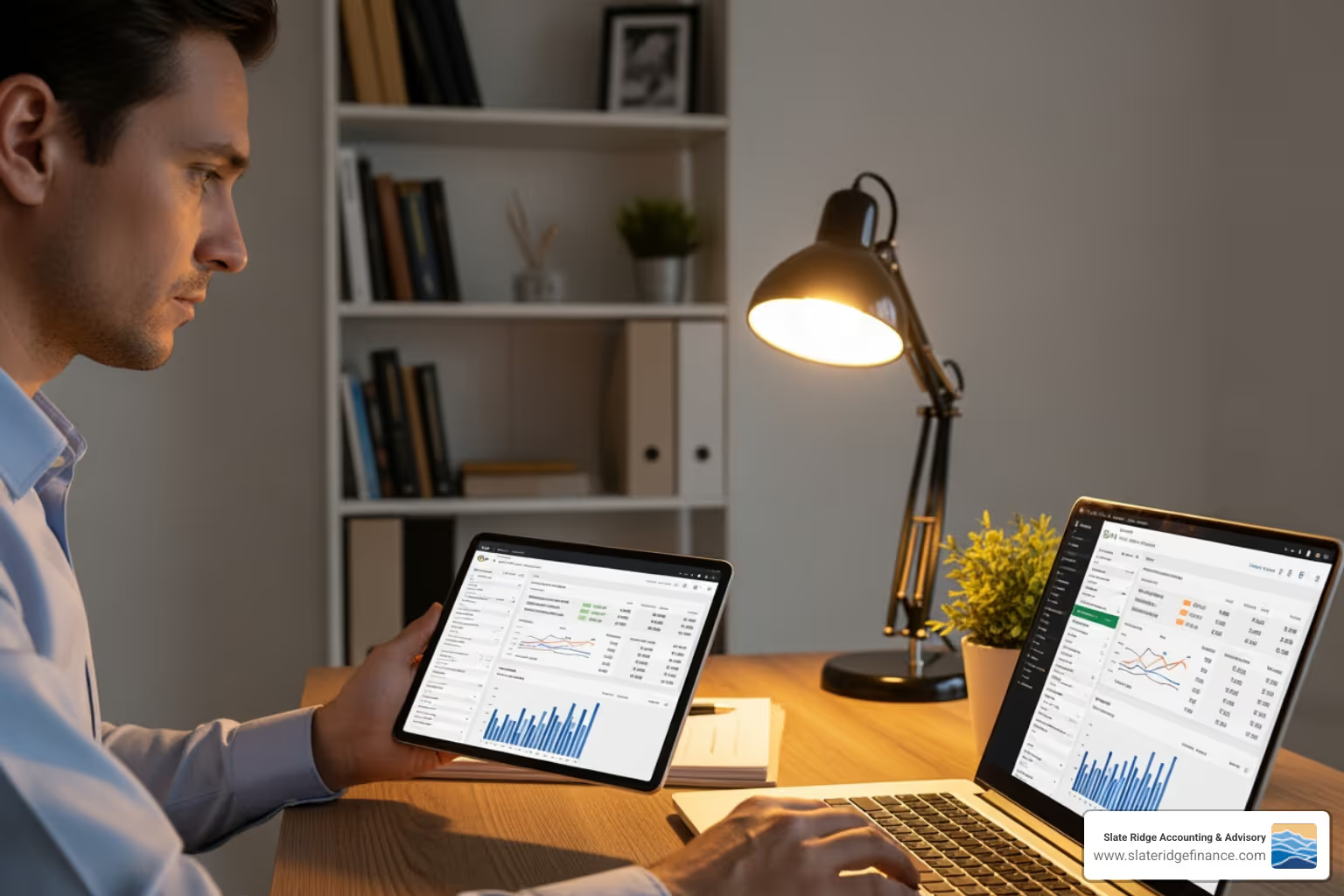
Why Cloud Accounting Matters for Your Business
More business owners are asking, what is cloud accounting services? It's a way to manage your finances using internet-based software hosted on remote servers. This gives you access to your financial data from anywhere, at any time, on any connected device.
Quick Answer:
- What it is: Accounting software that lives online (in "the cloud") instead of on your office computer
- How it works: Your financial data is stored on secure remote servers and accessed through your web browser or mobile app
- Key benefit: Real-time access to your books from anywhere, with automatic backups and updates
- Who it's for: Any business tired of manual data entry, lost receipts, and outdated financial information
Many small business owners face the frustration of scattered paper receipts, disconnected spreadsheets, and the uncertainty of their financial standing. You're not alone.
The move to cloud accounting is more than a tech upgrade; it's a fundamental shift in financial management. Instead of being tied to an office computer, you get real-time financial data at your fingertips.
This guide covers how cloud accounting works, its benefits compared to traditional methods, and whether it's right for you. You'll see how it can help you spend less time on bookkeeping and more time growing your business.
What is Cloud Accounting and How Does It Work?
At its core, what is cloud accounting services means using accounting software that lives online, not on your computer. It's hosted on remote servers by a provider, a model known as Software-as-a-Service (SaaS). Like online banking, you access your financial tools through a web browser or mobile app wherever you have internet.
With SaaS, you subscribe to a service instead of buying software. The provider handles data storage, security, processing, and updates, so you don't have to install or maintain anything on your computers.
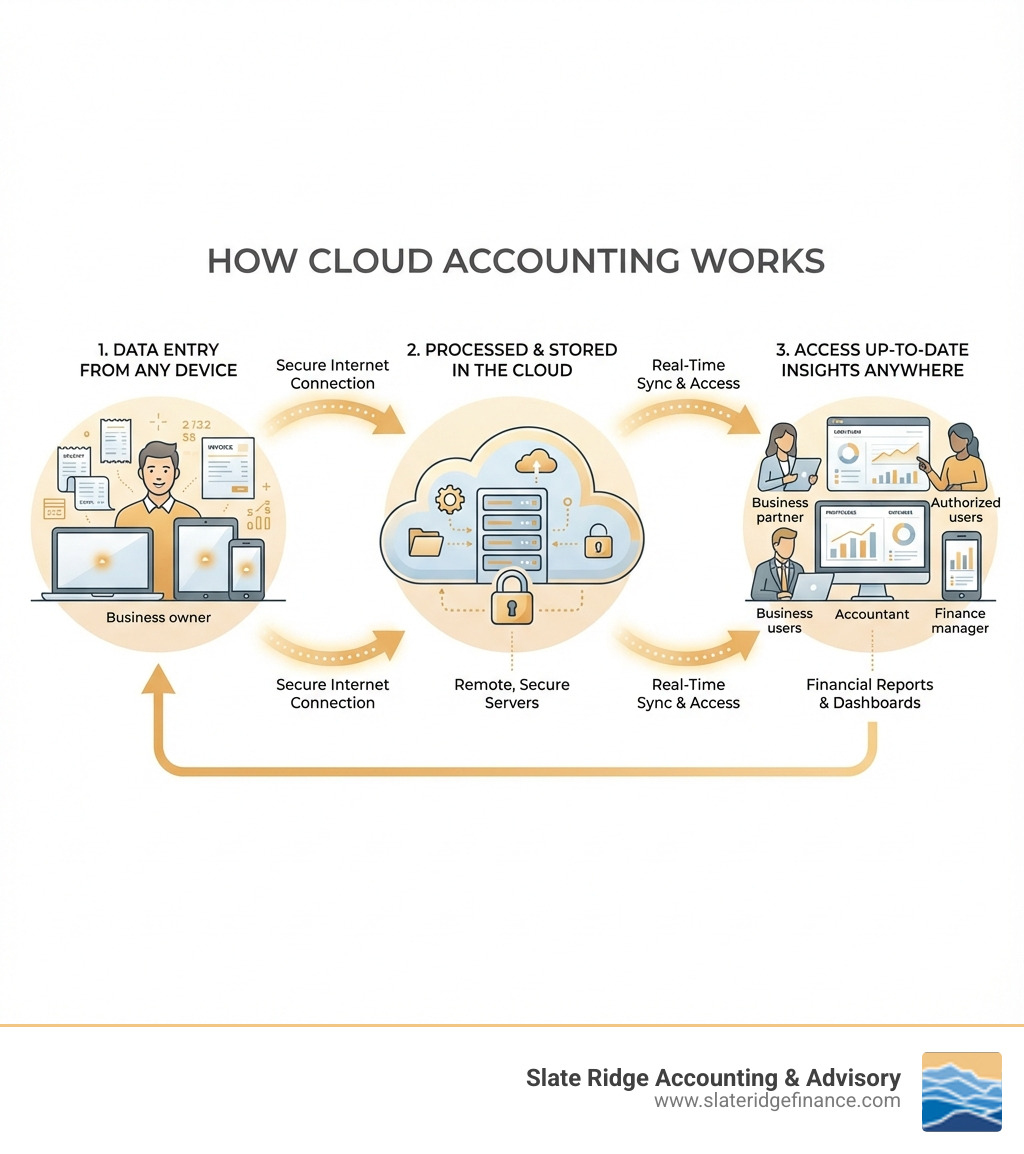
Here's how it generally works:
- Data Entry: You or your team enter financial information (like invoices or expenses) into the system via a web browser or app.
- Secure Transmission: This data is securely sent over the internet to the provider's remote servers—the "cloud."
- Processing and Storage: The servers process and store your data, often connecting to your bank accounts to stream transactions directly, which eliminates manual data entry.
- Anytime, Anywhere Access: You can access up-to-date financial reports and dashboards from any connected device, whether you're in the office in Asheville or working remotely from Boone.
This constant online connection means your financial data is always current, providing real-time insights without waiting for month-end reports. This flexibility is a key benefit explored in Remote Accounting Solutions.
Core Features of Modern Cloud Accounting Solutions
Modern cloud solutions are packed with features to streamline your financial operations and reduce manual effort.
Let's look at some key functionalities:
- Automation of Tasks: Automates routine tasks like categorizing bank transactions and sending recurring invoices. This reduces manual data entry and minimizes human error.
- Bank Reconciliations: Simplifies bank reconciliation by automatically matching transactions to your ledgers, allowing for faster and more accurate bookkeeping.
- Automated Invoicing and Billing: Create and send invoices, set up payment reminders, and track payment status. Many systems allow clients to pay directly online and help you manage accounts payable by tracking vendor bills.
- Real-time Financial Dashboards: Provides a clear, up-to-the-minute dashboard of your financial performance. Visuals display key metrics like cash flow, profitability, and account balances, helping you spot trends and issues quickly.
- Reporting and Analytics: Offers advanced reporting that turns financial data into business insights. Analyze trends, forecast cash flow, and make informed decisions by tracking key performance indicators (KPIs). Learn more about How to Track KPIs.
- Multi-user Access and Collaboration: Allows multiple authorized users—your team, bookkeeper, and advisor—to access the same financial data simultaneously. This real-time collaboration ensures everyone is on the same page, regardless of location.
- Scalability: Designed to grow with your business. You can start with basic features and add more capabilities as your needs evolve, so you only pay for what you use. This is ideal for businesses of all sizes across North Carolina.
- Integration with Other Apps: Integrates with other business apps like CRM, payroll, and e-commerce platforms. This creates a streamlined workflow and ensures data consistency across your business, which is key to Financial Process Optimization.
Cloud vs. Traditional Accounting: A Clear Comparison
Traditional desktop accounting software was the standard for years, but it had significant limitations. Cloud accounting offers a more flexible, efficient, and collaborative alternative.
Let's illustrate the stark contrast:
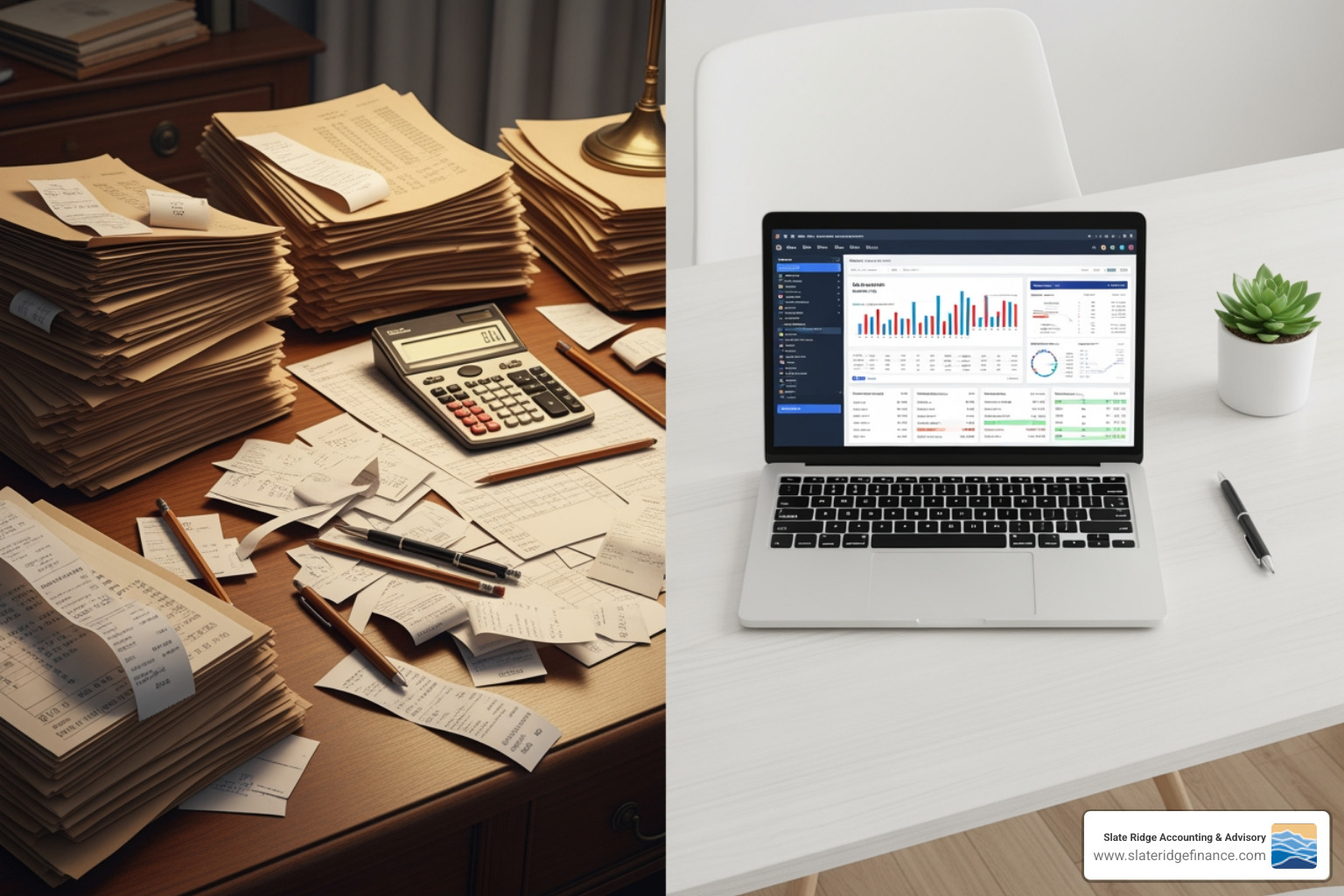
Imagine a cluttered desk piled high with paper receipts and ledgers—the reality of traditional accounting. Now picture a clean workspace with a laptop displaying a real-time financial dashboard. That's the promise of cloud accounting.
Here's a detailed comparison:
| Feature | Cloud Accounting | Traditional Accounting Software |
|---|---|---|
| Accessibility | Access from any internet-enabled device, anywhere. Perfect for remote teams and businesses with multiple locations. | Limited to the specific computer or network where the software is installed. Requires being in the office or a VPN connection. |
| Cost Structure | Subscription-based (SaaS) with monthly or annual fees. Includes updates and hosting, so you only pay for what you need. | One-time large purchase fee for software licenses. Additional costs for hardware, IT maintenance, upgrades, and support. |
| Data Security | Enterprise-grade security with encryption, multi-factor authentication, and regular backups on secure remote servers. Often safer than local storage. | Relies on your internal IT security and backup protocols. Vulnerable to local hardware failure, theft, or natural disasters if not properly backed up. |
| Software Updates | Updates are handled automatically by the provider, ensuring you always have the latest features and security patches. | Requires manual updates, which can be time-consuming, expensive, and sometimes disrupt operations. |
| Collaboration | Multiple users can access and work on the same data in real-time, enabling seamless collaboration with your team and accountant. | Limited multi-user access, often requiring data sharing via files, which can lead to version control issues and delays. |
| Scalability | Easily add or remove users and features as your business grows, without needing new infrastructure. | Scaling often requires purchasing new licenses, hardware, or installing more robust systems, which can be costly and time-consuming. |
Cloud accounting provides game-changing flexibility, reduces costs, and frees your business from the constraints of physical location and outdated systems. It enables a more dynamic approach to financial management.
The Key Benefits of Cloud Accounting Software
Switching to cloud accounting isn't just about modernizing; it's about gaining a competitive edge. For businesses in North Carolina, from Raleigh to Wilmington, the benefits are tangible.
- Improved Accuracy through Automation: By automating tasks like importing bank transactions and categorizing expenses, cloud software drastically reduces manual data entry errors. This leads to more reliable financial data.
- Greater Efficiency: Automating repetitive tasks frees up your team's time. Instead of tedious data entry, you can focus on strategic activities that grow your business, making your operations more efficient.
- Improved Compliance: Cloud platforms help you stay compliant with tax regulations. Features like automatic tax calculations and alerts for deadlines reduce the risk of errors and simplify financial reporting.
- Better Accessibility from Anywhere: Access your financial data from any internet-enabled device, whether you're in the office, at home, or traveling. This flexibility is invaluable for modern businesses and remote teams.
- Agility in Decision-Making: Real-time financial data means you always know where your business stands. This allows you to make fast, informed decisions and adapt to market changes, which is crucial for effective Business Growth Strategies.
- Stronger Collaboration with Accountants: Cloud platforms foster a collaborative partnership with your financial advisors. We can access your books in real-time to provide timely advice and strategic insights. This model is becoming the industry standard, freeing us to act as strategic partners rather than just number-crunchers.
- Powerful Scalability for Growing Businesses: Cloud solutions scale with your business. Easily add users, features, or handle more transactions as you expand, without overhauling your system. You can start small and grow, avoiding large upfront investments.
The impact is clear, with many firms reporting improved profitability after adopting cloud technology. Embracing these tools is a key step toward building an efficient, digital practice. For more information, this guide to creating a digital practice in the cloud offers valuable insights.
Choosing the Right Solution and Navigating Challenges
Choosing the right cloud accounting solution is a critical decision, as there is no one-size-fits-all answer. We help North Carolina businesses find a solution that fits their unique needs and supports their growth.
Here are key factors to consider:
- Assessing Your Business Needs: First, define your business needs. Do you need basic invoicing, robust payroll integration, or inventory management? Knowing your requirements will help narrow the options.
- Industry-Specific Solutions: Look for platforms with features custom to your industry. A construction business in Greensboro has different needs than a non-profit in Raleigh. Industry-specific solutions can address unique challenges and boost profits.
- Importance of User-Friendliness and Support: The software should be user-friendly with an intuitive interface. Also, check for reliable customer support. As your advisors, we provide the human support to help you steer your chosen solution.
- Scalability for Future Growth: Select a solution that can scale with your business, easily accommodating more users, features, and transactions as you grow.
- Integration Capabilities: Ensure the software integrates with your other business tools (CRM, POS systems, etc.). Seamless integration streamlines workflows and prevents data silos.
At Slate Ridge Accounting & Advisory, we specialize in providing Personalized Financial Solutions, helping you choose a cloud accounting service that aligns with your business goals.
What are the costs associated with cloud accounting services?
Understanding the costs of what is cloud accounting services is crucial. Unlike the large upfront cost of traditional software, cloud accounting uses a different financial model.
- Subscription-Based Pricing Models: Most providers use a subscription model (monthly or annual). This fee includes software access, updates, and support, making it a cost-effective "pay-as-you-go" approach.
- Tiered Plans Based on Features and Users: Providers offer tiered plans based on features, users, and transaction volume. This lets you pick a plan that fits your current budget and upgrade as you grow.
- One-Time Implementation Fees: Some complex solutions may have a one-time implementation fee for setup, data migration, and training. We can help you manage these costs for a smooth transition.
- Hidden Costs to Watch For: Be aware of potential hidden costs, such as fees for add-on modules, exceeding data limits, premium support, complex integrations, and the operational cost of a reliable internet connection.
When considering the overall cost, remember to factor in the savings from reduced IT maintenance and efficiency improvements. For a deeper dive, explore our guide on Virtual Bookkeeper Cost.
What are the potential risks of cloud accounting services?
While advantageous, it's important to understand the potential risks of cloud accounting and their mitigations. Cloud solutions have robust safeguards for most common concerns.
- Data Security and Privacy Concerns: Entrusting sensitive financial data to a third party is a common concern.
- Mitigation: Reputable providers use enterprise-grade security that most small businesses can't afford. This includes advanced data encryption, multi-factor authentication, and physically secured data centers. Regular, geographically dispersed backups mean your data is often safer in the cloud than on a local computer.
- Internet Dependency: Cloud accounting requires a reliable internet connection. An outage means temporary loss of access.
- Mitigation: Outages are usually brief. Your data remains secure, and you can use mobile hotspots as a backup. The benefits of constant access generally outweigh this risk.
- Challenges of Data Migration: Migrating historical data from a traditional system to a new cloud platform can be complex and requires careful planning to ensure accuracy.
- Mitigation: The process requires careful planning. While most platforms support data imports, working with an accounting professional is the best way to ensure a smooth, accurate transition. Our team has extensive experience helping businesses convert to a new system.
- Vendor Lock-in/Switching Costs: Switching between cloud providers can be difficult due to the effort of data migration and team retraining.
- Mitigation: Choose a reputable provider that allows you to easily export your data in a standard format.
By understanding these risks and their mitigations, businesses can confidently leverage cloud accounting.
The Future of Cloud Accounting
The landscape of cloud accounting is constantly evolving with new technology, promising more efficiency and automation. The question is shifting from "why cloud?" to "what's next for the cloud?"
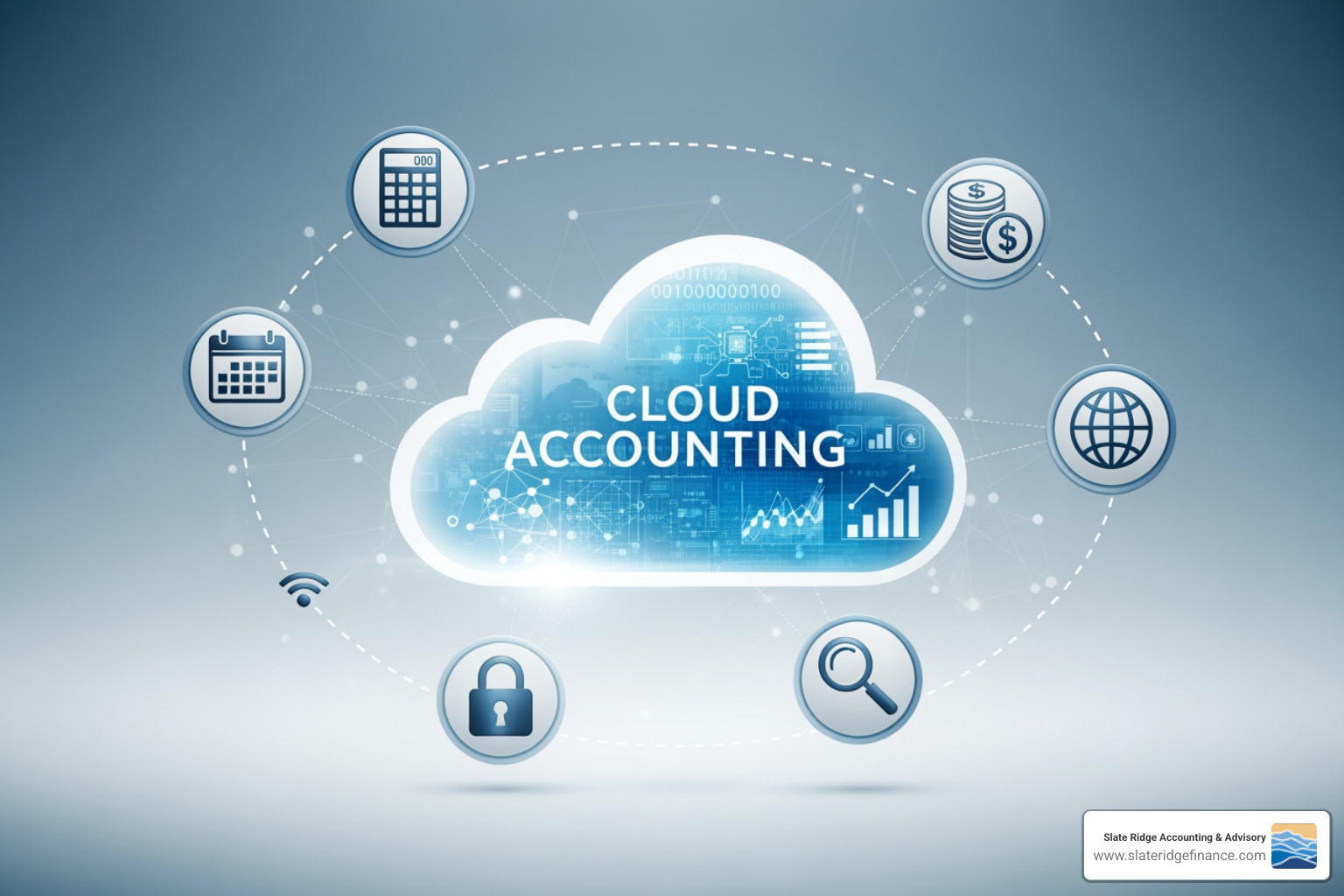
- Generative AI and Autonomous Finance: Artificial intelligence is moving beyond basic automation. Generative AI can now draft report commentary, answer complex financial questions, and help manage month-end closing. Machine learning is improving fraud detection and cash flow forecasting. The goal is "autonomous finance," where AI handles routine data processing, allowing small teams to operate at scale.
- Blockchain for Transaction Transparency: Blockchain technology offers a secure, unchangeable record for every transaction. This creates a tamper-proof audit trail, reduces fraud, and simplifies record-keeping. It promises to bring unprecedented transparency to financial operations by streaming verified transaction data directly into accounting systems.
- Deeper App Integrations and API Marketplaces: Integrations between accounting software and other business apps will become even more seamless. API marketplaces will make connecting tools easy, without complex coding. You'll be able to manage tasks from third-party apps directly within your accounting platform. AI will further streamline this by automating setup and reducing friction.
Cloud accounting is a strategic imperative for modern businesses. These advancements are shifting finance from number-crunching to real-time, automated analytics. This empowers us at Slate Ridge Accounting & Advisory to act as strategic advisors, providing high-value insights. Explore more on these Modern Accounting Practices.
Frequently Asked Questions about Cloud Accounting
Here are some of the most common questions business owners ask about switching to cloud accounting.
Is cloud-based accounting safe?
Yes, cloud accounting is very safe—often more secure than keeping data on a local computer, especially for small businesses. Here's why:
- Top-Tier Security: Providers invest heavily in security, with dedicated teams, physically secure data centers, and advanced cybersecurity that most small businesses cannot match.
- Data Encryption: Your data is encrypted both when stored and when transmitted over the internet, making it unreadable to unauthorized parties.
- Multi-Factor Authentication (MFA): MFA adds an extra layer of security by requiring a second verification step (like a code sent to your phone), making unauthorized access much more difficult.
- Automatic Backups: Data is backed up automatically to multiple secure locations, protecting it from loss due to hardware failure or disasters.
While no system is foolproof, the comprehensive security from top cloud providers makes your data significantly safer than it would be on a single office computer.
What industries or business sizes benefit most from cloud accounting?
Cloud accounting is versatile, but some businesses benefit more than others:
- Small and Medium-Sized Businesses (SMEs): SMEs gain access to powerful, affordable tools for managing finances and automating tasks without needing a large accounting department.
- Startups: With no expensive hardware and a scalable model, cloud accounting is perfect for getting new businesses started quickly.
- Businesses with Remote or Multiple Locations: For teams spread across North Carolina, from Wilmington to Hickory, cloud accounting ensures everyone can access the same real-time data.
- Service-Based Businesses: Ideal for consultants, agencies, and freelancers who need easy invoicing, expense tracking, and project management.
- Retail and E-commerce: Integration with POS and e-commerce platforms allows for real-time tracking of sales, inventory, and cash flow.
- Specific Industries: Many platforms offer custom solutions for industries like construction, real estate, and non-profits to help them meet unique challenges.
Any business seeking efficiency, accessibility, and scalable financial management can benefit. Our Bookkeeping Service for Small Business is designed to leverage these advantages for you.
Can I switch from my current desktop software?
Yes, switching from desktop software or spreadsheets to the cloud is a common and manageable process for businesses across North Carolina.
Here’s a general overview of the process:
- Data Export: First, export your financial data (like your chart of accounts, invoices, and contacts) from your current system, usually as CSV files.
- Cloud Setup: Next, configure your settings in the new cloud software and connect your bank accounts for automatic transaction feeds.
- Work with a Professional: To ensure accuracy and prevent data loss, we highly recommend working with an experienced professional. We can manage the entire migration process to ensure a seamless transition.
- Verification: After migration, it's crucial to test the new system and verify that all data was transferred correctly.
While it requires some planning, the long-term benefits of accessibility, automation, and real-time insights far outweigh the temporary challenge of migration. We're here to help you every step of the way.
Conclusion
Understanding what is cloud accounting services reveals it's more than a tech upgrade—it's a new way to manage finances. Cloud solutions offer accessibility, automation, efficiency, and security that free businesses from desktop software limitations. Across North Carolina, from Charlotte to Hickory, businesses are embracing this change.
This shift empowers you to focus on strategy instead of number-crunching. With real-time data, you can make informed decisions, track KPIs, and forecast growth. Future innovations in AI and blockchain will only make cloud accounting more essential.
At Slate Ridge Accounting & Advisory, we lead this revolution by providing modern, personalized financial solutions for small businesses in North Carolina. Our cloud-based services, including virtual bookkeeping and financial advisory, are accessible, efficient, and custom to your needs.
Don't let outdated accounting practices hold your business back. Accept the power and flexibility of cloud accounting.
Take control of your finances with expert virtual accounting services
Ready to get started?
Book a free consultation today and let’s explore how Slate Ridge can support your business with expert accounting that’s accurate, timely, and built around your goals.
You Might Also Like
A few more posts we think you’ll enjoy on topics that matter to business owners like you.