

What Is Bookkeeping Value — and Why It Matters for Your Business

Bookkeeping value is the measurable worth of a business's assets, equity, and financial health as recorded in its accounting records. For business owners, it answers a simple but critical question: What is my business actually worth on paper?
Here's what bookkeeping value covers at a glance:
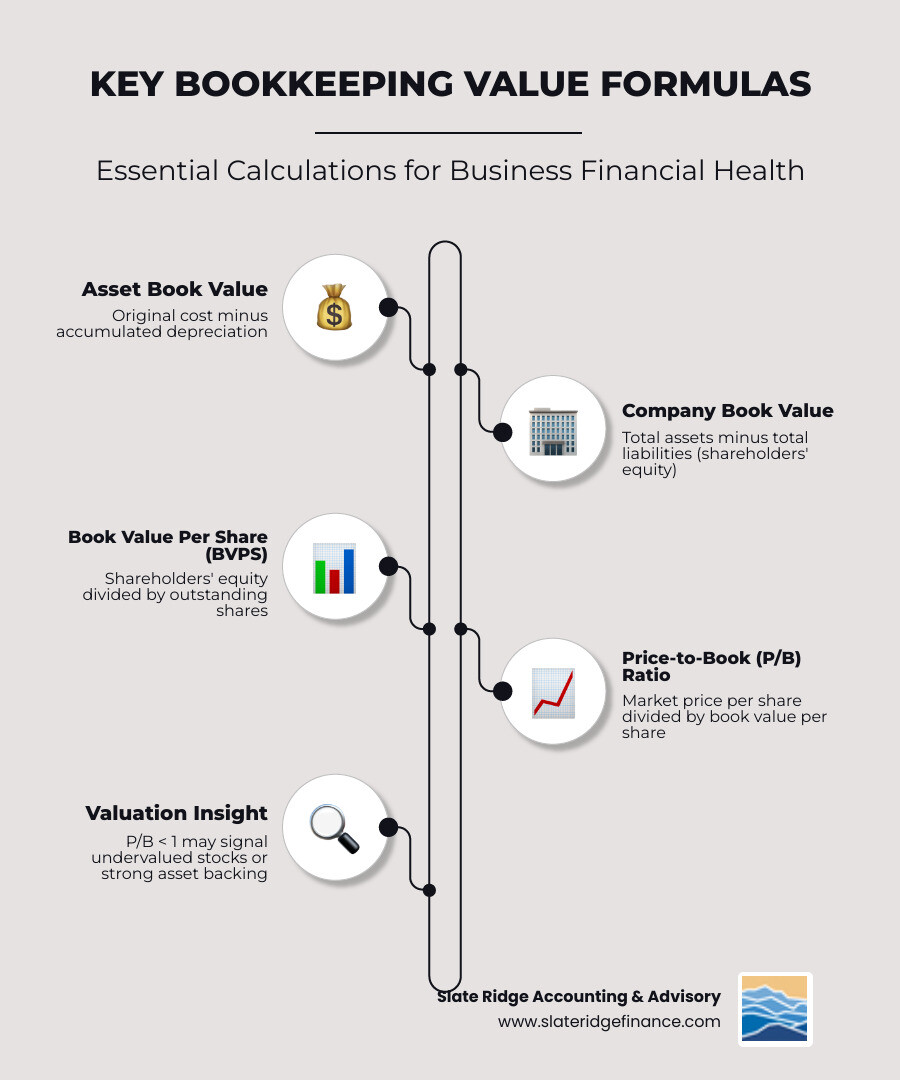
- Book value of an asset = Original cost minus accumulated depreciation
- Book value of a company = Total assets minus total liabilities
- Book value per share (BVPS) = Total shareholders' equity divided by outstanding shares
- Price-to-book (P/B) ratio = Market price per share divided by book value per share
Most business owners think of bookkeeping as a compliance task — something you do to keep the IRS happy. But that thinking leaves serious money on the table.
Your books aren't just a record of what happened. They're the foundation for every major financial decision you make: getting a loan, attracting investors, planning for growth, or eventually selling the business.
When your records are accurate and up to date, you know exactly where you stand. When they're not, you're flying blind — and that has a very real cost.
Bookkeeping value word list:
The Strategic Importance of Bookkeeping Value
When we talk about bookkeeping value, we are often referring to "book value" in a technical sense—the amount an asset or liability shows on the company's balance sheet. Also known as carrying value, this figure represents the net worth of an entity according to its "books" (the general ledger).
In our experience working with businesses across North Carolina, from Asheville to Raleigh, we’ve seen that many owners conflate "value" with "cash in the bank." While cash is king, book value represents the structural integrity of your business. It is the total value of your assets minus your total liabilities. If you were to close the doors today, sell every piece of equipment, and pay off every debt, the book value is theoretically what would be left for the shareholders.
Understanding this metric is vital because it provides a non-subjective, historical baseline. Unlike market value, which can swing wildly based on investor mood or economic trends, book value is grounded in the reality of what you actually paid for your assets and what you actually owe. However, relying on outdated or messy books can lead to 3 Bookkeeping Myths That Could Be Costing You Money, such as overestimating your equity or missing out on tax-saving depreciation.
Calculating Bookkeeping Value for Assets and Companies
To find the bookkeeping value of your entire company, we look at the balance sheet. The formula is straightforward: Total Assets - Total Liabilities = Book Value (Shareholders' Equity).
Assets include everything from cash and accounts receivable to inventory and equipment. Liabilities include your accounts payable, long-term loans, and deferred taxes. According to the Accounting Terminology Guide - Book Value, this is the "net asset value" of the corporation.
For an individual asset, the calculation is slightly different. It starts with the historical cost (what you paid for it) and subtracts any "contra-assets" like accumulated depreciation. For example, if your Charlotte-based catering business buys a delivery van for $40,000, that $40,000 is the initial book value. Over time, as you use the van, that value is "written down."
How Depreciation Impacts Bookkeeping Value
Depreciation is the accounting magic that spreads the cost of a physical asset over its useful life. It’s not just a tax break; it’s a way to ensure your Accounts for Small Business reflect the actual remaining utility of your equipment.
Most small businesses use the "straight-line method." If that $40,000 van has a five-year life and a $5,000 salvage value (what it’s worth at the end), you would record $7,000 in depreciation expense each year ($35,000 divided by 5).
- Year 1: Book value is $33,000.
- Year 2: Book value is $26,000.
By tracking this accurately, you avoid "sticker shock" when it’s time to replace equipment. You’ve already accounted for the diminishing value on your books.
Beyond the Balance Sheet: Market vs. Fair Value
One of the biggest points of confusion for business owners in Greensboro or Wilmington is why their "book value" is so much lower than what they think they could sell the business for. This is where we distinguish between book, market, and fair value.
| Feature | Book Value | Market Value | Fair Value |
|---|---|---|---|
| Basis | Historical Cost | Investor Sentiment / Supply & Demand | Current Market Estimates |
| Objectivity | High (based on receipts) | Low (subjective) | Moderate (appraisal-based) |
| Includes Intangibles? | Rarely (only if purchased) | Yes (brand, reputation) | Often |
The gap between these numbers usually exists because bookkeeping value often ignores "human capital"—the skills of your team—and "brand equity." If you’ve spent ten years building the best-known plumbing brand in Hickory, that reputation doesn't show up on a balance sheet unless you sell the company and "Goodwill" is recorded.
Understanding Book Value Per Share (BVPS)
If your business is structured as a corporation with multiple shareholders, we look at Book Value Per Share (BVPS). This is calculated by taking your total common equity and dividing it by the number of outstanding shares.
For investors, BVPS acts as a "floor." It tells them the minimum value of their stake if the company were to stop growing and simply exist as a collection of assets. Professional Bookkeeping Service for Small Business ensures that this equity distribution is tracked accurately, which is essential if you ever plan to bring on new partners or issue stock options to employees.
The Price-to-Book (P/B) Ratio and Undervalued Stocks
In value investing, the Price-to-Book (P/B) ratio is a holy grail. It compares the market’s valuation of a company to its actual book value.
- P/B < 1: The market thinks the company is worth less than its parts. This could mean the company is in trouble, or it could be a "bargain" for an eagle-eyed investor.
- P/B > 1: The market is paying a premium for future growth, brand power, or intellectual property.
According to Book value - Wikipedia, this ratio is most useful when comparing companies within the same industry. A tech startup in Raleigh will almost always have a higher P/B ratio than a heavy machinery manufacturer in Gastonia because the tech company's value is in its code (intangible), while the manufacturer's value is in its steel (tangible).
The Limitations of Traditional Valuation Metrics
While we love a clean balance sheet, we have to be honest: bookkeeping value has its limits. Because it relies on historical costs, it doesn't account for inflation. A piece of real estate bought in Boone thirty years ago might have a tiny book value but be worth millions today.
Furthermore, traditional bookkeeping often fails to capture the value of a modern, Modern Bookkeeping Services approach. It doesn't measure the "value" of having a virtual bookkeeper who catches a $5,000 billing error or provides the data needed to pivot your strategy before a downturn.
If you're looking for a deep dive into how to structure your finances to avoid these pitfalls, our Monthly Bookkeeping Packages Ultimate Guide explains how consistent tracking overcomes the limitations of "once-a-year" accounting.
Valuing a Bookkeeping Business or Service Entity
What if you are the one looking to buy or sell a service-based business, like a bookkeeping practice or a consulting firm? The rules change.
Traditional bookkeeping businesses often sell for about 1x annual revenue or billings. However, modern firms—especially those using cloud-based models—are increasingly valued like SaaS (Software as a Service) companies. Instead of just looking at last year's profit, buyers look at:
- Churn Rate: How many clients do you lose each month?
- Lifetime Value (LTV): How much is a client worth over the entire time they stay with you?
- Recurring Revenue: Is the income guaranteed by monthly contracts?
As Matt Paff explains in his valuation of Xero, the shift toward "subscription" models in accounting has changed the math. A practice with 100 clients paying a fixed monthly fee is worth significantly more than a practice that relies on hourly billing, because the revenue is predictable.
If you're curious about the investment required to reach this level of financial clarity, checking the Virtual Bookkeeper Cost can help you understand how professional services pay for themselves by increasing your business's ultimate exit value.
Frequently Asked Questions about Bookkeeping Value
What does an increasing book value per share indicate?
An increasing BVPS is a fantastic sign. It usually means the company is generating "retained earnings"—profit that isn't paid out as dividends but is reinvested back into the business. It shows effective financial management and a growing "safety net" for shareholders.
How do investors use book value to find bargains?
Investors look for a "margin of safety." If a stock's market price is $10 but its book value per share is $12, the investor is essentially buying $12 worth of assets for $10. If the company were liquidated, they would theoretically make a profit. This is a classic "value investing" strategy.
Is book value the same as liquidation value?
Not exactly. Book value is what the assets are worth according to accounting rules. Liquidation value is what you’d get in a "fire sale." If you have to sell all your inventory in 48 hours, you’ll likely get much less than the book value. Book value is the "orderly" value; liquidation is the "emergency" value.
Conclusion
At Slate Ridge Accounting & Advisory, we believe that bookkeeping value isn't just a number on a page—it's the story of your hard work, your smart investments, and your future potential. Whether you're in Asheville, Charlotte, or anywhere else in North Carolina, our goal is to move you beyond simple data entry.
We provide cloud-based virtual bookkeeping, financial clean-up, and advisory services that help you track KPIs and forecast growth. By maintaining accurate books, we don't just help you stay compliant; we help you build a business that is demonstrably valuable to lenders, investors, and yourself.
Ready to see the true value of your business? View our pricing and packages or explore our Best Small Business Bookkeeping Packages to find a solution tailored to your growth. Let’s turn your "books" into your most powerful strategic asset.
Ready to get started?
Book a free consultation today and let’s explore how Slate Ridge can support your business with expert accounting that’s accurate, timely, and built around your goals.
You Might Also Like
A few more posts we think you’ll enjoy on topics that matter to business owners like you.