

Why Finding the Right Small Business Accountant Matters More Than You Think
Finding an accountant small business near me means more than just hiring someone to file your taxes. It's about securing a financial partner who understands your business, keeps you compliant, and helps you make smarter decisions.
Quick Answer: How to Find the Best Small Business Accountant Near You
- Determine your needs: Tax prep only, full bookkeeping, strategic planning, or all three
- Check credentials: Look for CPAs or Enrolled Agents (EAs) with proper state licensing
- Search locally: Use the IRS Directory of Preparers, state CPA societies, or peer referrals
- Verify experience: Confirm they work with businesses in your industry
- Review pricing: Expect $500-$2,500 for basic tax filing, $75-$500+ monthly for ongoing services
- Assess technology: Ensure they use modern cloud-based tools for real-time collaboration
Running a small business is demanding. Managing taxes, expenses, and financial reports adds pressure, especially with ever-changing laws and deadlines.
Many business owners start by handling their own books. But as your business grows, the complexity grows too. Messy records, missed deductions, and compliance risks can cost you far more than an accountant's fee.
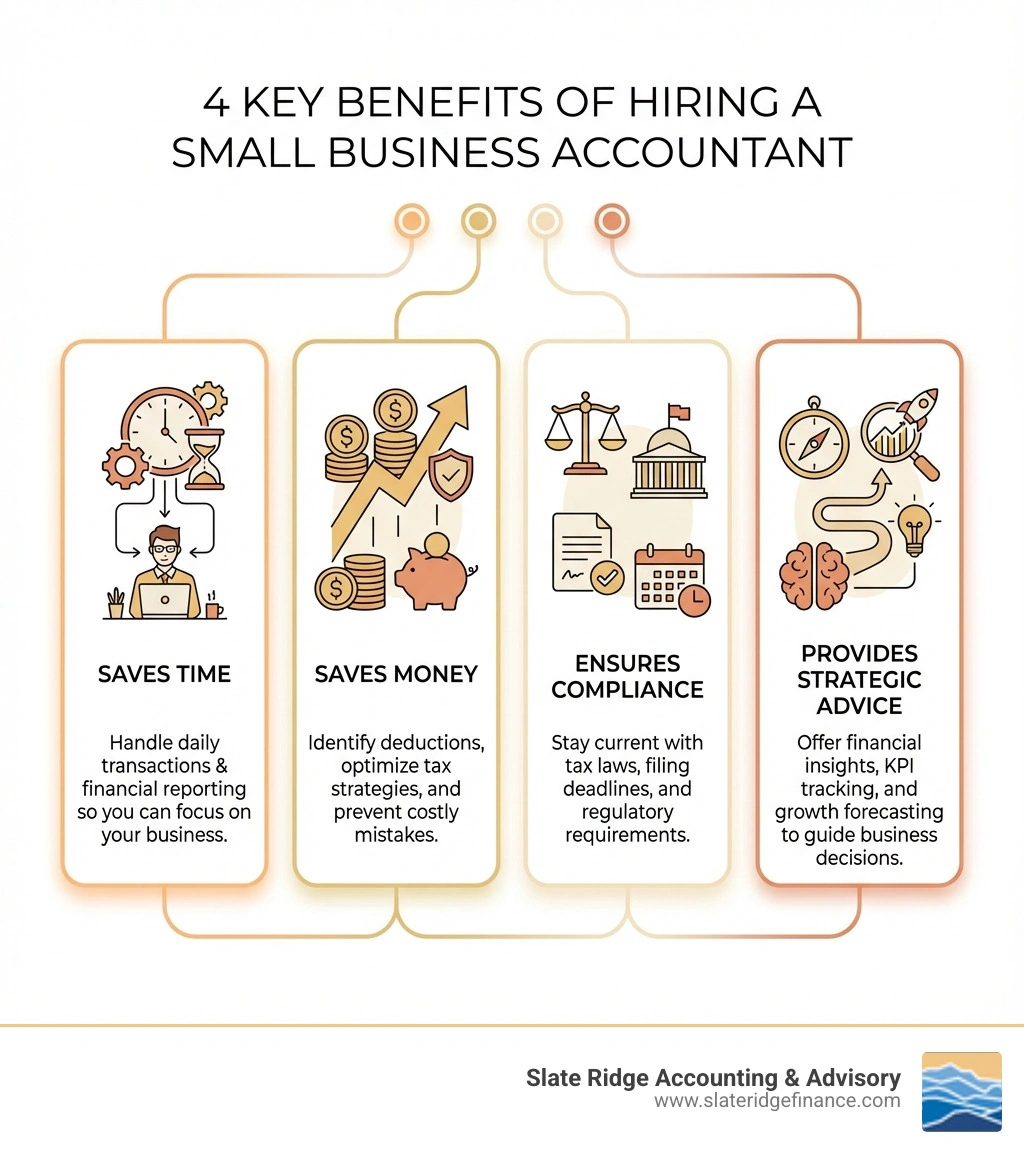
The right accountant does more than crunch numbers. They help you understand your finances, identify growth opportunities, and plan for the future. They can represent you with the IRS and free up your time to focus on your core business.
This guide walks you through everything you need to know: what accountants actually do, how much they cost, when to hire one, and exactly how to find the right fit for your business.
Understanding the Role: What a Small Business Accountant Really Does

When you search for an accountant small business near me, what should you expect? More than just a tax preparer, a skilled accountant offers comprehensive services that can turn your financial operations from a headache into a strategic advantage. They are not just number-crunchers; they are your financial copilots.
Our goal is to provide modern, personalized, and industry-custom financial solutions, helping you track key performance indicators (KPIs) and forecast growth. This goes far beyond basic record-keeping, diving deep into the financial health and future potential of your business.
Core Services: More Than Just Tax Prep
While tax preparation is certainly a crucial aspect of what an accountant does, it's just the tip of the iceberg. A dedicated small business accountant can handle a wide array of financial tasks, ensuring your business runs smoothly and compliantly.
A foundational service is bookkeeping, the daily recording of financial transactions to keep your ledgers accurate. This meticulous record-keeping is the backbone of all financial activities. If you need support, explore our Bookkeeping Service for Small Business. For a broader understanding, our guide on Accounts for Small Business is very helpful.
Beyond daily entries, accountants are vital for financial statement preparation. This includes crafting your income statements, balance sheets, and cash flow statements, which are essential for understanding your business's performance and making informed decisions. For a deeper dive, check out our Small Business Financial Reporting Complete Guide.
Payroll management is another critical service, especially as your team grows. This involves processing employee salaries, calculating and filing payroll taxes, and ensuring compliance with labor laws. Mistakes here can be costly, so entrusting this to an expert is often a wise move. Learn more about our Payroll Management Services. We also offer comprehensive Accounting and Payroll Services for Small Business.
Accountants can also provide invaluable business structure advice. Choosing the right legal structure (e.g., sole proprietorship, LLC, S-Corp) has significant tax implications and affects liability. An accountant can guide you through this decision to optimize your financial future.
Finally, managing your cash flow effectively often involves handling accounts payable and receivable. This means keeping track of who owes you money and who you owe money to, ensuring timely payments and collections. Our Accounts Payable Complete Guide Small Business provides excellent insights into this often-overlooked area.
Strategic Financial Guidance: Tax Planning vs. Tax Preparation
Many small business owners conflate tax preparation with tax planning, but these are distinct and equally important services.
Tax preparation is backward-looking. It involves compiling past-year data to accurately file tax returns with the IRS and state authorities, ensuring compliance and avoiding penalties.
Tax planning, on the other hand, is forward-looking and strategic. It's about proactively identifying opportunities to minimize your tax liability legally throughout the year. This involves:
- Proactive strategies: Advising on business decisions that have tax implications before they happen.
- Maximizing deductions: Ensuring you take advantage of every eligible deduction and credit for your industry and business type.
- Year-round financial advice: Helping you structure your finances, investments, and expenses in a tax-efficient manner. This could include advice on timing large purchases, adjusting payroll, or making retirement contributions.
A good accountant helps you move beyond just preparing your taxes to actively planning for them. This strategic guidance can save you significant money and improve your business's financial health. For more on how strategic insights can help, consider our Financial Reporting Services.
Accountant vs. CPA vs. Enrolled Agent: What's the Difference?
When searching for an accountant small business near me, you'll encounter various titles. It's important to understand what each one means:
- Accountant: This is a broad term for someone who has studied accounting and can prepare, maintain, and examine financial statements. They can perform audits, create budgets, analyze profits and losses, and process payroll. However, an accountant does not automatically hold a specific license or certification.
- Certified Public Accountant (CPA): A CPA is a licensed accountant who has met rigorous educational requirements (typically a bachelor's degree plus 150 semester hours of college coursework), passed the demanding Uniform CPA Examination, and fulfilled specific experience requirements. CPAs are licensed by their state's Board of Accountancy. They possess a deeper knowledge of tax codes and can represent clients before the IRS during audits. According to the American Institute of CPAs, CPAs financially advise individuals, big companies, and small businesses to help them reach their financial goals.
- Enrolled Agent (EA): An EA is a tax professional authorized by the U.S. Department of the Treasury to represent taxpayers before the IRS. EAs specialize in taxation, having passed a comprehensive three-part IRS exam covering all aspects of federal tax law. They can represent any taxpayer regarding audits, collections, and appeals, similar to CPAs and attorneys. Unlike CPAs, EAs don't have general accounting expertise; their focus is solely on tax matters.
Here's a quick comparison:
| Feature | Accountant | CPA | Enrolled Agent (EA) |
|---|---|---|---|
| Education | Accounting degree (typically) | Bachelor's degree + 150 hours | No specific degree required |
| Licensing | No specific license (may hold other certs) | State-licensed by Board of Accountancy | Federally licensed by IRS |
| Services | Bookkeeping, financial statements, payroll, etc. | All accountant services + audits, reviews, strategic tax planning, attest work | Tax preparation, tax planning, IRS representation |
| IRS Representation | Limited (can prepare taxes, but not represent during audit unless they also have PTIN) | Yes | Yes |
We often suggest working with a CPA for comprehensive financial needs due to their extensive knowledge and ability to handle complex tax and financial situations. You can Learn more about CPAs through the AICPA.
Decoding the Cost: How Much to Budget for an Accountant
One of the first questions small business owners ask when considering an accountant small business near me is, "How much will it cost?" It's a valid concern, and thankfully, we can provide some clear insights into typical pricing models and average fees. While cost is a factor, the value a good accountant brings often far outweighs their fees. They save you time, prevent costly mistakes, and help you grow your business.
Factors That Influence Accounting Fees
The cost of hiring an accountant for your small business isn't one-size-fits-all. Several factors play a significant role in determining the final price tag:
- Business size: Larger businesses with more employees, higher revenue, and more complex operations will naturally require more time and expertise, leading to higher fees.
- Transaction volume: The sheer number of financial transactions your business processes directly impacts the amount of work required for bookkeeping and reconciliation. More transactions mean more work.
- Industry complexity: Certain industries have unique regulations, inventory management challenges, or specialized tax codes (e.g., construction, healthcare, e-commerce). Accountants with industry-specific expertise may charge more.
- Service scope: Do you need basic tax preparation, monthly bookkeeping, payroll, or comprehensive financial advisory services? The more services you require, the higher the cost. For instance, our Best Small Business Bookkeeping Packages offer various tiers to match different needs.
- Accountant's qualifications: A CPA or an Enrolled Agent, with their specialized licensing and expertise, typically charges higher rates than a non-certified accountant. Their advanced knowledge and ability to represent you before the IRS justify the premium.
- Geographic location: Accountants in larger metropolitan areas, such as Charlotte or Raleigh, NC, may charge more due to higher operating costs and demand compared to those in smaller towns.
Typical Pricing Structures and Average Costs
Accountants typically use a few different pricing models:
- Hourly rates: For ad-hoc advice or specific projects, accountants might charge by the hour. These rates can range widely, from $40 per hour to $300 or more per hour, depending on their experience, location, and the complexity of the task. For advice or planning, this can be $50 to $400 per hour.
- Monthly retainers: For ongoing services like bookkeeping, payroll, and regular financial reporting, many accountants offer monthly packages. Basic monthly accounting services can range from $75 to $500 or more. For comprehensive CPA services on a monthly retainer, you can expect to spend $1,000 to $12,000 annually.
- Project-based fees: For specific tasks like setting up accounting systems, preparing for a loan application, or handling an audit, accountants may charge a flat fee. Facing an audit could cost $500 to $1,000+.
- Tax preparation costs: This is often a flat fee based on the complexity of your business's tax situation. Basic tax return preparation for small businesses could cost between $150 to $500, whereas full-service accounting (which includes tax prep) can range between $1,000 and $5,000 per year. On average, a small business should expect to spend $500 to $2,500 to file their taxes.
While a CPA on a monthly retainer might seem like a significant investment (averaging $1,000 to $12,000 according to Milestone Inc.), the value they bring in tax savings, strategic advice, and compliance can often far exceed the cost. For insights into the cost of virtual bookkeeping, our Virtual Bookkeeper Cost guide offers more details.
How to Find the Right Accountant Small Business Near Me
Finding the perfect accountant small business near me is a bit like dating – you need to know what you're looking for, where to find them, and how to spot a good match (or a red flag!). We're here to guide you through the process, especially for businesses in North Carolina locations like Asheville, Charlotte, Greensboro, and Raleigh.
Key Signs It's Time to Hire an Accountant
Many small business owners try to handle their finances themselves, and for a very new, very small operation, that might work. But there are definite signs that it's time to bring in a professional:
- Starting a business: Setting up the right financial foundation from day one is crucial. An accountant can advise on business structure, initial registrations, and accounting systems.
- Hiring employees: Payroll, payroll taxes, and compliance with labor laws add a layer of complexity that often requires expert handling.
- Rapid growth: When your revenue and transactions are increasing quickly, your financial management needs become more sophisticated. You might be missing deductions or struggling to keep up with the volume.
- Complex transactions: If you're dealing with inventory, international sales, multiple revenue streams, or significant assets, your financial picture is no longer simple.
- Facing an audit: If you receive a notice from the IRS or state tax authorities, an accountant (especially a CPA or EA) can represent you and steer the process.
- Seeking financing: Lenders often require professional financial statements. An accountant can prepare these and help you present your business in the best light.
- Changing business structure: Reorganizing your legal entity has major tax and financial implications that an accountant can help you manage.
Where to Find a Qualified Accountant or CPA Near Me
Once you know it's time, where do you start your search for an accountant small business near me in places like Asheville, Boone, Charlotte, or Greensboro?
- Online directories: The IRS Directory of Preparers allows you to search for tax preparers by location and credentials. You can also use tools like the Find a ProAdvisor tool, which helps you find accountants familiar with QuickBooks, a popular accounting software.
- State CPA societies: Your state's CPA society is an excellent resource for finding licensed professionals. For North Carolina, you can search the NCACPA directory.
- Local business groups or chambers of commerce: These organizations are fantastic for local referrals. Ask other small business owners in your area who they recommend.
- Referrals from peers: Word-of-mouth recommendations from trusted business contacts are often the most reliable way to find a good fit.
- Virtual firms: Don't limit yourself to just physical proximity. Many excellent firms, like ours, offer Remote Accounting Solutions and can serve your business effectively regardless of your physical location, thanks to cloud technology. We serve all North Carolina, including Wilmington, Hendersonville, and Morganton. Check out our Locations page for more details, including specific pages for Asheville, NC and Charlotte, NC.
Vetting Your Candidates: What to Look For and What to Avoid
Once you have a list of potential accountants, it's time to vet them thoroughly.
What to Look For:
- Qualifications (CPA, EA): Verify their credentials. For CPAs, you can use CPAverify or your state's Board of Accountancy website to confirm their license status.
- Industry experience: An accountant who understands your specific industry (e.g., retail, service, manufacturing) will be more effective at identifying relevant deductions and understanding your unique financial challenges.
- Client reviews: Look for testimonials and online reviews. What do other small business owners say about working with them?
- Communication style: Do they explain complex financial concepts in a way you can understand? Are they responsive to your questions? Clear and prompt communication is vital.
- Tech-savviness: Do they accept modern accounting software and cloud solutions? This is crucial for efficient collaboration and real-time data access.
Red Flags to Avoid:
- Unclear pricing: If they are vague about their fees or can't provide a clear estimate for services, proceed with caution.
- Poor communication: Unanswered emails, missed calls, or a general lack of responsiveness are major red flags. Your financial partner should be accessible.
- Lack of credentials: Be wary of anyone claiming to be a "tax expert" without verifiable CPA or EA credentials.
- Guarantees of refunds: No legitimate accountant can guarantee a specific tax refund amount. This often indicates a willingness to bend rules or make aggressive, potentially illegal, claims.
- Pushing for cash payments only: This can be a sign of unethical practices.
- Unsolicited contact: Legitimate professionals rarely solicit business this way.
Preparing for Your First Meeting
To make the most of your initial consultation with a potential accountant, come prepared. This shows you're serious and helps the accountant understand your needs quickly.
Gather these documents and information:
- Business registration documents: Articles of incorporation/organization, EIN.
- Previous tax returns: Typically the last 1-3 years.
- Bank statements: For your business accounts.
- Current financial reports: If you have them (e.g., profit and loss statement, balance sheet).
- List of questions: What are your biggest financial concerns? What services are you looking for?
- Business goals: Share your short-term and long-term objectives so they can understand your strategic needs.
The Modern Accountant: Technology and Your Financial Future
The world of accounting has evolved dramatically, thanks to technology. For an accountant small business near me, this means better tools, more efficiency, and a stronger partnership with their clients.
The Impact of Technology on the Accountant-Client Relationship
Gone are the days of shoeboxes full of receipts and endless paper trails. Modern accounting is digital, and that's a huge win for small businesses.
- Cloud software benefits: Platforms like QuickBooks Online allow for real-time access to your financial data from anywhere. This means you and your accountant can view the same up-to-date information simultaneously. Explore our guide on Online Accounting Software Small Business and learn about Cloud Accounting Services.
- Automation: Many routine tasks, like data entry and reconciliation, can now be automated, freeing up your accountant's time for more strategic analysis and advice.
- Improved security: Reputable cloud accounting platforms offer robust security features, often surpassing what a small business could implement on its own.
- Real-time collaboration: Technology facilitates seamless communication and collaboration. Questions can be answered quickly, and issues can be addressed proactively.
- Data-driven insights: With accurate, real-time data, accountants can provide much deeper insights into your business performance, helping you track KPIs and forecast growth more effectively.
- Integration: Accounting software often integrates with other business tools (e.g., payroll, CRM), creating a unified financial ecosystem. If you use QuickBooks, finding a QuickBooks ProAdvisor can be a great asset.
How to Seamlessly Switch to a New Accountant
Sometimes, despite your best efforts, an accountant might not be the right fit. Perhaps your needs have changed, or you're simply not satisfied with the service. Switching accountants is common and doesn't have to be difficult.
- Professional notification: Inform your current accountant of your decision respectfully. It's often best to do this after tax season or during a slower period (e.g., June-September or November-January) to avoid conflicts with deadlines.
- Document collection: Request all your financial records, including previous tax returns, general ledgers, and any other relevant documents. Your new accountant will need these.
- Planning the transition: Work with your new accountant to plan a smooth handover. They can often communicate directly with your previous accountant to obtain necessary information.
- Onboarding with the new firm: Provide your new accountant with all the requested information and be available to answer their questions during the setup phase.
- Importance of a good fit: This is about finding a partner who truly understands and supports your business. Don't settle for less than a perfect fit.
Frequently Asked Questions about Small Business Accountants
We often hear similar questions from business owners seeking an accountant small business near me. Let's tackle some of the most common ones.
Is a CPA really worth the cost for a small business?
Absolutely, a CPA is often worth the investment for a small business, especially as it grows in complexity. While their fees might be higher, the value they provide can be immense:
- Value of expertise: CPAs possess in-depth knowledge of tax laws and accounting standards. They can identify deductions and credits you might miss, leading to significant tax savings.
- Tax savings potential: A skilled CPA can implement strategic tax planning that often saves more money than their fees.
- Audit representation: If your business faces an IRS audit, a CPA can represent you, alleviating stress and ensuring the process is handled professionally.
- Strategic planning: Beyond taxes, CPAs offer invaluable advice on financial strategy, growth forecasting, and operational efficiency, helping you make informed decisions for your business's future. For more on this, check out our Accounting Best Practices Small Business Guide.
- When a CPA is essential: A CPA is typically necessary for businesses with complex financial situations, multiple revenue streams, investment activities, or those requiring audited financial statements for external stakeholders.
What is the difference between a bookkeeper and an accountant?
This is a common point of confusion! Here's the breakdown:
- Bookkeeper role (daily transactions): A bookkeeper's primary role is to record the day-to-day financial transactions of your business. This includes categorizing expenses, invoicing clients, managing accounts payable and receivable, and reconciling bank statements. They maintain the financial records. If you're searching for local bookkeeping support, our guide on Bookkeepers Near Me can help.
- Accountant role (analysis, strategy, reporting): An accountant takes the accurate data provided by the bookkeeper and analyzes it. They prepare financial statements, provide financial analysis, offer tax planning and preparation services, and give strategic financial advice. Think of them as the strategists and interpreters of your financial story.
- When to hire each: Many small businesses benefit from having both. A bookkeeper handles the routine data entry, which can be more cost-effective. An accountant then reviews the bookkeeper's work, prepares taxes, and provides higher-level strategic guidance. If your needs are very simple, a good accountant might handle both. As your business grows, separating these roles often becomes more efficient.
How do I find an accountant small business near me if I operate virtually?
Even if your business operates virtually, finding an accountant small business near me (or at least in your state) is still important, especially for state-specific tax compliance. However, "near me" takes on a broader meaning with virtual accounting.
- Virtual accounting firms: Many firms, including ours, specialize in Virtual Accounting. We leverage cloud technology to serve clients remotely, offering convenience and flexibility.
- Cloud-based collaboration: With cloud accounting software, geographic distance is no longer a barrier. You can securely share documents and communicate seamlessly online.
- National vs. local expertise: While a national firm might offer broad expertise, an accountant familiar with North Carolina's specific tax laws and business environment can be invaluable. We have locations throughout NC, including Hickory and Greenville, ensuring we understand the local landscape.
- Importance of state-specific knowledge: Even if your business is virtual, it's typically registered in a specific state and subject to its tax regulations. Ensuring your accountant has expertise in North Carolina tax laws is crucial.
Conclusion: Partnering for Success Beyond the Numbers
Finding the right accountant small business near me is one of the most impactful decisions you can make for your company's financial health and growth. It's about moving beyond just compliance to building a strategic partnership that empowers you to make informed decisions, optimize your finances, and confidently pursue your business goals.
A great accountant provides more than just accurate numbers; they offer peace of mind, valuable insights, and the freedom to focus on what you do best. They help you achieve financial clarity, track your KPIs, and confidently forecast your business's future. It's an investment in your business's long-term success.
At Slate Ridge Accounting & Advisory, we are passionate about providing modern, personalized, and industry-custom financial solutions to small businesses across North Carolina. Whether you're in Raleigh, Boone, or anywhere in between, we help you track KPIs and forecast growth, turning financial data into actionable strategies.
For modern, personalized financial solutions that help you track KPIs and forecast growth, explore our Virtual Accounting services.
Ready to get started?
Book a free consultation today and let’s explore how Slate Ridge can support your business with expert accounting that’s accurate, timely, and built around your goals.
You Might Also Like
A few more posts we think you’ll enjoy on topics that matter to business owners like you.